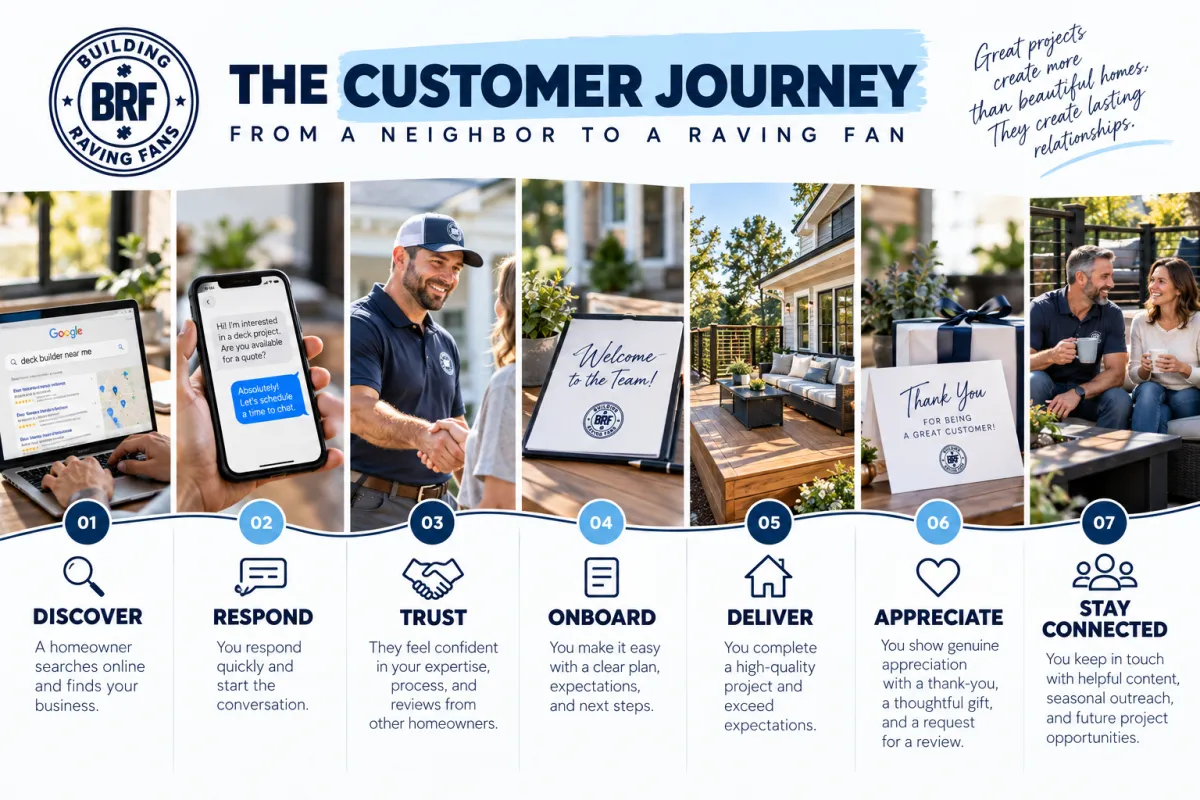
The Local Business Customer Journey: 7 Touchpoints That Create Customers for Life
The Local Business Customer Journey: 7 Touchpoints That Create Customers for Life
Most businesses spend a lot of time thinking about how to get customers.
But what happens after someone finds you?
For local businesses, contractors, home service companies, and other relationship-based businesses, the customer journey doesn't end when the contract is signed or even when the project is complete. Every interaction before, during, and after the sale shapes how customers remember your business and whether they choose you again, recommend you to someone else, or simply move on.
That is why understanding the local business customer journey is so important.
A strong customer journey creates more than satisfied customers. It creates customers who remember your name, trust your team, leave reviews, refer their friends and neighbors, and come back when they need you again.
The lesson is simple:
Customer relationships shouldn't be treated as a series of isolated transactions. They should be designed as a journey.
Here are seven customer touchpoints every local business should consider.
1. The Discovery Touchpoint: When Customers First Find You
The customer journey begins before someone ever contacts your business.
A homeowner might discover you through:
A Google search
A Google Business Profile
An online review
A referral from a neighbor
Your website
Social media
A completed project they see in their community
This first impression answers a very basic question:
"Can I trust this business?"
That means your online reputation isn't just something to check occasionally. It is part of your customer experience.
What to improve:
Make sure your:
Google Business Profile is complete and current
Website clearly explains what you do
Recent reviews reflect the quality of your service
Project photos demonstrate your capabilities
Messaging is consistent across platforms
Internal link: How Relationship Marketing Helps Contractors Rank Better on Google
Your marketing shouldn't simply tell people that you're trustworthy.
It should give them evidence.
2. The First Response Touchpoint: What Happens After They Reach Out
Once someone calls, fills out a form, sends a message, or requests an estimate, the customer journey becomes much more personal.
This is where many businesses unintentionally create friction.
A customer reaches out expecting a response, but instead receives silence for hours or sometimes days.
Even if your team eventually provides excellent service, that first experience can create uncertainty.
Your first response should accomplish three things:
Acknowledge the customer.
Set expectations.
Tell them what happens next.
Automation can help here without making the interaction feel robotic.
For example, an automated message can confirm that an inquiry was received while a team member follows up personally.
The goal isn't to automate the relationship.
The goal is to automate the routine so your team has more time for the relationship.
Building Raving Fans has written extensively about using automation to make customer communication more consistent without losing the human element.
Internal link: 10 Customer Touchpoints Every Contractor Should Automate
3. The Trust-Building Touchpoint: Sales, Estimates & Expectations
Getting a customer to contact you is one thing.
Getting them to trust you enough to move forward is another.
The sales process is an opportunity to establish confidence before a customer ever becomes a client.
This includes:
Showing up when you say you will
Communicating clearly
Explaining the process
Answering questions honestly
Providing realistic timelines
Setting expectations about communication
Making pricing and next steps easy to understand
For construction and home service businesses, this stage can be particularly important because customers are often making significant financial decisions.
Don't make customers guess what happens next.
Instead, build a process where every prospect knows:
"Here's where we are. Here's what happens next. Here's who will contact you."
That consistency creates confidence.
And confidence makes the transition from prospect to customer much smoother.
4. The Onboarding Touchpoint: Make Customers Feel They Made the Right Decision
The moment someone says "yes" is not the end of the sales process.
It is the beginning of the customer relationship.
This is the point where businesses have an opportunity to reinforce the customer's decision.
A thoughtful onboarding experience might include:
A welcome message
A clear project timeline
Contact information for the team
What the customer should expect
Important preparation instructions
A personal thank-you
Helpful educational resources
This is also a natural opportunity for appreciation.
Even something as simple as:
"We're excited to work with you, and we appreciate the opportunity to earn your business."
can change the emotional tone of the relationship.
The customer shouldn't feel like they've simply entered a production queue.
They should feel like they've joined a relationship with a company that genuinely values them.
5. The Experience Touchpoint: What Happens During the Project
This is where your operational experience becomes your marketing.
Customers are constantly forming opinions about your company during the work itself.
They notice:
Whether your team arrives when expected
How your employees communicate
Whether the job site is respected
How quickly questions are answered
Whether updates are proactive
How problems are handled
Whether your team does what it promised
A great project can become a powerful marketing asset.
A poorly communicated project can become a reputation problem even when the final workmanship is excellent.
That's why customer experience should be viewed as part of your marketing strategy, not something separate from it.
Internal link: Why Customer Experience Plays an Important Role in Referrals
Every interaction gives the customer another reason to think:
"I'm glad we chose them."
That's the feeling you want to reinforce.
6. The Completion Touchpoint: Turn Satisfaction Into Reviews & Appreciation
Project completion is one of the most valuable moments in the entire customer journey.
The work is finished.
The customer can see the result.
They're thinking about the experience.
And if you've delivered well, they're often at their highest level of satisfaction.
Don't let that moment disappear.
This is the time to create a simple, thoughtful sequence:
Complete → Thank → Review → Appreciate
First, thank the customer.
Then make it easy for them to share their experience.
Then show appreciation for their feedback and their business.
BrightLocal's 2026 research found that 78% of consumers were asked to write a review in the previous 12 months, and 65% of those who were asked went on to write one.
The important part is making the process easy.
Tools such as the Building Raving Fans' Raving Fans Reviews platform and Scan-to-Review QR code cards can reduce the friction involved in asking for feedback.
Instead of saying:
"Would you mind going online and finding our business and leaving us a review?"
you can give customers a simple next step.
Tap. Review. Done.
But don't stop at the review.
A review should be treated as a relationship milestone not the finish line.
Internal link: Turning Reviews into Raving Fans: A BRF Approach for Contractors
7. The Post-Project Touchpoint: Stay Connected After the Work Is Done
This may be the most overlooked part of the entire customer journey.
The invoice gets paid.
The project is closed.
The customer is happy.
And then...
Nothing.
Months pass.
Eventually, the customer needs another service, or someone they know needs a recommendation, and your business is no longer top of mind.
That's a missed opportunity.
The post-project relationship should continue through useful, thoughtful communication.
This might include:
Seasonal homeowner tips
Maintenance reminders
Helpful educational content
Customer anniversaries
Personal check-ins
Referral thank-yous
Handwritten notes
Surprise gifts
Special customer appreciation campaigns
Long-term nurture emails
This is where relationship marketing becomes especially powerful.
Building Raving Fans helps businesses create long-term nurture email campaigns that keep customers connected without requiring someone on your team to remember every follow-up manually.
Automated gifting and appreciation programs can also create meaningful moments throughout the relationship.
The goal isn't to constantly sell.
The goal is to stay useful, memorable, and appreciated.
Because when the customer eventually needs something again, or a neighbor asks, "Who did you use?" you want your business to be the name they remember.
Internal link: How to Develop a Consistent Client Appreciation Program
The Customer Journey Should Create a Flywheel
The seven touchpoints aren't separate strategies.
They should work together.
Think of the journey like this:
Discover → Respond → Build Trust → Onboard → Deliver → Appreciate → Nurture → Repeat → Refer
A customer discovers your business.
Your team responds quickly.
You build trust through communication.
The customer receives a great onboarding experience.
You deliver an excellent project.
You thank and appreciate them.
You continue the relationship after the sale.
Eventually, that customer either buys again or recommends you to someone else.
Then the cycle starts again.
That is how a one-time transaction can become a Customer for Life.
Don't Try to Automate the Relationship; Automate the Consistency
One of the biggest misconceptions about customer journey automation is that automation makes businesses less personal.
It doesn't have to.
Poorly designed automation feels robotic.
Thoughtful automation creates consistency.
For example, your CRM can remember when a project was completed.
Your system can trigger a review request.
A customer can receive a personalized appreciation gift.
A nurture campaign can deliver useful information months later.
Your team can receive a reminder to personally check in with a high-value customer.
The technology handles the timing.
Your business provides the humanity.
That's the combination that creates memorable customer experiences at scale.
Your Customer Journey Audit: Start Here
You don't have to rebuild your entire customer experience tomorrow.
Start by mapping the seven touchpoints.
For each one, ask:
1. Discovery
What does a new customer see before contacting us?
2. First Response
How quickly and clearly do we respond?
3. Trust & Sales
Are expectations clear before they buy?
4. Onboarding
Does the customer feel appreciated after saying yes?
5. Experience
How consistently do we communicate during the project?
6. Completion
Do we intentionally create a review and appreciation moment?
7. Post-Project
What happens after the invoice is paid?
If you find a gap, don't immediately ask:
"How can we add more work?"
Ask:
"How can we make this experience easier, more thoughtful, and more consistent for the customer?"
That question will often lead you to the right solution.
Customers for Life Are Built One Touchpoint at a Time
You don't create loyal customers with one clever marketing campaign.
You create them through dozens of small experiences that consistently communicate:
We see you. We appreciate you. We're here when you need us.
For contractors, home service companies, and relationship-based businesses, that can translate into stronger reviews, more referrals, higher retention, repeat opportunities, and a reputation that continues working long after the original project is complete.
The businesses that build Customers for Life aren't necessarily the businesses that communicate the most.
They're the businesses that communicate consistently and meaningfully.
If you want to evaluate where your customer journey is creating opportunities and where customers may be falling through the cracks, a customer journey strategy can be a great place to start.
Building Raving Fans helps businesses build the systems behind lasting customer relationships, including review generation, appreciation and gifting, long-term nurture, and referral-focused relationship marketing.
Ready to Turn More Customers Into Customers for Life?
Your customer list may already be one of your business's most valuable growth assets.
The question is whether you have a system for staying connected with the people who have already trusted you.
Talk with Building Raving Fans about building a customer journey that turns completed jobs into reviews, referrals, repeat business, and lifelong relationships.


