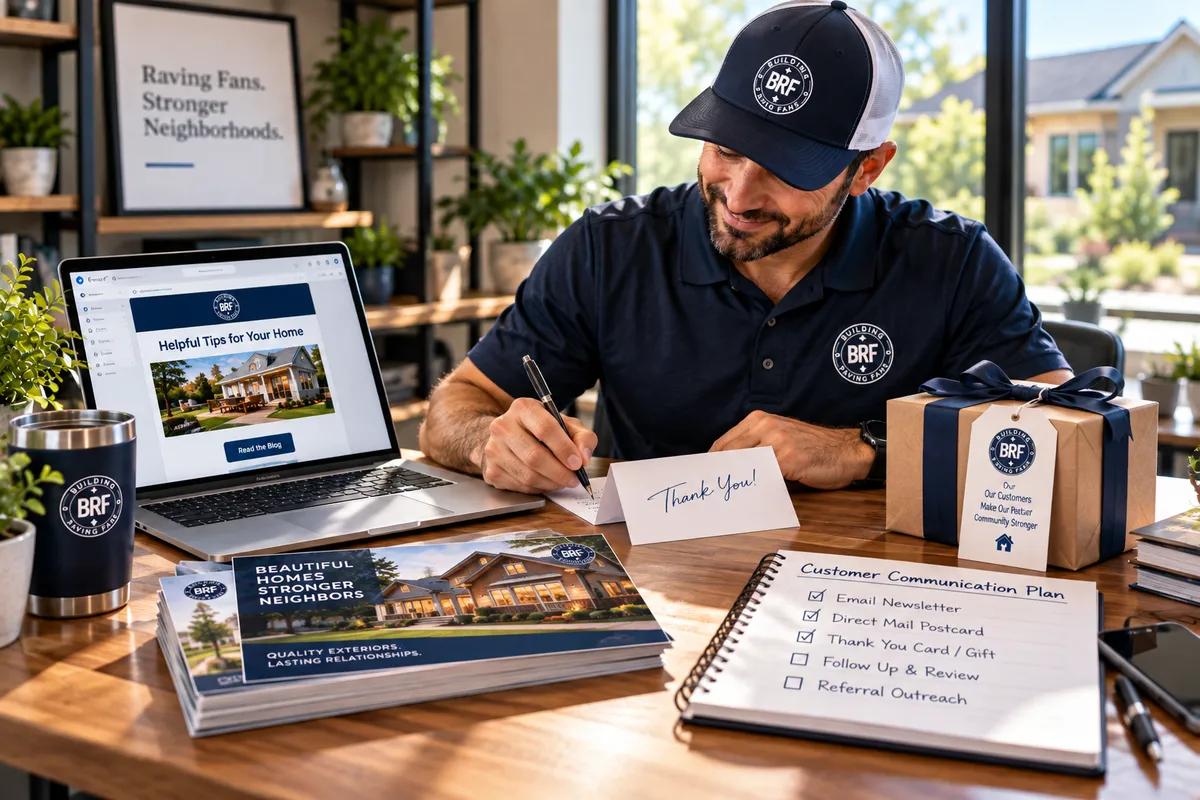
The Small Business Guide to Combining Email, Direct Mail & Personal Touches
The Small Business Guide to Combining Email, Direct Mail & Personal Touches
Small business marketing doesn't have to mean choosing between email marketing, direct mail, social media, paid advertising, or personal follow-up.
In fact, one of the biggest opportunities for small business customer retention and relationship marketing is learning how to combine digital communication with physical and personal experiences.
Email can keep your business connected to customers throughout the year. Direct mail can create a tangible reminder of your company. A handwritten note, phone call, or thoughtful gift can make the relationship feel personal.
Individually, each channel can be useful.
Together, they can create a customer experience that keeps your business top-of-mind long after the sale.
This is especially important for contractors, home service companies, and other relationship-based businesses. Your customers may only need your primary service once every few years but they may know several people who need it right now.
The challenge is staying connected without becoming annoying, overly promotional, or impersonal.
That's where a coordinated email, direct mail, and personal-touch marketing strategy comes in.
Why Small Businesses Should Stop Thinking in Marketing Channels
It's common to ask:
"Should we focus on email or direct mail?"
Or:
"Should we spend more on digital advertising?"
But customers don't experience your marketing as separate channels.
They experience your brand.
A homeowner might:
Receive an email from your company.
See a postcard in the mail.
Notice your completed project on a neighbor's home.
Search for your business online.
Read your Google reviews.
Visit your website.
Receive a personal follow-up.
Eventually call when they're ready.
They don't necessarily think:
"Email campaign number three influenced me."
They think:
"I've seen this company around. They seem trustworthy."
That familiarity matters.
The takeaway isn't that you need to market everywhere.
It's that your marketing should create consistent, reinforcing experiences.
The Three-Part Small Business Marketing System
A strong relationship-marketing strategy can be organized around three categories:
1. Email - Stay Connected
Email gives you an efficient way to communicate with a large customer base.
2. Direct Mail - Stay Visible
Physical mail creates a tangible experience that can reinforce your brand.
3. Personal Touches - Stay Human
Handwritten notes, phone calls, gifts, and personal messages make customers feel remembered.
Think of the three like this:
Email = consistency
Direct mail = visibility
Personal touches = connection
When you combine them, you create a much stronger customer relationship than relying on one channel alone.
1. Use Email to Stay Consistently Connected
Email is one of the easiest ways to maintain an ongoing relationship with past customers.
But the mistake many small businesses make is turning their email list into a sales list.
Every message becomes:
"We have an offer."
"Book now."
"Call today."
"Limited-time promotion."
Eventually, customers learn to ignore the messages.
Instead, your long-term nurture email campaigns should provide a mix of education, helpful information, appreciation, and relevant offers.
For example, a home service company could send:
Seasonal maintenance tips
Home improvement ideas
Project planning guides
Before-and-after stories
Customer spotlights
Local community information
Helpful checklists
Customer appreciation messages
Relevant service reminders
The goal is to make opening the email worthwhile.
The 80/20 Rule for Customer Emails
A useful framework is to make approximately 80% of your communication helpful, educational, or relationship-focused and approximately 20% promotional.
This isn't a rigid formula.
It's a reminder that customers shouldn't only hear from you when you want something.
For example:
Helpful email
"5 Things to Check Around Your Home Before Winter"
Relationship email
"It's Been One Year Since We Completed Your Project Thank You!"
Educational email
"What Homeowners Should Know Before Starting a Kitchen Remodel"
Promotional email
"Our Spring Project Schedule Is Now Open"
The promotional message becomes much less intrusive when it exists within a larger relationship.
Building Raving Fans helps businesses develop long-term nurture email campaigns that keep customers connected after the original transaction.
The goal isn't to automate every interaction.
It's to make sure valuable communication doesn't stop simply because the project is finished.
2. Use Direct Mail to Become More Memorable
Email is convenient.
But physical mail can create a different type of experience.
A postcard, thank-you card, handwritten note, or customer appreciation piece physically enters someone's home or office.
That makes direct mail particularly interesting for local businesses.
Instead of competing with dozens of digital notifications, your message becomes a physical object.
A contractor might send:
A neighborhood postcard
A completed-project showcase
A seasonal homeowner checklist
A customer anniversary card
A referral thank-you
A handwritten note
A customer appreciation package
The objective isn't necessarily to sell.
It's to create another memorable touchpoint.
Direct Mail Becomes More Powerful When It's Local
For contractors and home service businesses, one of the strongest direct-mail opportunities is geographic targeting.
Imagine you just completed a beautiful outdoor living project.
Instead of only posting it on Instagram, you could create a postcard showing the finished project and send it to nearby homeowners.
The message becomes:
"We just completed this project in your neighborhood."
That's more relevant than generic advertising.
It's proof.
It's local.
It's tangible.
And it supports the Own the Block philosophy: use the customers and projects you already have to create awareness around the neighborhoods you already serve.
Internal link: How to Build an “Own the Block” Marketing Strategy for Your Local Business
3. Add Personal Touches That Technology Can't Replace
Automation is useful.
But there are moments when customers need to feel that a real person remembers them.
That's where personal touches come in.
Consider:
Handwritten thank-you cards
Personal phone calls
Customer anniversary messages
Birthday recognition
Referral thank-you notes
Surprise gifts
Personal project follow-ups
Small customer appreciation packages
A customer may forget an automated email.
They are less likely to forget a thoughtful note that arrived unexpectedly after a great experience.
This doesn't mean every customer needs a $100 gift.
Often, the most meaningful gestures are simple.
"Thank you for trusting us."
"We hope you're still enjoying your new space."
"We appreciate your referral."
"We wanted you to know we're thinking of you."
Those messages reinforce the relationship.
The Difference Between Personalization and Personal Connection
This distinction is important.
Personalization might mean:
"Hi Sarah, thanks for being a customer."
That's useful.
Personal connection might mean:
"Sarah, it's hard to believe it's been a year since we finished your deck. We hope your family has been getting plenty of use out of it this summer. Thanks again for trusting our team."
The second feels more human because it recognizes the customer's history.
Your CRM can help provide the information.
Your team provides the humanity.
That's the sweet spot.
4. Connect Email, Direct Mail & Personal Touches
Now let's combine the three.
Imagine a customer has recently completed a remodeling project.
Week 1 - Email
Send a genuine thank-you and project-care information.
Week 2 - Direct Mail
Send a handwritten card or branded customer appreciation postcard.
Week 3 - Review Request
Make it easy for the customer to share their experience.
Month 2 - Email
Send useful maintenance or homeowner content.
Month 4 - Direct Mail
Send a seasonal checklist.
Month 6 - Personal Touch
Have someone personally check in.
Month 9 - Email
Share a customer story or educational resource.
Month 12 - Personal Touch
Recognize the project anniversary with a thank-you message or small appreciation gift.
Notice what's happening.
The business isn't constantly selling.
It's staying connected.
5. Build Review Requests Into the Customer Journey
Reviews are another important bridge between personal experience and digital marketing.
A customer has a great experience.
Now you want to make it easy for them to tell others.
This is where the timing matters.
A review request should generally follow a meaningful customer experience rather than appearing randomly months later.
The opportunity is to make your request simple and convenient.
Building Raving Fans' Raving Fans Reviews platform can help businesses incorporate review generation into their customer journey.
And Scan-to-Review QR code cards can provide a physical-to-digital bridge.
A customer receives the card.
They tap their phone.
They're taken directly to the review experience.
That's a much easier process than asking someone to search for your business manually.
Internal link: Turning Reviews into Raving Fans: A BRF Approach for Contractors
6. Use Appreciation to Strengthen the Relationship
Appreciation is where the three-channel strategy becomes especially powerful.
For example:
"Thank you for trusting us."
Direct mail
A handwritten card arrives a few days later.
Personal touch
A small appreciation gift arrives at a meaningful milestone.
None of these interactions needs to ask for a sale.
That's important.
If every gesture comes with:
"Now can you buy something?"
the appreciation starts to feel transactional.
Instead:
Give first.
Appreciate genuinely.
Stay connected.
Then ask for business when the timing makes sense.
Building Raving Fans' automated gifting and appreciation programs help businesses build these moments into repeatable customer workflows.
7. Use Email to Support Direct Mail
One of the biggest opportunities is using digital communication to reinforce physical communication.
For example:
Direct mail
Send a neighborhood postcard.
Follow up with a helpful article related to the postcard.
Social media
Show additional project photos.
Website
Create a detailed project story.
Reviews
Show what previous customers experienced.
Now one marketing idea has become multiple connected touchpoints.
This is more efficient than constantly inventing completely different campaigns.
One project can create:
A postcard
An email
A social post
A blog article
A case study
A review request
A referral opportunity
That's how small businesses can get more value from the work they're already doing.
8. Create a 12-Month Customer Communication Rhythm
Your customer relationship shouldn't depend on someone remembering to send an email.
Build a calendar.
For example:
Month | Direct Mail | Personal Touch | |
|---|---|---|---|
1 | Thank-you | — | Personal follow-up |
2 | Helpful tips | — | — |
3 | Review request | Review/QR code card | — |
4 | Seasonal content | Postcard | — |
5 | Customer story | — | — |
6 | Check-in | — | Personal call |
7 | Educational guide | — | — |
8 | Appreciation | Thank-you card | Gift |
9 | Referral content | — | Referral thank-you |
10 | Community content | Local postcard | — |
11 | Planning guide | — | — |
12 | Year-end appreciation | Holiday card | Personal message |
The exact timing will vary by business.
The important part is consistency.
9. Segment Your Customer List
Not every customer should receive exactly the same communication.
Segmentation makes your marketing more relevant.
You might organize customers by:
Service
Roofing
Remodeling
Decks
Landscaping
Painting
HVAC
Plumbing
Customer status
New customer
Recent customer
Past customer
Repeat customer
VIP customer
Relationship
Reviewer
Referral source
High-value customer
Long-term customer
Geography
Neighborhood
ZIP code
Service area
Project cluster
This allows you to send messages that make sense.
A homeowner who recently purchased a deck doesn't need the same content as someone who had a roof replacement five years ago.
10. Use Automation to Make the System Sustainable
Here's the problem with manually managing all of this:
Eventually, someone forgets.
A customer anniversary gets missed.
A review request doesn't go out.
A referral isn't acknowledged.
A nurture email gets delayed.
An appreciation gift isn't ordered.
That's why automation matters.
Your CRM can trigger communication based on events.
For example:
Project Completed
→ Thank-you email
→ Review request
→ Customer appreciation
→ Long-term nurture
→ Anniversary reminder
→ Referral opportunity
The system handles the timing.
Your team handles the relationship.
That distinction is critical.
Automation shouldn't replace personal connection.
It should make personal connection easier to deliver consistently.
11. Measure More Than Leads
If you're combining email, direct mail, and personal touches, don't measure the strategy only by immediate leads.
Track relationship metrics too.
Consider:
Open rate
Click rate
Engagement
Unsubscribe rate
Direct Mail
Response rate
QR scans
Website visits
Calls
Campaign-attributed opportunities
Customer Relationships
Reviews
Referral leads
Repeat customers
Repeat revenue
Customer retention
Customer lifetime value
Appreciation
Customers reached
Gifts delivered
Referral acknowledgments
Anniversary touches
The goal is to understand whether your marketing is strengthening the customer relationship not simply generating clicks.
12. Make Every Channel Support the Same Brand Promise
There's one more piece that businesses often overlook.
Your channels need to feel connected.
If your email says:
"We're a company that genuinely cares about our customers."
but your direct mail feels aggressive, and your sales team is difficult to reach, the message doesn't match the experience.
Your customer should encounter the same values everywhere:
Helpful.
Professional.
Responsive.
Appreciative.
Human.
That's what creates brand consistency.
A Simple Framework: Reach, Reinforce, Remember
If you want a simple way to remember the strategy, use:
REACH
Use email and direct mail to reach customers and prospects where they are.
REINFORCE
Use reviews, project stories, educational content, and repeated exposure to reinforce trust.
REMEMBER
Use personal touches, appreciation, gifts, handwritten notes, and thoughtful follow-up to make your business memorable.
Then repeat.
Reach → Reinforce → Remember → Repeat
That's relationship marketing in action.
What This Looks Like for a Local Contractor
Imagine a contractor completes a $25,000 outdoor living project.
Instead of ending the relationship at the final invoice:
Day 1
Thank-you email.
Day 3
Review request through the Raving Fans Reviews platform.
Day 5
Scan-to-Review QR code card or handwritten note delivered.
Day 10
Project-care email.
Month 2
Customer story shared through email and social media.
Month 4
Seasonal homeowner email.
Month 6
Personal check-in.
Month 8
Customer appreciation gift.
Month 9
Referral reminder.
Month 12
Project anniversary message.
At the same time, photos from the project can be used for a neighborhood direct-mail campaign.
Now one completed project is generating:
Customer retention
Reviews
Referral opportunities
Email content
Social content
Direct-mail content
Neighborhood awareness
Future sales opportunities
The project becomes a marketing asset instead of simply a completed job.
The Goal Isn't More Marketing. It's Better Relationships.
Small businesses don't necessarily need to send more messages.
They need to send better messages at better moments.
Email provides consistency.
Direct mail provides physical visibility.
Personal touches provide emotional connection.
Reviews provide social proof.
Appreciation creates goodwill.
Nurture maintains the relationship.
Referrals create new opportunities.
And great customer service makes the entire system believable.
When those pieces work together, marketing becomes less about chasing strangers and more about building a network of people who already know, trust, and value your business.
Combining Email, Direct Mail & Personal Touches Creates a Customer Experience That Lasts
The most effective small business marketing strategy isn't necessarily the one with the biggest advertising budget.
It's the one that creates the most consistent, relevant, and memorable customer experience.
A customer might forget an ad.
They might delete an email.
But when those digital touchpoints are reinforced by a postcard, a thoughtful note, a personal call, or an unexpected appreciation gift, the relationship becomes harder to forget.
That's the opportunity.
Don't make email, direct mail, and personal touches compete. Make them work together.
If you want to create a customer communication system that keeps your business visible, valuable, and memorable, start by mapping your customer journey and identifying where each channel can contribute.
Ready to Build a Relationship Marketing System That Works Together?
Building Raving Fans helps contractors, home service businesses, and relationship-based companies connect the pieces of their customer experience.
That can include:
Long-term nurture email campaigns
Own the Block direct-mail strategies
Raving Fans Reviews
Scan-to-Review QR code cards
Automated gifting and appreciation programs
Customer retention workflows
Referral-focused relationship marketing
You don't need to choose between digital and personal marketing.
You need a system that knows when to use each one.
Let's build a customer relationship strategy that keeps your business top-of-mind and gives your customers more reasons to stay connected, leave a review, refer a friend, and come back again.
Reach them. Reinforce the relationship. Make your business memorable.


