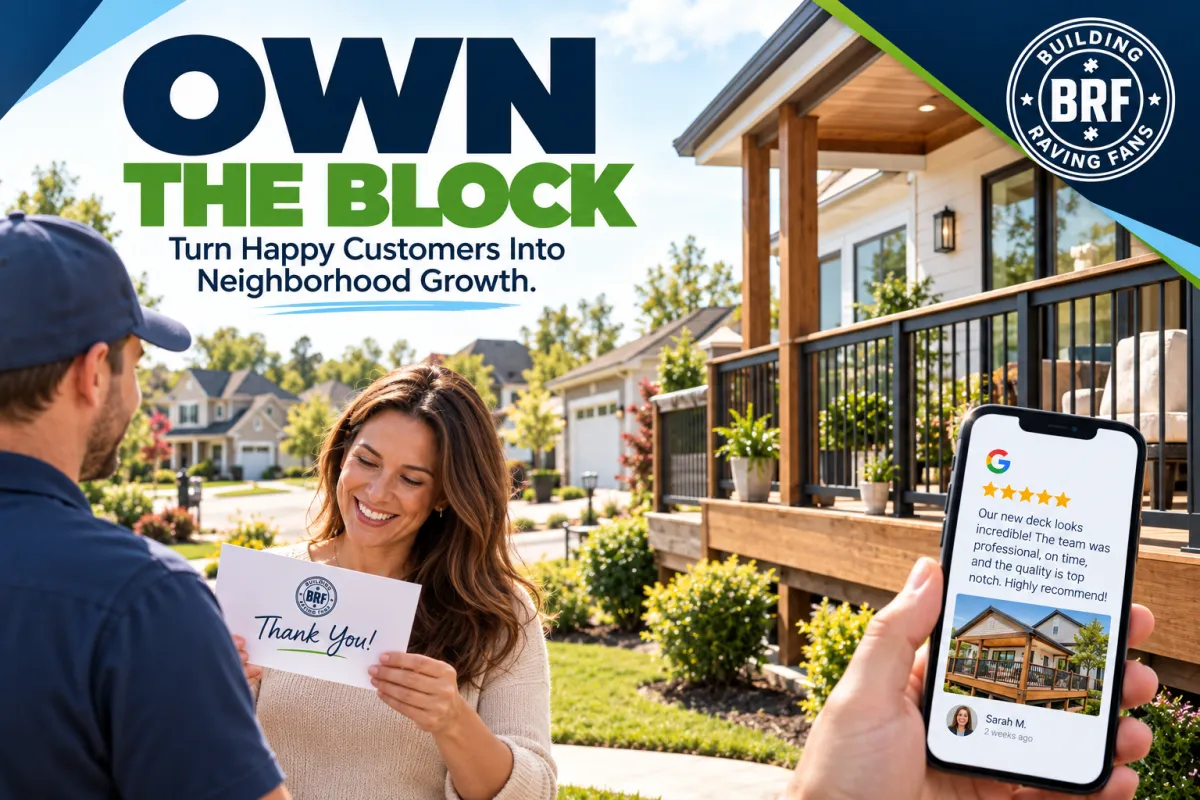
How to Build an “Own the Block” Marketing Strategy for Your Local Business
How to Build an “Own the Block” Marketing Strategy for Your Local Business
If you’re a local business owner, contractor, or home-service company, you probably spend a lot of time trying to get in front of new customers.
You invest in Google, social media, referrals, networking, SEO, and advertising.
But there’s another audience sitting much closer to your business: the people who already know your customers, live near your customers, and see the work you’ve already completed.
That’s where an Own the Block marketing strategy comes in.
Instead of treating every completed project as the end of a customer journey, you can use that project as the beginning of a larger neighborhood marketing opportunity.
A happy customer can become a review.
A review can become social proof.
A completed project can become a conversation with neighbors.
A thoughtful thank-you can create a referral.
And a relationship that continues after the sale can turn one customer into many future opportunities.
For relationship-based businesses, especially contractors, remodelers, landscapers, roofers, deck builders, and other home-service companies, this creates a powerful marketing loop:
Serve one customer → create a great experience → stay connected → build trust → become visible in the neighborhood → earn referrals and future business.
That is the foundation of an Own the Block strategy.
What Does “Own the Block” Mean in Marketing?
Owning the block doesn’t mean plastering your logo everywhere or trying to sell to every homeowner within a certain radius.
It means becoming recognizable, trusted, and memorable in the neighborhoods where you already have happy customers.
Think about a contractor who just completed a beautiful deck in a neighborhood.
The business could simply finish the project, collect payment, and move on to the next lead.
Or it could recognize that the completed project represents several marketing opportunities.
The homeowner can:
Leave a Google review.
Recommend the company to a neighbor.
Share photos of the finished project.
Introduce the contractor to someone nearby.
Receive a thoughtful appreciation gift.
Continue receiving helpful communication from the company.
Become a long-term advocate for the business.
Meanwhile, the neighbors have an opportunity to see the work, hear about the experience, and become familiar with the company.
The project becomes more than a completed job. It becomes a local marketing asset.
Why Local Businesses Should Think Beyond Lead Generation
Traditional marketing often focuses on one question:
“How do we get more leads?”
That’s important, but it isn’t the only question.
A stronger question is:
“How do we get more value from every customer relationship we already have?”
This matters because acquiring a new customer requires time, attention, marketing spend, sales effort, and follow-up.
Once someone has already chosen your business, you have something extremely valuable: trust.
The challenge is maintaining that relationship.
BRF has previously explored this problem in Why Homeowners Forget Contractors After the Project Ends (And How to Stay Top of Mind). The basic issue is simple: a great customer experience can still become a forgotten experience if the business disappears after the project is complete.
That is why an Own the Block strategy doesn't end when the truck leaves the driveway.
It begins there.
The 5-Part Own the Block Marketing Strategy
A successful strategy combines several relationship-building activities rather than relying on one postcard, one email, or one review request.
Here are five pieces to build into your system.
1. Start With the Customers You Already Have
Before buying another lead, look at your existing customer database.
Identify customers who:
Had a successful project
Have expressed satisfaction
Have left positive feedback
Have referred someone
Have been with your company for a long time
Live in neighborhoods you want to grow in
Have completed projects that are highly visible
Then organize your customer data geographically.
You may discover that you already have clusters of happy customers in the exact neighborhoods where you want more business.
That changes the marketing question.
Instead of:
“Where can we find more customers?”
You can ask:
“Where have we already earned trust?”
That is a much stronger starting point.
2. Turn Completed Projects Into Local Proof
People want to know whether a business can actually deliver.
For home-service companies, a completed project is tangible proof.
A beautiful deck.
A remodeled kitchen.
A new roof.
A landscaping transformation.
A finished addition.
A repaired exterior.
Whenever appropriate and with the customer's permission, turn those successes into marketing assets.
Consider creating:
Project photos
Before-and-after content
Customer stories
Testimonials
Google reviews
Social media posts
Neighborhood mailers
Case studies
Educational content
The goal isn't to brag.
It's to help potential customers see what your business can do.
And when that proof appears in the same neighborhood where someone is considering hiring a company, it becomes even more relevant.
3. Make Reviews Part of the Customer Experience
Your reputation is one of the most important assets you have in local marketing.
Google itself explains that local search results are influenced primarily by relevance, distance, and prominence, and notes that reviews are one of the factors associated with prominence.
Consumer behavior reinforces the importance of reviews.
BrightLocal's 2026 Local Consumer Review Survey found that 85% of consumers are more likely to use a business after reading positive reviews, while 54% visit the business's website after reading positive reviews.
The lesson isn't simply “get more five-star reviews.”
It's:
Create great experiences and make it easy for happy customers to share what happened.
That distinction matters.
Your review strategy should be connected to the customer journey.
For example:
Project completed → customer is happy → thank them → make feedback easy → capture the review → respond → continue the relationship.
Building Raving Fans helps businesses operationalize this process through the Raving Fans Reviews platform.
Scan-to-review QR code cards can also reduce friction by allowing a customer to tap their phone and quickly access the review experience.
The easier the next step is, the less likely the customer is to think, “I'll do that later.”
And “later” often becomes never.
4. Stay Connected After the Project
A customer shouldn't become invisible in your CRM just because the invoice has been paid.
This is where long-term nurture becomes an important part of an Own the Block strategy.
Instead of sending constant sales promotions, continue providing useful reasons for customers to hear from you.
Your communication could include:
Seasonal maintenance reminders
Helpful homeowner tips
Project inspiration
Local updates
Anniversary messages
Customer appreciation messages
Referral reminders
Educational content
New service announcements
Special customer-only opportunities
The goal is simple:
Be useful enough to remember.
BRF's Client Nurture Systems That Run While You Work explores how automated communication can keep customer relationships active without requiring the business owner to manually follow up with every person.
Long-term nurture campaigns allow businesses to stay connected consistently while the team focuses on today's jobs.
That's particularly valuable in construction and home services, where the next purchase may not happen for months or even years.
5. Give Customers a Reason to Talk About You
People don't usually refer a business because they received another generic sales email.
They refer businesses because something about the experience was worth talking about.
That might be:
Exceptional service
A beautiful finished project
An employee who went above and beyond
A thoughtful surprise
A handwritten thank-you
A memorable gift
A problem that was handled exceptionally well
This is where appreciation becomes a marketing strategy.
Building Raving Fans' automated gifting and appreciation programs help businesses create intentional moments of gratitude at important points in the customer journey.
The technology handles the consistency.
The business provides the heart.
That combination matters.
Because automation shouldn't make a relationship feel automated.
It should make it easier for your team to consistently do the things that are difficult to remember when business gets busy.
The Neighborhood Effect: One Customer Can Influence Many More
Imagine a contractor completes a project for a homeowner.
That homeowner is happy.
They leave a detailed review.
They share photos.
A neighbor sees the finished project.
Another neighbor asks who did the work.
The homeowner recommends the contractor.
The contractor follows up with the new opportunity.
One project has now created multiple touchpoints.
That's the neighborhood effect.
And it becomes even more powerful when several customers are concentrated in the same geographic area.
You aren't starting from zero.
You're building from existing trust.
How to Put Your Own Block Strategy Into Action
You don't need a massive marketing department to get started.
Begin with this simple framework.
Step 1: Map your customers
Export your customer list and identify where your best customers live.
Look for geographic clusters.
Step 2: Identify your advocates
Find customers who have:
Left positive reviews
Referred someone
Purchased repeatedly
Given positive feedback
Had memorable project experiences
Step 3: Create your post-project sequence
Build a consistent customer experience that includes:
Thank → Review → Appreciate → Nurture → Refer
Each step should feel natural rather than promotional.
Step 4: Add a neighborhood touchpoint
Depending on your business, this could include:
Direct mail
A project postcard
Neighborhood-specific content
Local social media
A customer story
A referral campaign
A helpful seasonal mailer
Step 5: Measure what happens
Track:
Reviews generated
Referral leads
Repeat customers
Website traffic
Leads by neighborhood
Conversion rates
Customer engagement
Revenue from existing customers
This turns relationship marketing from a vague idea into a measurable growth system.
Don't Make the Mistake of Treating Every Customer the Same
An Own the Block strategy becomes much more effective when communication is relevant.
A homeowner who just completed a major remodeling project shouldn't necessarily receive the same message as someone who completed a small repair five years ago.
Segment your audience based on:
Service purchased
Project completion date
Location
Customer value
Referral activity
Review status
Communication preferences
Then create appropriate touchpoints for each group.
This is one reason CRM and automation systems become so valuable.
Instead of asking your team to remember everything, the system helps make sure the right customer receives the right message at the right time.
The Goal Isn't to “Sell More.” It's to Become the Business People Remember.
That is the heart of relationship marketing.
If you want to own a neighborhood, don't start by asking:
“How can I advertise to more people?”
Start by asking:
“How can I become more valuable to the people who already know me?”
Serve them well.
Thank them.
Make it easy for them to review you.
Stay connected.
Show appreciation.
Give them something worth talking about.
Then make that experience visible to the people around them.
That's how one customer can become a neighborhood opportunity.
Build Your Own Block With a Relationship Marketing System
You don't have to manually manage every thank-you, review request, gift, email, and follow-up.
Building Raving Fans helps relationship-based businesses create systems that make customer appreciation and follow-up consistent.
From Raving Fans Reviews and Scan-to-Review QR code cards to automated gifting and appreciation programs and long-term nurture email campaigns, the goal is the same:
Help your best customers remember you, trust you, talk about you, and recommend you.
Because your next great customer may not come from another expensive ad.
They may live three houses down from someone you already served.
Ready to Own Your Block?
If your business already has happy customers but you're not systematically turning those relationships into reviews, referrals, repeat business, and neighborhood visibility, there's an opportunity sitting inside your existing customer list.
Building Raving Fans can help you build the system.
Book a strategy call with Building Raving Fans and discover how to turn your customer relationships into a long-term growth engine.
Don't just finish the job. Own the relationship. Own the neighborhood. Own the block.


