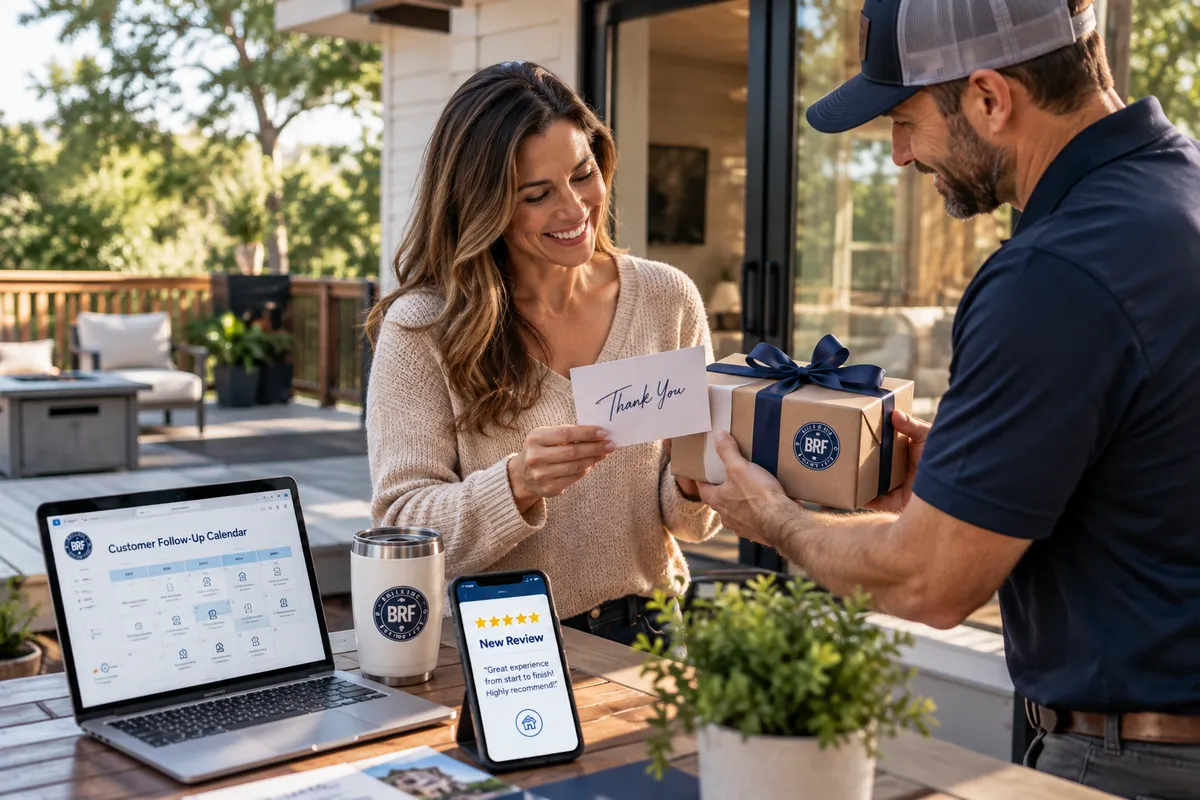
How to Create a Customer Appreciation System That Actually Drives Revenue
How to Create a Customer Appreciation System That Actually Drives Revenue
Customer appreciation is easy to talk about.
But here's the question most business owners should be asking:
Can your customer appreciation actually contribute to revenue?
For contractors, home service companies, and other relationship-based businesses, appreciation shouldn't be limited to an occasional holiday card or a thank-you email after a project.
When designed intentionally, a customer appreciation system can become part of a larger growth strategy—one that strengthens retention, generates reviews, encourages referrals, keeps past customers engaged, and creates more opportunities for repeat business.
The key is understanding that appreciation isn't about buying customers.
It's about creating experiences that make customers want to continue the relationship.
The opportunity is bigger than simply making customers happy.
A thoughtful appreciation system can help turn happy customers into loyal customers, reviewers, referral sources, and Customers for Life.
Customer Appreciation Is More Than Saying "Thank You"
A thank-you is a moment.
A customer appreciation system is a process.
There's a big difference.
A business might occasionally send:
"Thanks for choosing us!"
That's nice.
But a system asks:
When should we thank customers?
Which customers should receive appreciation?
What should we send?
Who is responsible for it?
Can any part of it be automated?
How does it connect to reviews?
How does it support referrals?
How do we stay connected after the project?
How do we measure whether it's working?
Once you answer those questions, appreciation becomes repeatable.
And repeatability is what makes it scalable.
Why Customer Appreciation Can Drive Revenue
Appreciation doesn't necessarily generate revenue because someone receives a gift and immediately buys something else.
The impact is usually more indirect—and more valuable over time.
A thoughtful customer experience can contribute to:
1. Retention
Customers who feel valued have more reason to continue the relationship.
2. Reviews
A strong customer experience creates an opportunity to ask satisfied customers to share their experience.
3. Referrals
Customers who feel genuinely appreciated may be more willing to recommend your company.
4. Repeat Business
Staying connected keeps your business top-of-mind when the customer needs another service.
5. Reputation
More positive customer experiences can contribute to stronger word-of-mouth and online reputation.
6. Customer Lifetime Value
A customer who buys once has a different economic value from one who returns, refers others, and stays connected for years.
That's why the right question isn't:
"How much should we spend on customer gifts?"
It's:
"How much value can we create by strengthening the customer relationship?"
Step 1: Define What "Appreciation" Means for Your Business
Before buying gifts or setting up automation, define the experience you want customers to have.
Ask:
What should customers feel after interacting with us?
Maybe your answer is:
Valued
Remembered
Respected
Taken care of
Confident
Appreciated
Connected
Those feelings should influence the entire customer journey.
For a home service business, appreciation could begin before the project even starts.
It might include:
A welcome message
A handwritten note
A thoughtful onboarding gift
Clear communication
A project-completion thank-you
A review request
A customer anniversary message
A surprise-and-delight gift
Long-term follow-up
This is why customer appreciation should be treated as part of customer experience, not simply as a marketing expense.
Step 2: Identify the Moments That Matter
You don't need to send something every week.
Instead, identify the moments when appreciation will have the most meaning.
For example:
Before the project
Welcome
Show customers they're more than another job number.
During the project
Milestones
Recognize important project moments.
At completion
Celebration
Thank them for trusting your team.
After completion
Follow-up
Make sure everything is going well.
Customer anniversary
Recognition
Celebrate the relationship.
Referral
Gratitude
Thank customers who introduce someone new.
Review
Recognition
Thank customers for taking the time to share their experience.
Holiday or seasonal moment
Connection
Give customers a reason to hear from you that isn't about selling.
These touchpoints create a relationship rhythm.
Internal link: Every Touchpoint Matters: Mapping the Contractor Customer Journey
Step 3: Match the Appreciation to the Moment
Not every customer deserves the same gift at every stage.
The gesture should make sense.
For example:
After a completed project
A handwritten thank-you card can be meaningful.
After a referral
A more substantial appreciation gift may make sense.
Customer anniversary
A personalized message or small gift can reinforce the relationship.
Major milestone
A thoughtful surprise can make the experience memorable.
Holiday
A simple customer appreciation package can strengthen goodwill.
The most important factor isn't price.
It's thoughtfulness.
A $20 gift that feels personal can create more emotional impact than a $100 generic item that feels like corporate swag.
Step 4: Build a Customer Appreciation Ladder
One useful way to structure your system is to create levels of appreciation.
For example:
Level 1: Every Customer
Thank-you email
Helpful follow-up
Review opportunity
Long-term nurture
Level 2: Engaged Customers
Handwritten card
Customer milestone recognition
Personalized communication
Level 3: Advocates
Referral appreciation
Special recognition
Surprise-and-delight gifts
Level 4: High-Value or Strategic Customers
Personal calls
Premium appreciation
Exclusive experiences
High-touch relationship management
This helps prevent your team from treating every customer interaction exactly the same.
Your most valuable relationships can receive a more intentional level of attention while every customer still receives a baseline experience.
Step 5: Connect Appreciation to Reviews
One of the most important opportunities comes immediately after a successful customer experience.
The customer is happy.
The project is complete.
The value is visible.
That's when you can make it easy for them to share their experience.
BrightLocal's 2026 research found that 78% of consumers had been asked to leave a review in the previous 12 months, and 65% of those who were asked went on to write one.
The lesson isn't to bombard customers with review requests.
It's to make the right request at the right time—and make the process easy.
Building Raving Fans' Raving Fans Reviews platform can help businesses build review generation into the customer journey.
And Scan-to-Review QR code cards can create a simple physical touchpoint that allows customers to access the review process directly from their phone.
The sequence can be simple:
Deliver → Thank → Ask → Make It Easy → Appreciate
The appreciation shouldn't be conditional on leaving a positive review.
The purpose is to recognize the customer regardless.
Internal link: Turning Reviews into Raving Fans: A BRF Approach for Contractors
Step 6: Connect Appreciation to Referrals
Here's where appreciation can become a powerful growth mechanism.
Happy customers often know other people who need the same services.
A homeowner may know:
A neighbor planning a remodel
A friend who needs a new deck
A family member dealing with storm damage
Someone preparing to sell their home
Another business owner who needs a contractor
But referrals usually don't happen simply because a business wants them.
They happen when the customer has:
A great experience + confidence in the company + a reason to recommend it.
Your appreciation strategy helps reinforce that relationship.
After a successful experience, a simple message can say:
"We're grateful you trusted our team. If someone you know needs help with a similar project, we'd be honored to take care of them too."
That's a much more natural referral request than constantly asking:
"Who can you send us?"
Internal link: Why Customer Experience Plays an Important Role in Referrals
Step 7: Keep the Relationship Going After the Gift
Here's an important mistake to avoid.
Don't let the gift become the end of the relationship.
A customer receives a nice package.
They say thank you.
Then six months of silence follows.
The gift created a moment—but the system didn't create continuity.
That's where long-term nurture email campaigns become important.
After appreciation, continue providing useful communication.
For example:
Seasonal maintenance tips
Educational resources
Homeowner checklists
Project ideas
Customer stories
Community news
Relevant reminders
Personal check-ins
Building Raving Fans helps businesses create long-term nurture campaigns designed to keep past customers connected without requiring someone to manually remember every follow-up.
The goal isn't to constantly sell.
It's to stay useful, familiar, and top-of-mind.
Step 8: Automate the System Without Making It Feel Automated
This is where many business owners hesitate.
They think:
"If we automate appreciation, won't it feel less personal?"
Not necessarily.
The problem isn't automation.
The problem is impersonal automation.
A thoughtful system can automate the timing while keeping the experience human.
For example:
Automated:
Project completion triggers
Customer anniversary reminders
Review requests
Nurture emails
Gift reminders
Referral follow-up
Customer segmentation
Human:
Personal calls
Handwritten notes
Problem resolution
High-value customer conversations
Responding to reviews
Personalized gifts
Relationship-building
Building Raving Fans' automated gifting and appreciation programs are designed around this principle.
Automation handles the consistency.
Your team provides the humanity.
Step 9: Create Appreciation Triggers Inside Your CRM
A strong appreciation system should live inside the same operational environment where your customer data already exists.
Useful triggers might include:
Project Completed
→ Send thank-you
→ Trigger review request
→ Add to nurture
Review Submitted
→ Send appreciation
→ Update customer record
Referral Received
→ Notify team
→ Send thank-you
→ Trigger referral appreciation
Customer Anniversary
→ Send personalized message
→ Consider gift
High-Value Customer Milestone
→ Notify account owner
→ Personal outreach
This turns customer appreciation from something someone has to remember into something the business consistently delivers.
Step 10: Measure the Revenue Impact
If you want customer appreciation to be treated as a business strategy, measure it.
You don't need to measure everything.
Start with a few meaningful metrics.
Retention
How many customers return?
Repeat Revenue
How much revenue comes from existing customers?
Reviews
How many new reviews are generated?
Referral Revenue
How many new customers come from existing customers?
Customer Lifetime Value
How much revenue does the average customer generate over the entire relationship?
Engagement
Are customers opening and interacting with your long-term nurture communication?
Appreciation Activity
How many customers received the intended touchpoints?
These metrics help you understand whether your customer experience is producing business outcomes.
A Simple Customer Appreciation Revenue Flywheel
The entire strategy can be summarized as a flywheel:
Great Experience
↓
Appreciation
↓
Review
↓
Social Proof
↓
Referral
↓
New Customer
↓
Great Experience
↓
Repeat
The flywheel becomes even stronger when long-term nurture keeps the original customer connected.
That creates two potential growth paths:
Existing Customer → Repeat Business
and
Existing Customer → Referral → New Customer
That's why appreciation shouldn't be viewed as simply a cost.
It's an investment in the relationship that can influence multiple parts of the customer lifecycle.
What a Customer Appreciation System Could Look Like
Imagine a customer completes a $15,000 home improvement project.
Instead of:
Project Complete → Invoice → Goodbye
The system could look like this:
Day 0
Project marked complete.
Day 1
Customer receives a thank-you message.
Day 3
Review request is delivered through the company's review process.
Day 7
Customer receives a thoughtful appreciation card or gift.
Day 30
Helpful project-care information is sent.
Month 3
Customer receives useful seasonal content.
Month 6
Personal check-in.
Month 9
Referral opportunity.
Month 12
Customer anniversary appreciation.
Then the relationship continues.
None of these interactions needs to feel like a sales campaign.
Together, they communicate:
"We remember you."
And that's powerful.
Don't Make Appreciation Transactional
There's one final principle worth emphasizing.
If you give customers something and immediately ask for something in return, the gesture can feel transactional.
For example:
"Here's a gift. Now please leave us a review."
That can undermine the very relationship you're trying to strengthen.
Instead:
Give first. Appreciate genuinely. Ask when appropriate.
Your review request can stand on its own.
Your gift can stand on its own.
Your referral request can stand on its own.
When those moments are connected by a larger relationship strategy, the customer experiences a business that genuinely cares about the relationship.
Customer Appreciation Should Be a System, Not an Afterthought
The best customer appreciation programs aren't built around one expensive gift.
They're built around consistent moments of recognition.
A thank-you after a project.
A review opportunity at the right time.
A handwritten card.
A helpful email.
A customer anniversary.
A referral thank-you.
A surprise gift.
A personal check-in.
Individually, these moments may seem small.
Together, they create an experience.
And that experience can contribute to the outcomes every relationship-based business wants:
More loyal customers.More reviews.More referrals.More repeat business.Stronger retention.Higher customer lifetime value.
That is when customer appreciation stops being "just a nice thing to do."
It becomes part of your growth strategy.
Ready to Build a Customer Appreciation System That Drives Growth?
If your team is already delivering great service but customer appreciation, review requests, referrals, and long-term follow-up happen inconsistently, there's an opportunity to build a better system.
Building Raving Fans helps contractors, home service businesses, and relationship-based companies create that system through:
Raving Fans Reviews
Scan-to-Review QR code cards
Automated gifting and appreciation programs
Long-term nurture email campaigns
Customer relationship workflows
Referral and retention strategies
The goal isn't to send more gifts.
The goal is to build a customer experience that makes people want to stay connected.
If you're ready to turn appreciation into a repeatable growth strategy, talk with Building Raving Fans about building a system that turns great customers into loyal customers, reviewers, and raving fans.
Don't just finish the job. Build the relationship that comes after it.


