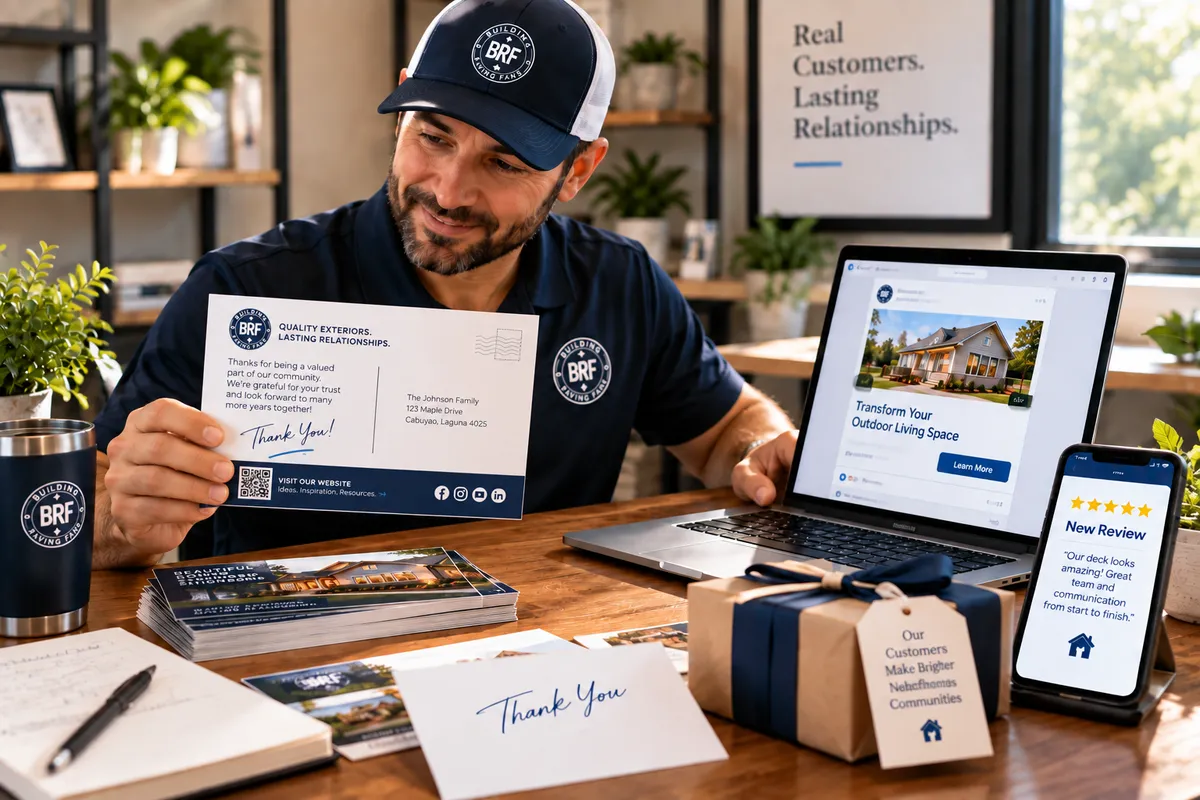
Direct Mail vs. Digital Ads: Which Keeps Your Business Top of Mind?
Direct Mail vs. Digital Ads: Which Keeps Your Business Top of Mind?
For local businesses, contractors, and home service companies, the marketing question is often framed as:
Direct mail vs. digital ads: Which one works better?
But that's not always the most useful question.
Digital advertising can help you reach people who are actively searching, browsing, or showing interest in a service. Direct mail can put your business physically into someone's home and create a tangible reminder of your company.
The bigger opportunity is understanding what each channel is actually designed to do and how they can work together.
This matters because getting attention and staying top-of-mind are not necessarily the same thing.
A paid ad may generate a click today.
A postcard may sit on a kitchen counter for several days.
A review may influence someone weeks later.
A helpful email may keep your company familiar for months.
A handwritten note may be remembered long after it arrives.
For relationship-based businesses, the strongest marketing strategy often isn't about choosing between direct mail and digital advertising.
It's about creating a system where multiple touchpoints reinforce the same relationship.
The Association of National Advertisers continues to benchmark direct mail alongside email, social media, paid search, SMS, and digital display as part of the broader direct-marketing mix. Its recent industry programming has also highlighted the use of personalization, segmentation, automation, and coordinated direct-mail/digital strategies.
So let's look at what each channel does well and how local businesses can use both without wasting money.
Direct Mail vs. Digital Ads: Start With the Job Each Channel Does
Before comparing channels, define the job you're asking your marketing to accomplish.
Are you trying to:
Generate immediate leads?
Build local awareness?
Stay top-of-mind?
Reach homeowners in specific neighborhoods?
Reconnect with past customers?
Generate referrals?
Build trust?
Promote a new service?
Drive traffic to your website?
Generate reviews?
Create repeat business?
Different channels are better suited to different jobs.
Digital advertising is often built for immediate visibility.
Someone searches for "deck builder near me."
Your ad appears.
They click.
They call.
That's a direct path from intent to action.
Direct mail can be built for physical visibility and memory.
A homeowner receives a postcard featuring a project completed nearby.
They may not need the service today.
But three months later, when they start planning their own project, your company may already be familiar.
That's a different type of marketing value.
One captures attention in the moment. The other can help build familiarity over time.
What Digital Ads Do Well
Digital advertising has obvious advantages.
You can:
Target specific geographic areas
Adjust budgets quickly
Test multiple messages
Track clicks and conversions
Retarget website visitors
Reach people based on interests or search behavior
Scale campaigns based on performance
For example, a roofing company dealing with storm-related demand might use digital advertising to reach homeowners actively searching for roof inspections.
A remodeling company might target people searching for kitchen renovation services.
A deck company might run ads around searches related to outdoor living.
This is valuable because digital advertising can meet people when intent already exists.
But there is a limitation.
Someone who isn't ready to buy today may never click.
And if you stop paying for the ad, the visibility generally stops with it.
That doesn't make digital advertising bad.
It simply means paid advertising is often strongest when you're using it for the job it's designed to do.
What Direct Mail Does Differently
Direct mail works in a fundamentally different environment.
A physical piece of mail enters the customer's real-world environment.
It might land:
On the kitchen counter
On a desk
Near the front door
On a refrigerator
In a mail organizer
Next to other household decisions
And unlike a digital ad that can disappear as someone scrolls, a physical piece can remain visible.
The ANA has specifically highlighted direct mail's continuing role in acquiring customers and rewarding existing-customer loyalty, as well as the growing use of personalization and data segmentation to improve performance.
That makes direct mail particularly interesting for local businesses.
You can target:
A neighborhood.
A customer list.
A geographic cluster.
A specific homeowner segment.
People surrounding completed projects.
That last opportunity is especially powerful for contractors.
The "Own the Block" Advantage
Imagine you just completed a beautiful deck in a neighborhood.
You could take photos of the project and put them on social media.
That's useful.
You could also run digital ads in the area.
That's useful too.
But now imagine taking that completed project and creating a highly relevant piece of direct mail for nearby homeowners.
The message could essentially communicate:
"We just completed this project right here in your neighborhood."
Now the marketing isn't abstract.
It's local.
It's visible.
It's proof.
This is the foundation of an Own the Block approach.
Instead of simply telling people:
"We build great decks."
You're showing them:
"We built this one nearby."
That distinction can make your marketing feel more credible and relevant.
Internal link: How to Build an “Own the Block” Marketing Strategy for Your Local Business
Direct Mail Isn't Just for Finding New Customers
One of the biggest mistakes businesses make is thinking direct mail is only for prospecting.
It can also be used to strengthen existing relationships.
For example, you could mail:
Customer appreciation postcards
Project anniversary cards
Seasonal homeowner tips
Referral thank-you cards
Handwritten notes
Neighborhood project announcements
Maintenance reminders
Customer-exclusive offers
Community updates
That changes the role of direct mail.
It becomes less about:
"Buy from us."
And more about:
"We remember you."
Building Raving Fans has specifically emphasized handwritten mail and personalized notes as relationship-marketing tools for contractors. Its existing content highlights how physical, personalized communication can complement digital follow-up and help businesses stay memorable.
Why Digital and Direct Mail Work Better Together
Here's where the comparison gets interesting.
You don't have to choose.
Imagine a homeowner receives a postcard from your company.
The postcard introduces your business and features a completed project nearby.
A few days later, they see your company on social media.
Then they visit your website.
A month later, they receive a helpful email.
Later, they see a customer review.
Then, when they're finally ready to start their project, they've already encountered your company several times.
No single touchpoint had to do all the work.
The system did the work.
The ANA has highlighted coordinated direct-mail and digital strategies as a way for different channels to work together rather than operate in isolation.
That's the important takeaway:
Direct mail and digital aren't necessarily competitors. They can be reinforcement channels.
The Difference Between Awareness and Intent
Let's simplify the customer journey.
Stage 1: "I've never heard of you."
Awareness.
Direct mail, social media, local content, referrals, community visibility, and other channels can help here.
Stage 2: "I've seen your name before."
Familiarity.
Repeated exposure begins building recognition.
Stage 3: "I might need this service."
Consideration.
Reviews, project examples, educational content, and your website become important.
Stage 4: "I'm ready to hire someone."
Intent.
Search, referrals, website conversion, sales follow-up, and reviews can influence the decision.
Stage 5: "I hired you."
Experience.
Now communication, appreciation, service delivery, and customer experience matter.
Stage 6: "I'd recommend you."
Advocacy.
Reviews, referrals, and word-of-mouth become growth channels.
The mistake is expecting one channel to perform every job.
Direct Mail + Reviews = Physical Attention Meets Digital Trust
Here's another powerful combination.
Imagine receiving a postcard from a local contractor.
It has a great project photo and a clear message.
You're interested.
What's the next thing you might do?
Look them up.
And what do you find?
Their Google reviews.
That's why direct mail should not exist separately from your digital reputation.
A postcard may create awareness.
Your website provides information.
Your reviews provide social proof.
Your customer experience creates the story behind those reviews.
Building Raving Fans' Raving Fans Reviews platform helps businesses create a more consistent system for collecting and managing customer reviews.
Scan-to-Review QR code cards can also connect physical customer touchpoints with digital review experiences.
It's a simple concept:
Physical interaction → Digital action.
That bridge is extremely useful for local businesses.
What About Long-Term Nurture?
Here's another area where digital communication becomes valuable.
A postcard may get someone's attention.
But you don't necessarily want to mail a postcard every week.
This is where long-term nurture email campaigns can fill the gap.
You might send:
Seasonal tips
Project planning guides
Maintenance reminders
Customer stories
Educational articles
Community updates
Helpful checklists
Referral reminders
Now your customer journey becomes:
Direct Mail → Website → Email Nurture → Reviews → Appreciation → Referral
Each channel has a role.
And none of them has to do everything.
Direct Mail vs. Digital Ads: A Practical Comparison
Marketing Goal | Direct Mail | Digital Ads |
|---|---|---|
Local awareness | Strong | Strong |
Neighborhood targeting | Strong | Strong |
Immediate search intent | Limited | Strong |
Physical visibility | Strong | Limited |
Fast campaign changes | Limited | Strong |
Personalization | Strong | Strong |
Retargeting | Limited | Strong |
Customer appreciation | Strong | Limited |
Review generation | Indirect | Indirect |
Long-term nurture | Strong when coordinated | Strong when coordinated |
Local project storytelling | Strong | Strong |
Referral marketing | Strong when relationship-based | Limited |
Measurable clicks | Limited | Strong |
Tangible brand experience | Strong | Limited |
The point isn't that one column "wins."
The point is that they solve different problems.
When Direct Mail Makes Sense for a Contractor
Direct mail can be especially useful when you have something highly local and visual to communicate.
Consider using it when:
You completed a standout project
Show the neighborhood what you can do.
You have multiple customers in the same area
Create geographic density.
You want to enter a new neighborhood
Introduce your company before customers need you.
You have seasonal services
Connect the message to a timely homeowner need.
You're launching Own the Block
Use completed projects and neighborhood visibility to build local recognition.
You want to appreciate past customers
Send something they can physically receive and remember.
When Digital Ads Make Sense
Digital advertising can be particularly useful when:
Customers are actively searching
Capture existing intent.
You need immediate lead generation
Digital campaigns can be launched and adjusted quickly.
You want to test messaging
Run multiple variations and evaluate results.
You want to retarget website visitors
Stay visible after someone has shown interest.
You have a specific service to promote
Target relevant audiences and geographic areas.
Digital ads can be an important part of a healthy marketing system.
But they shouldn't necessarily be the entire system.
The Better Question: "How Do We Stay Top-of-Mind?"
Instead of asking:
"Should we spend more on direct mail or digital ads?"
ask:
"What sequence will keep us visible and valuable throughout the customer journey?"
For example:
Touchpoint 1 - Direct Mail
Introduce your company to a neighborhood.
Touchpoint 2 - Digital
Reinforce the brand through social media or paid advertising.
Touchpoint 3 - Website
Provide project examples, testimonials, and helpful information.
Touchpoint 4 - Reviews
Give prospects social proof.
Touchpoint 5 - Email
Continue the relationship through helpful nurture.
Touchpoint 6 - Appreciation
Create memorable customer experiences.
Touchpoint 7 - Referral
Make it easy for happy customers to recommend you.
Now you have a system.
Not just a campaign.
Don't Forget Your Existing Customers
There's another major opportunity here.
Businesses often spend heavily to reach people they don't know while barely communicating with the people who have already trusted them.
That's backwards from a relationship-marketing perspective.
Your existing customers can receive:
Handwritten cards
Appreciation gifts
Anniversary mail
Seasonal postcards
Helpful emails
Review requests
Referral messages
Building Raving Fans' automated gifting and appreciation programs are designed to help businesses create these moments consistently.
The purpose isn't to overwhelm customers with marketing.
It's to make sure the relationship doesn't disappear simply because the project ended.
A Simple Direct Mail + Digital Strategy for Local Businesses
Here's an example of how a contractor could combine the channels.
Week 1
Send a neighborhood postcard featuring a recently completed project.
Week 2
Run digital ads featuring the same project.
Week 3
Publish a helpful blog about planning the same type of project.
Week 4
Retarget website visitors with project examples or educational content.
Month 2
Send a helpful email to interested prospects and past customers.
Month 3
Feature a customer story and review.
Month 4
Send another local or seasonal touchpoint.
The customer doesn't necessarily need to act immediately.
The goal is to build familiarity and trust before the buying moment arrives.
The Most Powerful Marketing Channel May Be the Combination
Direct mail isn't a replacement for digital.
Digital advertising isn't a replacement for relationship marketing.
And neither replaces great customer experience.
They all contribute different pieces.
A strong local marketing system might look like:
Direct Mail
creates physical awareness.
Digital Advertising
captures and reinforces attention.
Website
provides information.
Reviews
provide social proof.
Email Nurture
maintains the relationship.
Appreciation
creates emotional connection.
Referrals
create warm opportunities.
Great Service
turns customers into advocates.
That's the ecosystem.
Top-of-Mind Isn't the Same as "Seen the Most"
This distinction is important.
Being visible everywhere doesn't automatically make your company memorable.
Top-of-mind means that when the need appears, your business comes to mind.
A homeowner might see 100 ads in a week.
But the postcard from the contractor who completed a beautiful project two streets away may be the thing they remember when their spouse says:
"We should finally redo the backyard."
That's why relevance matters.
The best marketing isn't necessarily the loudest.
It's often the marketing that arrives at the right place, at the right time, with the right message.
Build a Marketing System That Compounds
Paid advertising can generate immediate opportunities.
Direct mail can build local visibility.
Email can maintain relationships.
Reviews can strengthen credibility.
Appreciation can deepen loyalty.
Referrals can introduce new customers.
The real advantage comes when those systems reinforce one another.
That is the heart of relationship marketing.
Building Raving Fans focuses on helping small businesses and contractors create systems that go beyond simply buying attention.
That includes Own the Block direct-mail strategies, automated appreciation and gifting, long-term nurture campaigns, Raving Fans Reviews, and Scan-to-Review QR code cards.
The goal is to help businesses stay connected to customers and communities long enough for relationships to create measurable business value.
Direct Mail vs. Digital Ads: Stop Thinking Either/Or
So, which keeps your business top-of-mind?
The answer depends on the job you're trying to accomplish.
Digital ads can be excellent for capturing active demand and putting your offer in front of targeted audiences.
Direct mail can create tangible, local, memorable touchpoints, especially when the message is personalized and relevant.
But the strongest strategy doesn't necessarily force a choice.
It connects the channels.
A postcard can create awareness.
A digital ad can reinforce it.
A website can build confidence.
A review can provide proof.
An email can nurture the relationship.
An appreciation touchpoint can make the business memorable.
And a referral can turn one customer into the next opportunity.
That's how you move from marketing campaigns to a relationship marketing system.
Ready to Build a Marketing System That Keeps You Top-of-Mind?
If your marketing strategy depends almost entirely on paid ads, it may be time to look at the customers and neighborhoods you already have around you.
Building Raving Fans can help you create a coordinated relationship-marketing strategy that combines Own the Block direct mail, customer appreciation, automated gifting, long-term nurture campaigns, review generation, and Scan-to-Review QR code cards.
Instead of asking which channel you should choose, let's look at how the right combination can keep your business visible, valuable, and remembered.
Your next customer may already live in the neighborhood you just finished working in.
Let's help you own the relationship and the block.


