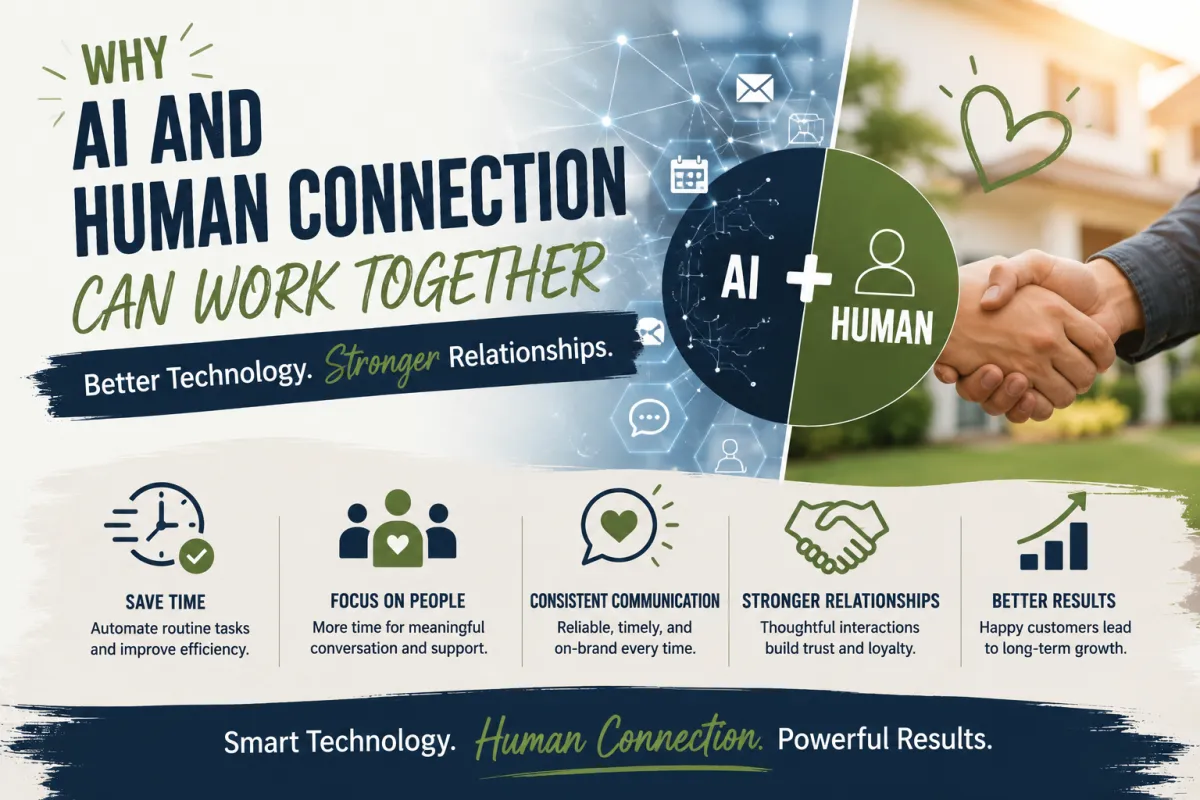
Why AI and Human Connection Can Work Together
Why AI and Human Connection Can Work Together
Artificial intelligence (AI) is changing how many businesses manage communication, marketing, and daily operations.
Today, AI tools can assist with tasks such as:
Drafting emails
Organizing customer information
Scheduling appointments
Creating marketing content
Responding to common inquiries
Automating repetitive administrative work
These technologies can improve efficiency and help teams spend less time on routine tasks.
At the same time, customer relationships continue to depend on clear communication, professionalism, responsiveness, and thoughtful customer experiences.
AI can support many aspects of a business, but meaningful customer relationships are still shaped by how businesses communicate, respond to customer needs, and deliver value throughout the customer journey.
Rather than viewing AI as a replacement for human interaction, many businesses use it to support their teams while continuing to provide personalized customer experiences.
Free Resource
Use Our ROI Calculator
Estimate how strengthening customer relationships and improving customer experience can contribute to long-term business growth.
Technology Supports Customer Relationships
Advances in technology have changed how businesses communicate with customers.
Automation and AI can help improve efficiency by assisting with routine activities such as:
Appointment reminders
Internal workflows
Email drafting
Scheduling
Customer data management
Educational content creation
These tools can help businesses save time and improve consistency.
However, technology is only one part of the customer experience.
Customers may also value:
Clear communication
Timely responses
Professional service
Honest expectations
Helpful information
Ongoing support after a project is completed
Combining efficient processes with thoughtful customer communication allows businesses to take advantage of technology while continuing to focus on customer relationships.
Action Step: Review your team's recurring administrative tasks and identify opportunities where automation may improve efficiency while allowing more time for customer-focused activities.
Balancing Automation and Personal Communication
Automation can make communication faster and more consistent.
Businesses may also choose to identify moments where personal communication provides additional value.
Examples might include:
Thank-you messages
Project completion follow-up
Customer appreciation
Answering unique customer questions
Providing educational resources
Responding to customer concerns
The appropriate balance between automation and personal interaction will vary depending on the business, its customers, and the services it provides.
Evaluating each stage of the customer journey can help determine where technology is most effective and where personal communication remains especially valuable.
Why Balancing Automation and Personal Communication Matters
Automation can help businesses improve efficiency by reducing the time spent on repetitive administrative tasks.
Common uses for AI and automation include:
Scheduling appointments
Sending reminders
Organizing customer information
Drafting communications
Managing workflows
Creating educational content
By reducing manual work, teams may have more time to focus on activities that require personal attention, such as answering customer questions, providing guidance, or following up after a project.
Every business has different communication needs, and the appropriate balance between automation and personal interaction will depend on the services provided and customer expectations.
Key Takeaway: Automation can improve efficiency, while thoughtful personal communication helps support a positive customer experience.
Common Questions About AI and Customer Communication
Businesses adopting AI often ask how automation should fit into their customer experience strategy.
Here are a few common considerations.
"Can AI write customer emails?"
AI can assist with drafting emails, organizing information, and creating first drafts.
Before sending customer communications, businesses should review the content for accuracy, tone, and relevance to ensure it reflects their brand and the specific needs of the customer.
"Should every customer interaction be automated?"
Not necessarily.
Many businesses choose to automate repetitive administrative tasks while reserving certain interactions for personal communication, particularly when responding to unique questions or discussing important milestones in the customer journey.
The appropriate balance depends on the business and its customers.
"Can AI help create customer resources?"
Yes.
AI can assist with drafting educational content, organizing maintenance information, creating FAQs, and developing informational resources.
Businesses should review and edit AI-generated content to ensure it is accurate, helpful, and appropriate for their audience.
"How can businesses evaluate their use of AI?"
Businesses can periodically ask questions such as:
Which repetitive tasks consume the most time?
Where can automation improve efficiency?
Which customer interactions benefit from a more personal approach?
Does our communication remain accurate, helpful, and consistent?
Regular evaluation helps ensure technology supports business operations while maintaining a positive customer experience.
Developing a Balanced AI Strategy
Every business uses technology differently.
As AI and automation become more common, it's helpful to evaluate where they can improve efficiency while maintaining clear, thoughtful customer communication.
Many businesses review their processes by asking questions such as:
"Which tasks are best suited for automation?"
Routine administrative activities are often good candidates for automation.
Examples include:
Appointment scheduling
Calendar reminders
Internal workflows
Document preparation
Data organization
Routine status updates
Automating repetitive work can help teams spend more time on activities that require individual attention.
"Which customer interactions benefit from a personal approach?"
Some customer interactions may benefit from direct communication rather than relying solely on automated messages.
Examples may include:
Project completion
Customer appreciation
Answering unique questions
Addressing concerns
Follow-up conversations
Milestone communications
The appropriate level of personalization will depend on the business, the services provided, and customer expectations.
"How can AI support customer communication?"
AI can assist with preparing content that businesses later review and personalize.
Examples include:
Educational articles
Maintenance guides
Frequently asked questions
Email drafts
Seasonal reminders
Reviewing AI-generated content before sharing it helps ensure accuracy, relevance, and consistency with the organization's communication style.
"How should businesses evaluate their AI strategy?"
Technology continues to evolve, making it valuable to periodically review how AI supports business operations.
Questions to consider include:
Are repetitive tasks being handled efficiently?
Is customer communication accurate and helpful?
Are there opportunities to personalize important interactions?
Does our technology support the customer experience we want to provide?
Regular evaluation helps businesses adapt their processes as technology and customer expectations evolve.
An Example Framework for Using AI Throughout the Customer Journey
Every business has unique workflows and customer communication needs.
The following example illustrates one way AI and personal communication may work together.
Step 1: Automate Routine Administrative Tasks
Use automation where it can improve efficiency and reduce repetitive manual work.
Examples include:
Appointment reminders
Scheduling
Workflow management
Internal notifications
Routine follow-up reminders
Step 2: Personalize Meaningful Customer Interactions
Identify moments where direct communication may provide additional value.
Examples include:
Thank-you messages
Project completion follow-up
Customer appreciation
Responding to customer questions
Discussing project-specific concerns
Step 3: Use AI to Support Educational Content
AI can assist in drafting resources such as:
Maintenance tips
Seasonal guidance
Frequently asked questions
Educational newsletters
Businesses should review and personalize this content before publishing or sharing it with customers.
Step 4: Use Automation to Support Consistency
Automation can help ensure recurring tasks are completed on schedule.
Examples include:
Follow-up reminders
Warranty notifications
Customer check-in schedules
Educational email sequences
Automation supports consistency, while team members determine how communication is delivered.
Step 5: Review and Improve the Process
Customer communication strategies should be reviewed periodically.
As business needs, technology, and customer expectations change, businesses can refine their processes to better support the overall customer experience.
"AI can improve efficiency, while thoughtful communication helps support meaningful customer experiences."
A Thoughtful Approach to AI and Customer Experience
At Building Raving Fans, we encourage businesses to evaluate how AI and automation fit into their broader customer experience strategy.
Depending on an organization's goals, technology may support:
Customer communication
Review request processes
Customer appreciation initiatives
Educational content
Long-term email communication
Workflow automation
Customer journey management
These tools are designed to help businesses improve consistency and efficiency while supporting ongoing customer communication.
Because every business is different, AI strategies should be tailored to each organization's services, operational processes, and customer expectations.
Why AI Should Support the Customer Experience
AI is one of many tools businesses can use to improve efficiency and organize customer communication.
Depending on the business, automation may reduce time spent on repetitive administrative tasks, allowing team members to focus on activities that benefit from individual attention.
Technology alone does not define the customer experience.
Communication, responsiveness, professionalism, and ongoing customer support all contribute to how customers experience a business.
By periodically evaluating both technology and communication processes, businesses can identify opportunities to improve operational efficiency while continuing to provide a thoughtful customer experience.
Your 7-Day AI and Customer Communication Review
Implementing AI doesn't require replacing your existing customer communication process.
Instead, consider how automation and personal communication can work together to support both operational efficiency and the overall customer experience.
Use this seven-day review to evaluate your current approach.
Day 1: Identify Current Automation
List every customer interaction currently supported by AI or automation.
Examples may include:
Appointment reminders
Scheduling
Workflow notifications
Email drafts
Customer follow-up reminders
Day 2: Review Personal Communication
Identify interactions where direct communication may provide additional value.
Examples include:
Project completion
Customer appreciation
Answering questions
Discussing project-specific concerns
Resolving customer issues
Day 3: Review AI-Generated Content
Evaluate any emails, educational resources, or marketing materials created with AI.
Ensure they:
Are accurate
Reflect your organization's communication style
Provide relevant information for customers
Day 4: Review Automated Emails
Read your automated customer emails from the perspective of a customer.
Consider whether they are:
Clear
Helpful
Easy to understand
Appropriate for the stage of the customer journey
Day 5: Review Educational Resources
Identify opportunities where AI can assist in developing helpful resources such as:
Maintenance guides
Frequently asked questions
Seasonal reminders
Educational articles
Review and personalize these materials before sharing them with customers.
Day 6: Evaluate the Customer Journey
Review how automation and personal communication work together throughout your customer journey.
Look for opportunities to improve consistency while maintaining appropriate customer engagement.
Day 7: Document Your Process
Create a documented workflow that outlines:
Which activities are automated
Which interactions involve personal communication
How customer communication is reviewed and updated over time
Regular evaluation helps ensure your processes continue supporting both operational efficiency and customer experience.
Action Summary
As you evaluate your use of AI, consider these questions:
✔ Are repetitive administrative tasks being handled efficiently?
✔ Does our customer communication remain accurate and helpful?
✔ Have we identified opportunities to personalize important customer interactions?
✔ Are AI-generated materials reviewed before they are shared?
✔ Does our communication process align with the customer experience we want to provide?
Regularly reviewing these questions can help identify opportunities to improve both operational processes and customer communication.
The Bottom Line
Artificial intelligence continues to provide businesses with new ways to improve efficiency, automate repetitive tasks, and support customer communication.
At the same time, customer experience is influenced by many factors, including communication, responsiveness, professionalism, and the overall quality of service provided.
Rather than viewing AI as a replacement for personal interaction, businesses can evaluate how technology supports their existing customer communication and operational processes.
By combining efficient systems with thoughtful communication, organizations can create customer experiences that align with their business goals while adapting to new technologies as they evolve.
Ready to Evaluate Your AI and Customer Experience Strategy?
If you're exploring ways to incorporate AI into your business while maintaining a strong customer experience, a thoughtful review of your communication process is a practical place to begin.
At Building Raving Fans, we help contractors evaluate their customer journey, identify opportunities to improve communication, and develop strategies that integrate technology with relationship-focused customer experiences.
During a Building Raving Fans Strategy Call, we'll review your current customer journey, discuss how AI and automation fit into your communication process, and identify practical opportunities to improve efficiency while maintaining meaningful customer interactions.
Whether you're implementing AI for the first time or refining an existing process, our goal is to provide practical guidance that supports your business objectives and customer experience.


