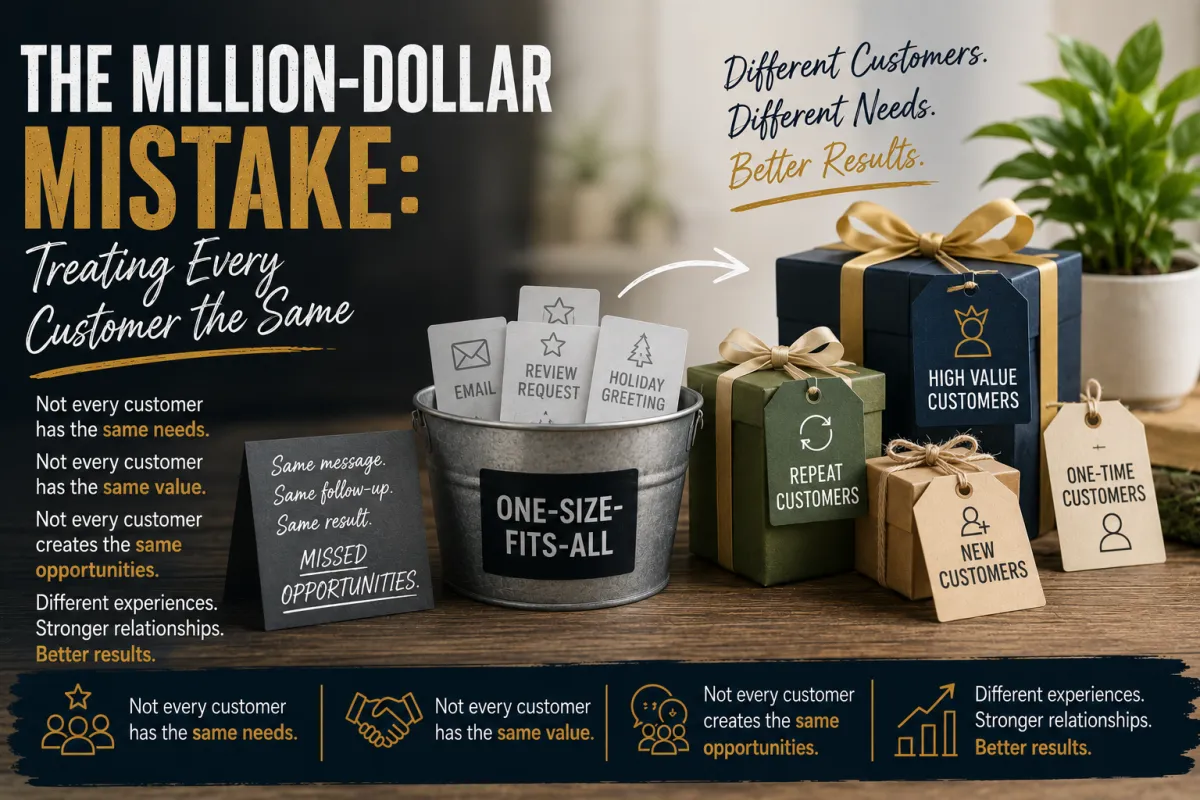
The Million-Dollar Mistake: Treating Every Customer the Same
The Million-Dollar Mistake: Treating Every Customer the Same
You finish two projects in the same week.
The first is a $4,500 plumbing repair.
The second is a $95,000 whole-home remodel.
Both homeowners are thrilled with the work.
Both receive the exact same thank-you email.
The same review request.
The same follow-up.
The same holiday greeting.
The same communication for the next two years.
On paper, it seems fair.
In reality, it's costing your business more than you realize.
Not every customer has the same needs.
Not every customer has the same lifetime value.
Not every customer creates the same referral opportunities.
Yet many contractors unintentionally treat every customer exactly the same.
It's one of the biggest reasons referral programs underperform, repeat business slows, and marketing budgets continue to grow.
The contractors creating consistent, predictable growth understand something different.
They don't just build great projects.
They build different experiences for different customers.
Fair Doesn't Always Mean Equal
Contractors often pride themselves on treating every customer equally.
That's a good value.
It's not always a good business strategy.
Equal respect?
Absolutely.
Equal craftsmanship?
Without question.
Equal communication after every project?
That's where things become more complicated.
Imagine two customers.
Customer A hired your company to repair a leaking pipe.
Customer B trusted your team with a six-month, whole-home renovation.
Would you expect those relationships to have the same long-term value?
Probably not.
Yet many contractors create one standard follow-up process regardless of project size, customer history, referral potential, or future buying opportunities.
The result?
Your highest-value relationships receive the same attention as one-time service calls.
That's not relationship marketing.
That's relationship maintenance on autopilot.
Action Step: Look at your last 100 completed projects. Would you honestly say every customer represents the same long-term opportunity?
Every Customer Has a Different Lifetime Value
One of the biggest mistakes contractors make is measuring customers only by the invoice they just paid.
That invoice tells you what the customer was worth yesterday.
It doesn't tell you what they could be worth over the next ten years.
Think about these examples.
A homeowner hires your roofing company.
Three years later, they replace their windows.
Five years later, they remodel their kitchen.
Seven years later, they recommend you to two neighbors.
Ten years later, they sell the home, and the new owner calls you because your company maintained the relationship.
That original customer may have generated hundreds of thousands of dollars in lifetime value.
Now compare that to a one-time emergency plumbing repair for a rental property.
Still valuable.
Just different.
When every customer receives identical communication, you're overlooking opportunities to strengthen relationships where the long-term return is greatest.
One Insight to Remember: The most valuable customer isn't always the one who spent the most today. It's often the one who can create the most opportunities tomorrow.
Why Contractors Fall Into This Trap
It's rarely intentional.
Most contractors are simply busy.
They create one process because it's easier.
One email.
One review request.
One thank-you message.
One holiday campaign.
One newsletter.
Everyone receives the same thing.
The system feels organized.
The problem is that customers don't experience your company the same way.
A first-time customer has different questions than someone who's hired you three times.
A homeowner who spent $100,000 with your company expects a different relationship than someone who purchased a small repair.
A loyal advocate deserves more than someone you've never heard from again.
When every customer receives identical treatment, your communication becomes generic.
Generic experiences rarely create memorable relationships.
The Hidden Cost of Treating Everyone the Same
Let's use a realistic example.
Suppose your remodeling company completes 60 projects each year.
Average project value:
$25,000.
Annual revenue:
$1.5 million.
Within those 60 customers:
10 are highly connected in their communities.
15 own multiple properties.
20 are likely to complete another project within five years.
15 are probably one-time customers.
Now imagine every customer receives identical follow-up.
Your most influential homeowners never receive additional appreciation.
Your repeat customers never receive personalized communication.
Your strongest referral sources never receive recognition.
Your one-size-fits-all approach quietly reduces existing opportunities.
Now imagine something different.
Your top 20% of customers receive:
Personalized appreciation gifts.
Anniversary check-ins.
Quarterly homeowner tips.
VIP referral recognition.
Exclusive educational content.
The remaining customers still receive excellent communication.
Just not identical communication.
Would that increase referrals?
Probably.
Would it improve loyalty?
Almost certainly.
Would customers notice?
Without a doubt.
Customer Segmentation Isn't Complicated
The word "segmentation" sounds technical.
It isn't.
It's simply organizing customers into meaningful groups.
Here are five groups every contractor should consider.
1. New Customers
Their confidence is still growing.
They need reassurance.
Clear communication.
A smooth onboarding experience.
Quick responses.
Education.
The first 90 days shape long-term trust.
2. Repeat Customers
These homeowners already trust your company.
Instead of convincing them to hire you again, focus on rewarding that loyalty.
A handwritten thank-you.
Priority scheduling.
Exclusive homeowner resources.
Small gestures reinforce big relationships.
3. Referral Champions
These customers recommend you regularly.
Treat them differently.
Recognize them.
Celebrate referrals.
Thank them personally.
People continue behaviors that are appreciated.
4. High-Value Customers
Large remodeling projects.
Multiple properties.
Long-term maintenance agreements.
These relationships deserve proactive communication throughout the year.
Not because they spent more.
Because their future potential is greater.
5. Dormant Customers
These homeowners haven't interacted with your company in years.
Many contractors assume they're gone.
Often, they simply haven't been reminded that you still exist.
A thoughtful re-engagement campaign can revive relationships before competitors do.
Action Step: Divide your customer database into these five groups. You don't need expensive software just a spreadsheet and a clear plan.
Why Most Contractors Never Segment Their Customers
We hear the same concerns all the time.
"Our CRM already stores everyone."
A database isn't a strategy.
Customer information only creates value when it influences communication.
"We don't have time."
Segmentation actually saves time.
Instead of guessing what every customer needs, your team follows a clear plan.
"It sounds complicated."
It doesn't have to be.
Start with three categories.
New.
Repeat.
Referral.
That's enough to begin.
"We already send newsletters."
If every customer receives identical emails regardless of their relationship with your company, you're missing opportunities to create more meaningful conversations.
Customers don't want more emails.
They want communication that feels relevant.
"Will customers even notice?"
Absolutely.
People notice when businesses remember them.
They notice birthdays.
Project anniversaries.
Helpful maintenance reminders.
Personal thank-you notes.
Recognition feels different.
That's exactly why it works.
The Better Approach: Build Experiences Around Customer Value
The goal isn't to treat some customers better.
It's to serve every customer more intentionally.
Imagine this customer journey.
New Customer
Welcome email.
Project expectations.
Helpful homeowner guide.
Thank-you card.
Review request using an NFC Review Card.
Repeat Customer
Personalized appreciation.
Priority scheduling.
Exclusive maintenance resources.
Seasonal check-ins.
Referral Champion
Personal thank-you.
Recognition after every referral.
Customer appreciation gift.
Referral updates.
High-Value Customer
Quarterly relationship check-ins.
VIP communication.
Project anniversary messages.
Long-term email nurture.
Personalized appreciation throughout the year.
Dormant Customer
Reactivation campaign.
Helpful homeowner content.
Seasonal reminders.
Exclusive offers.
Friendly check-ins.
Every customer still receives excellent service.
The experience simply becomes more relevant.
Why Building Raving Fans Focuses on Relationship Segmentation
One lesson we've learned after working with contractors is simple.
The companies experiencing predictable growth don't communicate more.
They communicate smarter.
They know which customers are likely to refer.
Which customers may need another project.
Which homeowners haven't heard from them recently.
Which relationships deserve extra attention.
Instead of relying on memory, they rely on intentional systems.
We've seen contractors dramatically improve customer engagement simply by changing who receives what communication and when.
A personalized appreciation gift means more when it arrives unexpectedly.
A review request performs better when it comes at the right moment.
Long-term email nurture keeps your company top of mind without overwhelming homeowners.
Segmentation isn't about automation.
It's about relevance.
And relevance creates stronger relationships.
Will This Actually Work for My Company?
That's a fair question.
The answer depends on one thing.
Will your team consistently follow the plan?
The good news is that customer segmentation doesn't require major operational changes.
It starts with understanding your customers.
Once your customer groups are defined, every future communication becomes easier.
Your office knows what to send.
Your marketing becomes more relevant.
Your appreciation becomes more meaningful.
Your customers feel recognized, not processed.
That's something every homeowner notices.
Your 7-Day Customer Segmentation Plan
Day 1
Export your customer list.
Day 2
Group customers into:
New
Repeat
Referral
High-Value
Dormant
Day 3
Identify your top 20 customers.
Ask:
"If we lost contact with these homeowners tomorrow, what opportunities would disappear?"
Day 4
Create one communication plan for each group.
Day 5
Write one personalized message for each customer segment.
Day 6
Schedule your next appreciation touchpoint.
Day 7
Meet with your office staff.
Review the plan together.
Ask:
"Does every customer receive communication that's appropriate for their relationship with us?"
Small adjustments today create stronger customer relationships for years to come.
The Bottom Line
Not every customer represents the same opportunity.
Some will hire you again.
Some will recommend you to everyone they know.
Some will quietly disappear unless you stay connected.
Treating every customer identically feels efficient.
Treating every customer intentionally is far more profitable.
The companies that create customers for life understand that relationship marketing isn't about sending more messages.
It's about sending the right message to the right customer at the right time.
That's how referrals become predictable.
That's how loyalty grows.
That's how businesses become memorable.
Because customers don't expect perfection.
They expect to feel remembered.
Ready to Build Smarter Customer Relationships?
If your business is generating projects but not enough referrals, repeat customers, or long-term loyalty, your customer communication strategy may be missing one critical piece: segmentation.
During a Building Raving Fans Strategy Call, we'll help you identify your highest-value customer groups, evaluate your current communication strategy, and uncover practical opportunities to create stronger relationships that lead to more referrals, reviews, and repeat business.
You'll walk away with actionable recommendations tailored to your company, not a generic marketing pitch.
This conversation is ideal for contractors who want to build predictable growth by strengthening customer relationships rather than continually increasing advertising spend.
If you're looking for a shortcut, this may not be the right fit.
But if you're ready to stop treating every customer the same and start building experiences that create customers for life, we'd love to help.
Because the most profitable customer relationship isn't the one you just closed; it's the one you continue to grow.


