How to Market to Past Customers Without Sounding Salesy
How to Market to Past Customers Without Sounding Salesy
If your marketing strategy only focuses on finding new customers, you may be overlooking one of your most valuable growth opportunities: the customers who already know and trust your business.
Learning how to market to past customers without sounding salesy isn't about sending more promotions. It's about staying connected, providing useful information, showing appreciation, and giving customers a reason to remember you when they or someone they know needs your services again.
For contractors, home service businesses, and other relationship-based companies, this distinction matters.
A customer who recently completed a project with you already knows what it's like to work with your company. You don't have to start the trust-building process from zero.
The challenge is staying relevant without turning every interaction into:
"Hey, do you need anything else?"
The answer is relationship marketing: communicating with past customers in ways that are helpful, personal, timely, and genuinely valuable.
Why Past Customers Are So Important to Your Marketing Strategy
Your past customers aren't just names sitting inside your CRM.
They're people who have already:
Experienced your service
Interacted with your team
Trusted you with their money
Seen the quality of your work
Formed an opinion about your company
Potentially recommended you to others
That makes your existing customer database a valuable marketing asset.
Yet many businesses follow a predictable pattern:
Lead → Sale → Project → Invoice → Silence
Once the project is complete, communication stops.
The customer may be completely satisfied, but six months later they might not remember your company when a friend asks for a recommendation.
That's the problem relationship marketing solves.
Building Raving Fans' own research and customer marketing philosophy centers on the idea that the relationship shouldn't end when the project does. Long-term nurture, appreciation, reviews, and thoughtful follow-up can keep a business connected to customers long after the original transaction.
Internal link: The Hidden Revenue You’re Missing After Every Completed Job
The Secret to Marketing Without Sounding Salesy
Here's the simplest rule:
Don't make every communication about what you want from the customer.
Instead, ask:
"What would be useful, helpful, thoughtful, or valuable to this customer right now?"
That one shift can completely change your marketing.
Compare these two messages:
Sales-focused:
"It's been six months since your project. Do you need any additional work? Contact us today for a quote!"
Relationship-focused:
"It's been six months since we completed your project. Here's a quick checklist of three things to look for as we head into the season. If you ever have a question, we're always happy to help."
The second message isn't necessarily trying to generate an immediate sale.
But it keeps your business relevant and useful.
And when the customer eventually does need something, your company is already top of mind.
1. Lead With Value, Not Offers
The easiest way to sound salesy is to make every email promotional.
Instead, build your communication around information your customers actually care about.
For a roofing company, that might be:
Seasonal roof maintenance tips
How to spot storm damage
Gutter maintenance reminders
What homeowners should check before winter
For a remodeling company:
Kitchen maintenance tips
Home improvement planning guides
Remodeling budget considerations
Ideas for improving outdoor living spaces
For a deck or outdoor living company:
Seasonal deck maintenance
How to prepare outdoor spaces for winter
Cleaning and sealing tips
Ideas for getting more use from an outdoor space
The goal is simple:
Become useful before you try to become profitable.
When customers consistently receive information that helps them, your emails stop feeling like advertisements.
They start feeling like service.
2. Use Seasonal Communication to Stay Relevant
Seasonality gives you a natural reason to contact past customers without forcing a sales pitch.
Instead of randomly emailing a customer with an offer, connect your message to something happening in their life.
For example:
Spring:
"5 Things to Check Around Your Home After Winter"
Summer:
"How to Get More Use Out of Your Outdoor Living Space"
Fall:
"Your Home Maintenance Checklist Before Cold Weather"
Winter:
"Planning Next Year's Home Improvements? Here's Where to Start"
These messages can occasionally include a relevant service, but the service shouldn't be the entire reason for the communication.
A helpful email might end with:
"If you notice something that needs attention, our team is always happy to help."
That's very different from:
"BOOK NOW! LIMITED-TIME OFFER!"
The first builds trust.
The second creates pressure.
3. Celebrate the Customer Relationship
Not every touchpoint needs to be about maintenance, education, or another service.
Sometimes, the best marketing is simply appreciation.
Consider recognizing:
Project anniversaries
Customer birthdays
Home purchase anniversaries
Holidays
Major milestones
Referral milestones
Long-term customer relationships
A simple message can have more emotional impact than another discount.
For example:
"It's been one year since we completed your project. We just wanted to say thank you again for trusting our team with your home."
That message isn't asking for anything.
And that's precisely why it can be powerful.
Building Raving Fans helps businesses create automated gifting and appreciation programs that allow companies to recognize customers consistently without relying on someone to remember every milestone manually.
The technology handles the timing.
The gesture creates the relationship.
Internal link: How to Develop a Consistent Client Appreciation Program
4. Ask for Reviews at the Right Moment
Marketing to past customers doesn't always mean trying to sell something.
Sometimes, you're asking them to help someone else make a better decision.
Reviews are a perfect example.
BrightLocal's 2026 Local Consumer Review Survey found that 97% of consumers use reviews to help guide their purchase decisions, while 85% said positive reviews make them more likely to use a business. The survey also found that 78% of consumers were asked to leave a review in the previous 12 months, and 65% of those asked went on to write one.
The key is timing.
Don't randomly ask a customer for a review months after you've disappeared.
Ask after a positive experience, when the value you've delivered is fresh.
And make the process easy.
Building Raving Fans' Raving Fans Reviews platform is designed to help businesses create a more consistent review-generation process, while Scan-to-Review QR code cards can make it simple for customers to access the review process.
Instead of creating friction, you're simply giving a happy customer an easy way to share their experience.
Internal link: Turning Reviews into Raving Fans: A BRF Approach for Contractors
5. Turn Customer Stories Into Community Content
Your past customers can also become part of your marketing without constantly selling to them.
With permission, showcase:
Before-and-after projects
Customer success stories
Home transformations
Project challenges you solved
Customer testimonials
Community projects
Interesting project details
Then share those stories through your:
Website
Social media
Email newsletter
Google Business Profile
Case studies
This creates a powerful combination:
You celebrate the customer while demonstrating your expertise to future customers.
Instead of saying:
"We're the best contractor in town."
You're showing people what you've actually accomplished.
That's much more credible.
6. Make Referral Requests Feel Natural
One of the worst ways to ask for a referral is to make it feel like an obligation.
You don't want:
"Refer three friends and get a discount!"
Instead, create a natural connection between a great experience and the possibility of helping someone else.
For example:
"We're grateful you trusted us with your project. If you have a friend or neighbor who's considering something similar, we'd be honored to help them too."
That feels different because the request comes from gratitude.
A strong referral system doesn't need to constantly ask:
"Who can you send us?"
It can simply remind happy customers that referrals are welcome.
BRF's approach to relationship marketing focuses on creating the systems and touchpoints that help happy customers become advocates naturally.
Internal link: Why Thoughtful Client Follow-Up is the Key to Growing Referrals
7. Use Long-Term Nurture Instead of Constant Promotions
Here's where many businesses get stuck.
They understand they should stay in touch with customers but they don't know what to send.
That's where a long-term nurture email campaign can help.
Instead of sending random emails whenever the marketing team remembers, create a communication rhythm.
For example:
Month 1
Thank-you and post-project check-in.
Month 2
Helpful maintenance or care tips.
Month 3
Educational content related to the customer's home or industry.
Month 4
Customer story or project spotlight.
Month 5
Seasonal advice.
Month 6
Personal appreciation message.
Month 7+
Continue providing useful content, occasional service reminders, customer appreciation, and relevant offers.
Notice something important:
Not every email sells.
That's intentional.
Building Raving Fans' long-term nurture email campaigns helps businesses remain top-of-mind through consistent, value-based communication rather than relying on manual follow-up.
BRF's own guidance recommends using long-term nurture to provide educational newsletters, seasonal tips, maintenance reminders, community updates, and helpful resources, not simply promotional messages.
8. Follow the 80/20 Relationship Marketing Rule
A useful guideline is to make the majority of your communication valuable without requiring a purchase.
You might think of your content mix like this:
80% Helpful, educational, personal, or appreciation-focused
20% Promotional or sales-focused
It's not a rigid mathematical rule.
It's a mindset.
If customers only hear from you when you're trying to sell something, they'll eventually learn to ignore your messages.
But if most of your communication is genuinely useful, your promotional messages have a much better chance of being noticed.
9. Personalize Based on What You Already Know
Personalization doesn't mean writing a completely different email for every customer.
It means using the information you already have to make communication more relevant.
Your CRM might tell you:
What service they purchased
When the project was completed
Their location
Their customer anniversary
Previous communication
Referral activity
Review status
Relevant services
That information can help you segment your database.
For example:
Past deck customers can receive outdoor maintenance content.
Roofing customers can receive seasonal roof-care reminders.
Remodeling customers can receive home improvement ideas.
Long-term customers can receive appreciation campaigns.
Your customers don't need to feel like they're on a mass email list.
They should feel like you're continuing the conversation.
10. Don't Confuse "Not Salesy" With "Never Selling"
There is an important distinction here.
Relationship marketing doesn't mean you should never promote your services.
Your customers may genuinely need what you offer.
The problem isn't selling.
The problem is making every interaction feel like a transaction.
If you've spent months providing helpful information and staying connected, a relevant offer can feel completely natural.
For example:
"You've worked with us before, so we wanted to give you first access to our fall maintenance schedule."
That's relationship-based selling.
It acknowledges the history between the customer and the business.
The Past Customer Marketing Formula
If you want a simple framework to use, remember:
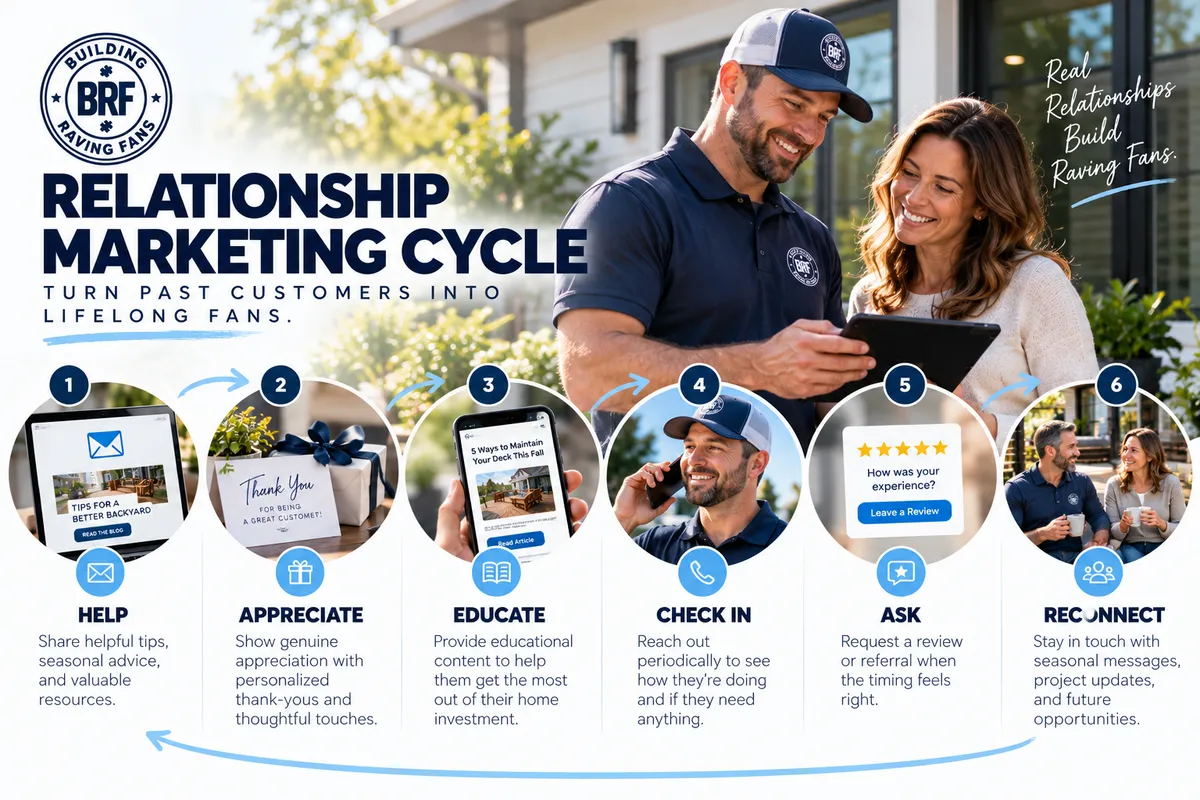
HELP → APPRECIATE → EDUCATE → CHECK IN → ASK → RECONNECT
HELP
Give customers useful information.
APPRECIATE
Show gratitude without asking for anything.
EDUCATE
Share knowledge that helps them make better decisions.
CHECK IN
Make sure everything is still going well.
ASK
When appropriate, ask for a review, referral, or opportunity.
RECONNECT
Continue the relationship over time.
This creates a customer experience that feels human rather than transactional.
Your Past Customers Are Already Part of Your Growth Strategy
You don't always need another lead source.
Sometimes, you need a better system for the customers you already have.
Think about the people in your CRM today.
How many completed a project with you in the last 12 months?
How many have received a genuine thank-you since then?
How many have heard from you in the last 90 days?
How many have been asked for a review?
How many have been given an opportunity to refer someone?
How many would immediately remember your company if a neighbor asked for a recommendation?
Those questions reveal the difference between having a customer database and building a customer relationship system.
And that's where relationship marketing becomes a growth strategy.
Marketing to Past Customers Should Feel Like a Relationship Because It Is
Your past customers don't need another company constantly asking them to buy something.
They need a reason to remember you.
They need useful information.
They need thoughtful communication.
They need to feel appreciated.
And when the timing is right, they need an easy way to take the next step, whether that's leaving a review, making another purchase, or referring someone they care about.
That's what makes relationship marketing different from traditional promotional marketing.
You're not constantly asking, "What can this customer buy from us?"
You're asking:
"How can we continue to be valuable to this customer?"
That mindset can transform the way your business approaches retention, referrals, reviews, and repeat business.
If you're looking for ways to stay connected with past customers without adding another manual task to your team's workload, start by identifying the moments that matter most and then build a system around them.
Building Raving Fans helps contractors, home service companies, and relationship-based businesses create those systems through review generation, automated appreciation and gifting, long-term nurture campaigns, and customer relationship strategies.
Ready to Turn Past Customers Into Long-Term Advocates?
Your past customers already know your business.
They've already experienced your service.
Now it's time to give those relationships the attention they deserve.
Building Raving Fans can help you create a customer relationship system that keeps your business top-of-mind, generates more reviews, encourages referrals, and turns past customers into Customers for Life.
Start building a system that keeps the relationship going long after the job is done.


