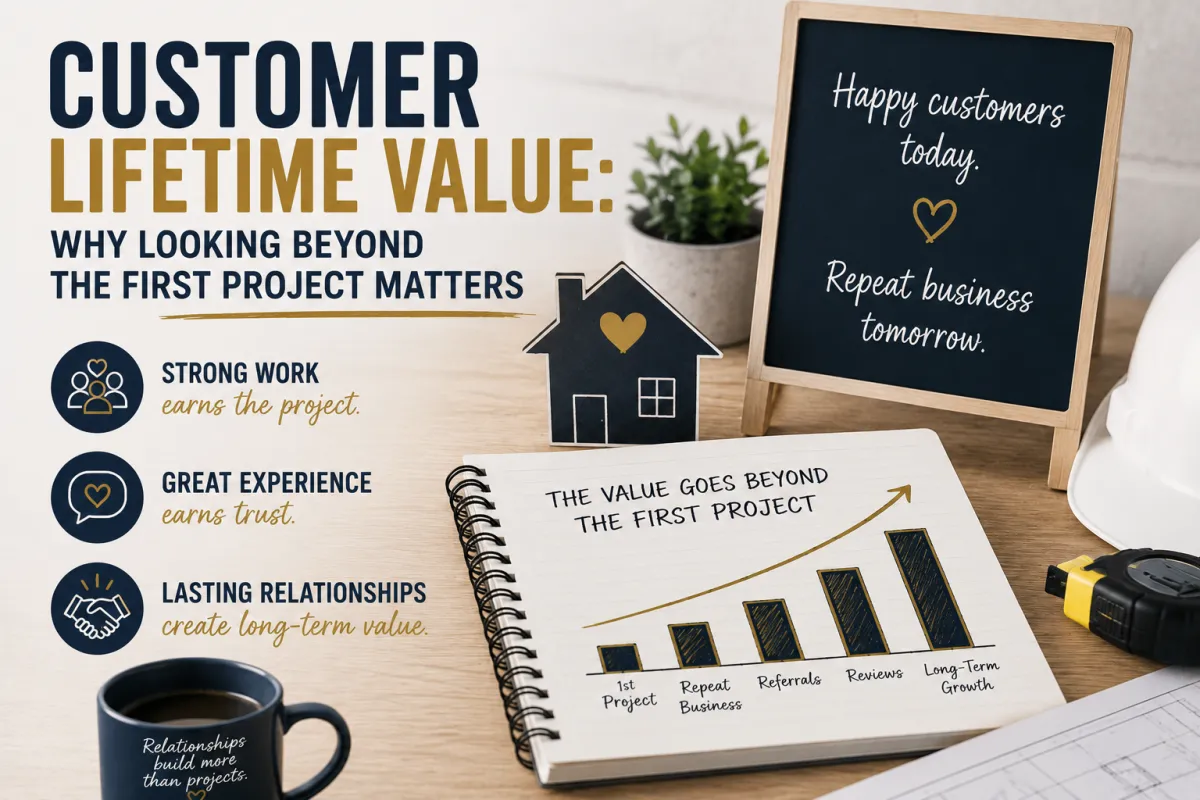
Customer Lifetime Value: Why Looking Beyond the First Project Matters
Customer Lifetime Value: Why Looking Beyond the First Project Matters
Many businesses measure success using metrics such as the number of leads generated, projects completed, or revenue earned during a specific period.
While these measurements are important, they don't always capture the full value of a customer relationship.
Customer Lifetime Value (CLV) is a business metric that estimates the total value a customer may bring to a company over the course of their relationship. Depending on the industry, this value may come from repeat purchases, referrals, positive reviews, additional services, or other long-term contributions.
For contractors, not every customer will require the same service again. However, satisfied customers may create value in other ways, such as recommending a business to family and friends, leaving online reviews, or returning for complementary services when appropriate.
Looking beyond a single project encourages businesses to think not only about completing quality work today, but also about creating positive customer experiences that support long-term relationships.
Rather than asking only,
"What was this project worth?"
it can also be valuable to ask,
"How can we continue providing value after the project is complete?"
This perspective helps shift customer communication from being purely transactional to becoming part of a longer-term relationship.
Free Resource: Explore the potential impact of stronger customer relationships with our ROI Calculator. Estimate how increasing customer retention, referrals, and repeat business can contribute to long-term revenue growth.
Why Customer Lifetime Value Is Worth Measuring
Many businesses can quickly identify metrics such as:
Average project value
Monthly revenue
Number of completed projects
Leads generated
These measurements help evaluate current business performance.
Customer Lifetime Value provides a different perspective.
Instead of focusing only on the initial transaction, it encourages businesses to consider the broader relationship with each customer and the ways that relationship may continue to create value over time.
Depending on the nature of a business, that value might include:
Future services
Referrals
Online reviews
Recommendations to friends or family
Positive word-of-mouth
Ongoing engagement with the business
The exact contribution will differ from one customer to another.
Some customers may never purchase another service.
Others may recommend your business to several people over many years.
Because of that, Customer Lifetime Value is best viewed as a strategic planning metric rather than a guaranteed financial outcome.
Thinking in terms of long-term relationships can help businesses make decisions about customer communication, service, and retention that extend beyond the completion of a project.
Action Step: Review how your business currently measures customer success. In addition to project revenue, consider whether you're tracking indicators such as customer retention, referrals, reviews, or ongoing engagement.
Why Businesses Often Focus on Individual Projects
Many contractors operate in fast-paced environments where immediate priorities naturally take precedence.
Daily responsibilities often include:
Meeting with prospective customers
Managing active projects
Coordinating schedules
Ordering materials
Supporting field teams
Preparing estimates
With so much attention devoted to current work, it's understandable that customer communication after project completion can receive less attention.
Once the project is complete and the invoice has been paid, businesses often shift their focus to the next opportunity.
However, the completion of a project can also represent the beginning of a long-term customer relationship.
Continuing to provide helpful communication after the work is finished, such as educational resources, maintenance reminders, or customer appreciation initiatives, can help businesses remain connected with customers over time.
Rather than viewing growth solely as acquiring new customers, many businesses also look for ways to strengthen relationships with existing customers.
Both acquisition and retention play important roles in long-term business growth.
Looking Beyond the First Project
Customer Lifetime Value is often associated with repeat purchases, but its impact extends beyond that.
For contractors, customers may continue creating value in several ways after a project is complete, even if they never purchase the exact same service again.
For example, satisfied customers may:
Recommend your business to friends, family, or neighbors.
Leave an online review that helps future customers make informed decisions.
Return for complementary services, when applicable.
Contact your business for maintenance or repairs.
Share positive experiences within their community or on social media.
Not every customer will create value in the same way, and not every relationship will lead to additional business opportunities.
However, maintaining positive customer relationships increases the likelihood that customers will remember your business when opportunities to recommend or work with you arise.
Rather than viewing a completed project as the end of the customer journey, many businesses treat it as the beginning of an ongoing relationship.
This perspective encourages businesses to continue providing value through helpful communication, educational resources, and excellent customer service long after the work has been completed.
A Different Way to Think About Customer Relationships
One way to understand Customer Lifetime Value is to compare two different approaches to customer engagement.
Transaction-Focused Relationship-Focused Focuses on completing the current project Focuses on building long-term customer relationships Measures individual project revenue Considers the broader value of customer relationships Communication ends after the project Communication continues when it provides value Prioritizes acquiring new customers Balances acquiring new customers with retaining existing ones Views projects as completed transactions Views projects as opportunities to build trust over time
Neither approach is inherently wrong.
Every business needs new customers to grow.
However, businesses that also invest in maintaining relationships with existing customers may create additional opportunities for customer engagement over time.
The objective isn't to choose between customer acquisition and customer retention.
It's to recognize that both contribute to sustainable business growth.
Key Takeaway: Every completed project is an opportunity to create a positive customer experience. Continuing the relationship through thoughtful communication can help your business remain connected with customers long after the work is finished.
Customer Lifetime Value Includes More Than Repeat Business
When people hear the phrase Customer Lifetime Value, they often think only about repeat purchases.
For many contractors, repeat business may occur less frequently because customers don't typically need the same major home improvement service every year.
That's why Customer Lifetime Value should be viewed more broadly.
Depending on the nature of your business and the services you provide, customers may continue contributing value by:
Referring friends, family, or neighbors.
Leaving online reviews.
Sharing positive experiences within their community.
Returning for related or complementary services.
Engaging with your educational content or newsletters.
Recommending your business when someone asks for a trusted contractor.
These actions help strengthen a company's reputation and visibility, even when they don't result in an immediate sale.
Customer Lifetime Value is therefore about the overall impact of a customer relationship not just the revenue generated from a single project.
Businesses that consistently deliver excellent service and maintain positive customer relationships are often better positioned to remain top of mind when future opportunities arise.
Action Step: Brainstorm all the ways your customers create value beyond the initial project. Referrals and repeat business are important, but don't overlook reviews, testimonials, community recommendations, and positive word-of-mouth.
Common Questions About Customer Lifetime Value
Many businesses understand the importance of Customer Lifetime Value but aren't always sure how to improve it.
Here are a few common questions.
"Does Customer Lifetime Value only apply if customers make repeat purchases?"
No.
Customer Lifetime Value reflects the overall value of a customer relationship, which may include repeat business, referrals, reviews, recommendations, and other forms of ongoing engagement.
The specific ways customers create value will vary depending on the industry and the services provided.
"Can Customer Lifetime Value be measured precisely?"
Customer Lifetime Value is generally an estimate rather than an exact figure.
Businesses often use historical data, customer behavior, and business goals to better understand how customer relationships contribute over time.
The calculation may differ from one company to another.
"Is finding new customers still important?"
Absolutely.
Customer acquisition remains an essential part of growing any business.
Customer Lifetime Value complements acquisition by encouraging businesses to also invest in serving and retaining the customers they already have.
The two strategies work best together.
"How can businesses increase Customer Lifetime Value?"
There isn't a single formula.
However, businesses often focus on areas such as:
Delivering excellent customer service.
Maintaining consistent communication.
Providing educational resources.
Making it easy for customers to leave reviews.
Creating positive experiences throughout the customer journey.
These efforts can strengthen customer relationships and encourage long-term engagement.
A Relationship-Focused Approach to Customer Lifetime Value
Customer Lifetime Value isn't increased by a single marketing campaign or customer interaction.
Instead, it's influenced by the overall experience customers have with your business from their first inquiry through the communication they receive after the project is complete.
Many aspects of the customer experience can contribute to long-term relationships, including:
Clear and timely communication
Consistent follow-up
Educational resources
Customer appreciation initiatives
Easy ways to provide feedback or reviews
Ongoing support when appropriate
While every customer relationship is different, these types of touchpoints can help businesses remain connected with customers in meaningful ways.
Rather than focusing only on the completion of a project, businesses can consider how to continue providing value after the work is finished.
For example, customers may appreciate receiving:
Seasonal maintenance reminders
Homeowner care guides
Helpful educational articles
Anniversary check-ins
Company updates
Invitations to provide feedback
Information about additional services that may be relevant to their needs
Not every customer will engage with every communication.
The objective isn't to increase the number of messages you send.
It's to ensure the communication you do send remains relevant, timely, and helpful.
Customer Lifetime Value grows from positive customer experiences over time not from any single interaction.
How Building Raving Fans Supports Long-Term Customer Relationships
At Building Raving Fans, we believe Customer Lifetime Value is closely connected to the overall customer experience.
Businesses that communicate consistently and continue providing value after a project is complete are often better positioned to stay connected with their customers over time.
Our approach focuses on helping contractors create customer relationship systems that support communication throughout the customer journey.
Depending on a company's goals, that may include:
Customer journey planning
Long-term email nurture
Customer appreciation programs
Review generation strategies
Referral marketing initiatives
Educational homeowner communication
Customer gifting programs
Follow-up communication workflows
These strategies are designed to help businesses maintain consistent communication while creating opportunities to continue serving customers after a project has been completed.
Every business has different customers, services, and communication goals.
For that reason, there isn't a single Customer Lifetime Value strategy that works for every company.
Instead, businesses benefit from developing communication plans that align with their customer journey and the experience they want to create.
The objective isn't simply to maintain contact.
It's to remain helpful, relevant, and memorable whenever customers choose to engage with your business.
A Different Perspective on Growth
Growing a business typically involves both attracting new customers and strengthening relationships with existing ones.
Customer acquisition introduces new opportunities.
Customer retention helps businesses continue building on the trust they've already earned.
Rather than viewing these strategies as competing priorities, many businesses invest in both.
Maintaining relationships with existing customers can complement lead generation by encouraging ongoing engagement, supporting positive customer experiences, and making it easier for satisfied customers to recommend the business when appropriate.
A balanced growth strategy considers the entire customer journey from the first interaction through the relationship that continues after the project is complete.
Key Insight: Customer Lifetime Value isn't about maximizing a single transaction. It's about creating positive customer experiences that encourage long-term relationships whenever opportunities arise.
"A completed project may mark the end of the work, but it doesn't have to mark the end of the customer relationship."
The Bottom Line
Customer Lifetime Value encourages businesses to think beyond individual projects and consider the long-term impact of positive customer relationships.
While project revenue remains an important measure of business performance, it represents only one part of the customer journey.
Satisfied customers may continue contributing value in many ways, including leaving reviews, recommending a business to others, engaging with educational content, or returning for additional services when appropriate.
Because every customer relationship is different, Customer Lifetime Value is best viewed as a strategic way of thinking rather than a guaranteed financial outcome.
Businesses that consistently deliver excellent service, communicate thoughtfully, and continue providing value after a project is complete are often better positioned to build lasting customer relationships.
The project may end.
The relationship doesn't have to.
By viewing customer communication as an ongoing part of the customer experience, businesses can create more opportunities to remain helpful, relevant, and memorable over time.
Ready to Strengthen Your Customer Relationships?
If you're looking for ways to improve your customer experience, Customer Lifetime Value can provide a useful framework for evaluating how your business communicates with customers before, during, and after a project.
At Building Raving Fans, we help contractors evaluate their customer journey, identify opportunities to strengthen customer communication, and develop relationship marketing strategies that support long-term customer engagement.
During a Building Raving Fans Strategy Call, we'll review your current customer experience, discuss your communication process, and explore practical ways to create a more consistent and relationship-focused customer journey.
Whether you're refining an existing customer communication strategy or building one for the first time, our goal is to help you create systems that continue delivering value long after a project is complete.
Strong customer relationships aren't built through a single interaction. They're developed through consistent, thoughtful experiences over time.


