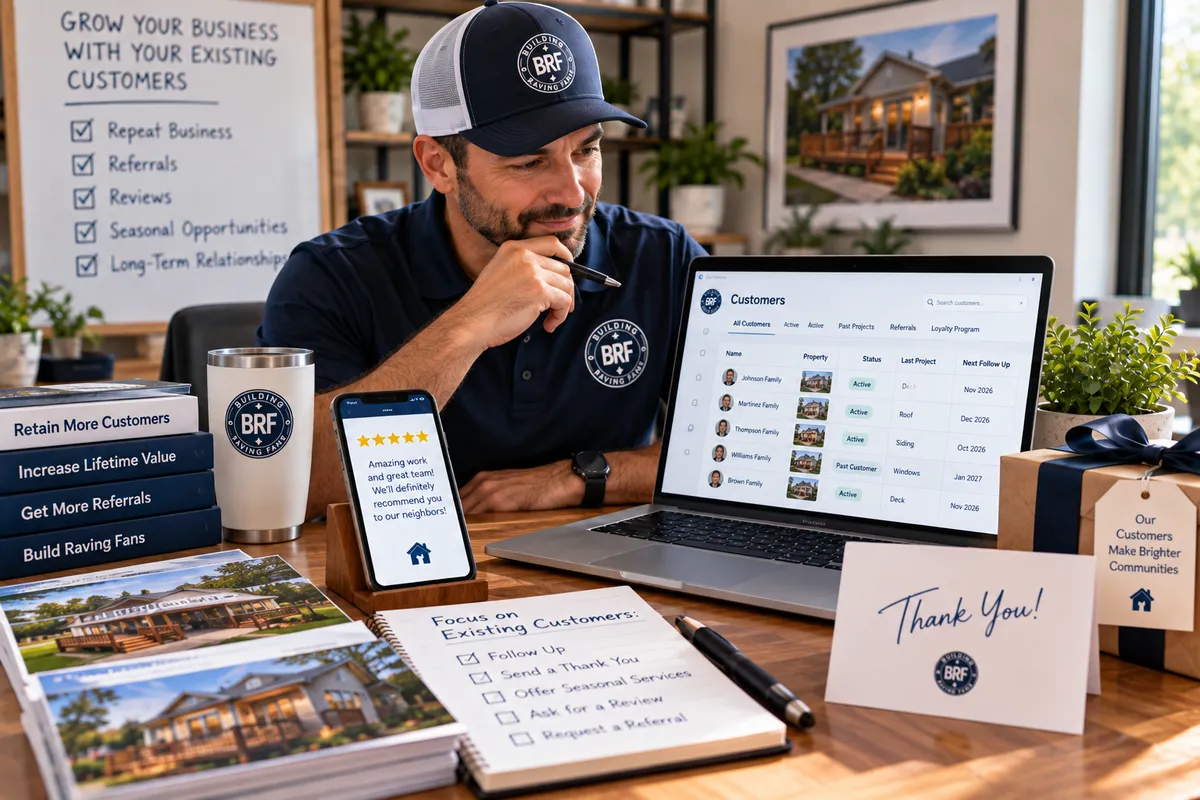
Before You Spend More on Ads: 7 Ways to Get More Revenue From Customers You Already Have
Before You Spend More on Ads: 7 Ways to Get More Revenue From Customers You Already Have
Before you spend another dollar on advertising, take a look at the customers already in your database.
For contractors, home service businesses, remodelers, and other relationship-driven companies, some of the biggest growth opportunities may not come from generating more leads. They may come from doing more with the customers you've already earned.
You have customers who already know your company.
They've experienced your service.
They've trusted you with their home, project, money, or business.
Some may need another service. Some may know someone who does. Others may be willing to leave a review, recommend you to a neighbor, or continue hearing from you throughout the year.
Yet many businesses invest heavily in acquisition while treating completed customers as if their value ends when the invoice is paid.
That's an expensive habit.
A smarter growth strategy is to look at customer retention, repeat business, referrals, reviews, and customer appreciation alongside lead generation.
This doesn't mean you should stop advertising.
It means you should make sure you're maximizing the customers you're already paying to acquire before increasing your acquisition budget.
Your Existing Customers Are a Growth Asset
Every customer represents more than one transaction.
Consider a homeowner who hires your company for a $15,000 project.
The immediate revenue is $15,000.
But what if that customer:
Leaves a detailed review
Refers two neighbors
Hires you again three years later
Recommends you to a family member
Shares photos of the project
Responds to your educational emails
Becomes a source of additional business
The original transaction can become the starting point for much more revenue.
That's why customer lifetime value matters.
And there is research behind the importance of retention. Frequently cited research associated with Bain & Company and Frederick Reichheld has found that improving customer retention can have a significant effect on profitability, although the exact impact varies by industry and business model.
The broader lesson is more important than any single percentage:
Keeping valuable customers engaged can be an important part of profitable growth.
For businesses built around relationships, the customer you already have deserves as much strategic attention as the customer you're trying to acquire.
Why Businesses Keep Spending More on Ads
Advertising feels productive because the activity is visible.
You launch a campaign.
Leads come in.
Your sales team follows up.
You can see clicks, impressions, cost per lead, and booked appointments.
Customer retention is different.
There isn't always a dramatic dashboard showing the value of a customer who remembered your company six months later and called again.
But that doesn't make the relationship less valuable.
A business can spend thousands of dollars generating new leads while hundreds of previous customers sit untouched in its CRM.
That's the opportunity gap.
Before increasing your ad budget, ask:
Are we fully maximizing the customers we already have?
If the answer is no, there may be revenue opportunities worth addressing first.
7 Ways to Get More Revenue From Customers You Already Have
1. Build a System for Repeat Business
The first opportunity is simple:
Give existing customers a reason to come back.
Many service businesses assume that if a customer needs them again, the customer will simply call.
Sometimes they will.
But people get busy.
They forget names.
They don't remember which company completed the work.
They don't know what services you offer beyond the original project.
And they may not realize you can help them with their next need.
That's why staying connected matters.
Create a system that reminds customers:
Who you are
What you do
What services you offer
How you can help them
What they should do when they're ready
This could include seasonal maintenance reminders, educational emails, project anniversary messages, service recommendations, and helpful homeowner content.
The objective isn't to constantly sell.
It's to remain relevant.
Think beyond the original purchase
A roofing customer may eventually need gutters.
A deck customer may eventually need staining or maintenance.
A remodeling customer may eventually renovate another area of the home.
A landscaping customer may need seasonal services.
A commercial client may have another property.
Your existing customer base already contains opportunities.
You need a system for identifying and nurturing them.
2. Stay in Touch With Long-Term Nurture
One of the easiest ways to lose future revenue is to disappear after the sale.
A customer might have loved your company six months ago.
But if they haven't heard from you since, you're no longer part of their daily awareness.
That's where long-term nurture email campaigns can help.
Instead of sending promotional emails every few weeks, create a communication rhythm built around useful information.
For example:
January
Planning tips for the year ahead.
February
Maintenance or preparation checklist.
March
Seasonal project ideas.
April
Helpful homeowner education.
May
Customer story or project spotlight.
June
Maintenance reminders.
July
Summer improvement ideas.
August
Planning guidance for fall projects.
September
Seasonal preparation tips.
October
Year-end maintenance checklist.
November
Customer appreciation message.
December
Thank-you and relationship-focused communication.
The customer doesn't need to buy something every month.
They simply need to remember that your company exists and recognize you as a helpful resource.
This is one of the principles behind Building Raving Fans' long-term nurture approach: stay connected without making every interaction a sales pitch.
For more on building this type of system, see From Lead to Loyal Client: BRF’s Follow-Up System for Contractors.
3. Turn Happy Customers Into Reviews
Your existing customers can also help generate one of your most valuable marketing assets: customer reviews.
BrightLocal's 2026 Local Consumer Review Survey found that 97% of consumers read reviews for local businesses. The same research found that 85% of consumers say positive reviews make them more likely to use a business.
That makes your customer database an important part of your reputation strategy.
But don't make the process difficult.
If someone has to search for your business, find the right listing, log in, and figure out where to leave feedback, there's unnecessary friction.
Make it easy.
A review strategy can include:
Timely review requests
Direct review links
QR codes
Scan-to-review QR code cards
Follow-up reminders
Personal thank-you messages
Building Raving Fans' Raving Fans Reviews platform is designed to help businesses create a more consistent review-generation process.
Scan-to-review QR code cards can also make the experience incredibly simple: a customer taps their phone and can immediately access the review experience.
And timing matters.
For a deeper look at this strategy, read Turning Reviews into Raving Fans: A BRF Approach for Contractors.
Your review strategy shouldn't end with the review
A review is also a relationship signal.
Someone who takes the time to write about their experience has demonstrated engagement with your company.
Thank them.
Recognize them.
Continue the relationship.
That customer may become a repeat customer or referral source.
4. Create a Customer Appreciation Program
Sometimes the simplest way to generate more long-term value is to make customers feel valued.
Customer appreciation isn't just about sending gifts.
It's about intentionally creating moments that reinforce:
"We're glad you're our customer."
That could happen after:
A completed project
A referral
A major milestone
A customer anniversary
A repeat purchase
A review
A holiday
A significant life event
The gesture doesn't have to be expensive.
It needs to be thoughtful.
A handwritten note can be more meaningful than a generic promotional item.
A useful gift can be more memorable than another sales email.
A personal phone call can stand out because customers aren't expecting it.
Building Raving Fans helps businesses create automated gifting and appreciation programs so these moments don't depend entirely on someone remembering to do them manually.
That's an important distinction:
Automate the process, not the feeling.
For more practical ideas, read How to Develop a Consistent Client Appreciation Program.
5. Build a Referral Engine From Your Existing Customers
You don't have to create a complicated referral program to generate referrals.
Start by creating an experience worth talking about.
Referrals often happen because customers trust a business enough to recommend it.
That means referral marketing begins long before the referral request.
Look at the entire customer experience:
Was communication clear?
Did your team arrive when promised?
Was the customer kept informed?
Was the project handled professionally?
Did someone follow up afterward?
Did the customer feel appreciated?
Building Raving Fans' research and content around referrals emphasizes this point: referral programs can help make recommendations easier, but the customer experience creates the foundation for those recommendations.
Make the referral opportunity easy
Don't simply say:
"Let us know if you know anyone."
Give customers a clear way to act.
For example:
"If you have a friend or neighbor who's thinking about a similar project, we'd be grateful if you passed our name along."
Then make it easy to share your information.
You can include:
Referral links
Shareable project pages
Business cards
Text-friendly referral messages
Email introductions
Neighborhood campaigns
The goal isn't to pressure customers.
It's to remove friction when they naturally want to recommend you.
6. Reactivate Past Customers Who Have Gone Quiet
Your CRM probably contains customers you haven't heard from in months or years.
Don't assume they're gone forever.
Some may simply need a reason to reconnect.
Create a reactivation campaign based on customer history.
For example:
"It's been a while..."
Send a friendly message acknowledging the relationship.
"Here's what's new..."
Share new services, team updates, or helpful resources.
"You may want to check this..."
Provide a relevant maintenance or planning resource.
"Can we help?"
Invite them to reconnect if they have a project coming up.
Segmentation makes these campaigns more effective.
A customer who hired you for a deck project shouldn't receive the exact same communication as someone who hired you for a kitchen renovation.
Use the information already stored in your CRM.
That's what makes a database valuable.
7. Turn Your Best Customers Into Your Marketing Team
Your best customers can create marketing value without becoming "marketers."
Their stories can become:
Testimonials
Reviews
Case studies
Social media content
Before-and-after posts
Project spotlights
Referral opportunities
Neighborhood proof
For example, one completed deck project might produce:
1 customer story
↓
1 case study
↓
1 Google review
↓
3 social media posts
↓
1 email feature
↓
1 neighborhood direct-mail opportunity
↓
multiple referral conversations
That's leverage.
Instead of constantly creating new marketing from scratch, you're repurposing real customer experiences.
And real experiences are often more persuasive than generic advertising.
Don't Choose Between Ads and Customer Marketing
This isn't an argument against advertising.
Paid advertising can be extremely valuable.
The problem is relying on acquisition alone.
Think of your growth strategy as two engines.
Acquisition
Bring new people into your business through:
Paid ads
SEO
Social media
Referrals
Partnerships
Events
Direct mail
Content
Retention & Expansion
Create more value from the customers you've already earned through:
Repeat business
Reviews
Referrals
Appreciation
Long-term nurture
Reactivation
Cross-selling
Customer stories
A strong business needs both.
But if the second engine isn't working, adding more fuel to the first one won't necessarily solve the problem.
Calculate the Opportunity in Your Own Database
Here's a simple exercise.
Take the number of customers you've served over the past three years.
Let's say you have:
500 customers
Now estimate:
10% could need another service = 50 opportunities
10% could generate a referral = 50 potential referral conversations
30% haven't left a review = 150 review opportunities
20% haven't received meaningful follow-up = 100 relationship opportunities
These aren't guaranteed sales.
They're opportunities.
And you already paid to acquire these customers.
The next step is figuring out which opportunities are realistic for your business.
Start with these questions:
How many past customers have we contacted in the last 90 days?
How many have received an appreciation touchpoint?
How many have been asked for a review?
How many have referred someone?
How many have purchased more than once?
How many customers are currently receiving useful nurture content?
If you don't know the answers, your first marketing investment may not need to be another ad campaign.
It may need to be better customer data and follow-up.
Measure More Than Leads
If you're serious about getting more revenue from existing customers, don't measure only lead volume.
Track relationship metrics too.
Customer metrics
Repeat purchase rate
Customer retention
Customer lifetime value
Revenue from existing customers
Reactivated customers
Reputation metrics
Review requests
Reviews received
Review recency
Average rating
Review response rate
Referral metrics
Referral opportunities
Referrals received
Referral-to-customer conversion
Revenue from referrals
Engagement metrics
Email open rates
Email clicks
Nurture engagement
Appreciation response
Customer re-engagement
These metrics tell a much bigger story than cost per lead alone.
The Customer You Already Have May Be Your Next Opportunity
Growth doesn't always begin with finding someone new.
Sometimes it begins with looking at the people who already trusted you.
Your customer database can contain opportunities for:
More reviews.
More referrals.
More repeat business.
More engagement.
More appreciation.
More relationships.
And ultimately, more revenue.
Before increasing your advertising budget, take a hard look at what happens after the sale.
Do you have a review system?
Do you stay in touch?
Do customers receive appreciation?
Do you have long-term nurture?
Do you make referrals easy?
Do you know which past customers are ready for another conversation?
If the answer to several of these questions is no, there may be meaningful growth sitting inside your existing customer base.
Turn Existing Customers Into Customers for Life
At Building Raving Fans, we believe customer relationships shouldn't end when the project ends.
The goal is to build systems that help businesses stay connected with customers through the entire relationship.
That can include:
Raving Fans Reviews to create a consistent review-generation process
Scan-to-review QR code cards that make providing feedback simple
Automated gifting and appreciation programs that help customers feel remembered
Long-term nurture email campaigns that keep your business top-of-mind
Customer follow-up systems that create opportunities for repeat business and referrals
The objective isn't to replace advertising.
It's to make sure you're getting more value from the customers your marketing has already brought through the door.
If you're spending more and more on lead generation but aren't sure whether you're maximizing your existing customer base, start there.
Audit your customer list. Identify your missed opportunities. Build the relationship system. Then decide how much more you actually need to spend on acquisition.
Ready to Get More Revenue From the Customers You Already Have?
Your CRM shouldn't be a graveyard of old contacts.
It should be one of your most valuable growth assets.
Building Raving Fans helps contractors, home service businesses, and relationship-driven companies turn customer relationships into repeat business, reviews, referrals, and long-term loyalty.
From review generation and Scan-to-Review QR code cards to automated gifting, appreciation programs, and long-term nurture campaigns, we help create the systems that keep your customers connected long after the original transaction.
Before you spend more money trying to find your next customer, let's look at the customers you already have.
Schedule a strategy conversation with Building Raving Fans and discover where your existing customer relationships may be leaving revenue on the table.


