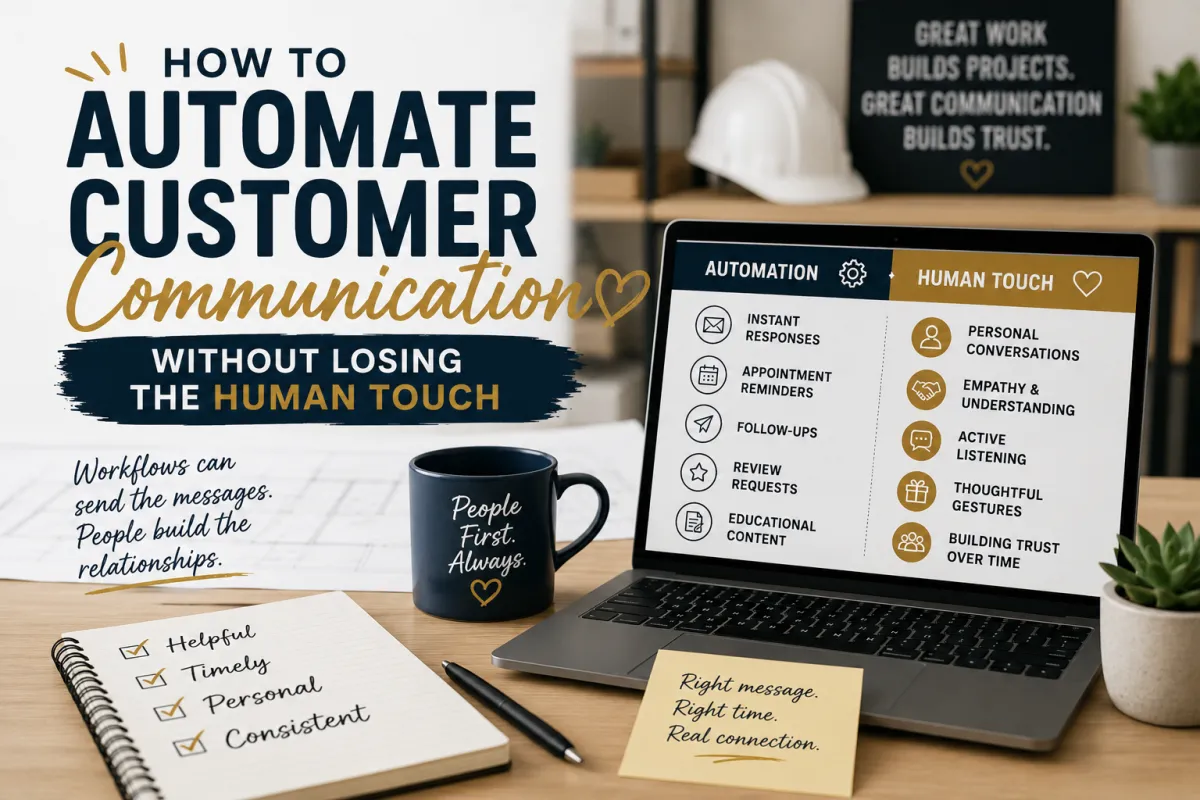
How to Automate Customer Communication Without Losing the Human Touch
How to Automate Customer Communication Without Losing the Human Touch
Automation has become an essential tool for businesses looking to improve efficiency and provide more consistent customer communication.
Today, many customer interactions can be automated, including appointment reminders, lead confirmations, follow-up emails, review requests, newsletters, and educational content. These workflows help reduce repetitive administrative work while ensuring customers receive timely information throughout their experience.
For contractors, automation can make it easier to stay organized and communicate consistently, especially as the number of projects and customer interactions grows.
However, automation alone doesn't create meaningful customer relationships.
Customers appreciate timely communication, but they also value authenticity. Messages that are relevant, helpful, and reflective of your company's personality are often more engaging than communication that feels generic or overly transactional.
That's why automation works best when it's used to support human relationships rather than replace them.
The goal isn't simply to send more messages.
It's to deliver the right message at the right time while preserving the personality and values that make your business unique.
When automation is paired with thoughtful communication, businesses can improve consistency without sacrificing the customer experience.
Free Resource: Discover the potential return on stronger customer relationships with our ROI Calculator. Estimate how improving customer communication, referrals, and repeat business can drive long-term growth without increasing your advertising budget.
Why Automated Communication Can Feel Impersonal
Automation isn't what causes communication to feel impersonal.
The content of the message is.
Many automated workflows are designed to send the right message at the right time. However, if those messages are generic, overly promotional, or lack relevance to the customer, they may not provide much value beyond confirming that an action occurred.
For example, customers generally expect to receive communications such as:
Appointment confirmations
Reminder emails or text messages
Project updates
Review requests
Service reminders
These messages serve an important purpose by keeping customers informed and reducing uncertainty throughout the customer journey.
Where businesses often have an opportunity to improve is in how those messages are written.
Consider the difference between a message that simply confirms an appointment and one that also provides helpful information about what the customer can expect next.
Or a review request that simply asks for feedback versus one that expresses appreciation and explains why customer reviews are valuable.
The purpose of automation shouldn't be limited to delivering notifications.
It should also support clear, helpful, and customer-focused communication.
Another common challenge is relying too heavily on templates without adapting them to reflect your company's voice.
Many CRM and marketing automation platforms include pre-written email templates to help businesses get started. While these templates can save time, they often work best when customized to reflect your brand, your communication style, and the needs of your customers.
Automation creates consistency.
Personality creates familiarity.
The combination of both helps businesses communicate efficiently while maintaining a customer experience that feels genuine.
Action Step: Review your last five automated customer emails. Ask yourself:
Does this message sound like our company?
Does it provide useful information?
Would I find this communication helpful if I were the customer?
If the answer is "no" to any of these questions, consider revising the message before automating it.
Helpful Automation vs. Unhelpful Communication
Automation itself isn't the problem.
The value of automation depends on how it's used.
When automation delivers timely, relevant, and helpful information, it can improve the customer experience by keeping people informed and reducing unnecessary friction.
For example, customers generally appreciate receiving:
Appointment confirmations
Project reminders
Status updates
Review requests
Maintenance reminders
Educational resources related to the services they received
These communications help customers know what to expect and can make working with your business more convenient.
However, automation becomes less effective when communication focuses only on sending more messages instead of providing value.
Messages that feel repetitive, overly promotional, or disconnected from the customer's experience are less likely to encourage meaningful engagement.
Instead, consider how each communication contributes to the overall customer experience.
Ask yourself:
Does this message answer a question?
Does it reduce uncertainty?
Does it help the customer maintain the work we completed?
Does it provide information the customer is likely to find useful?
If the answer is yes, automation is supporting the customer relationship.
If not, the communication may benefit from being revised before it's added to an automated workflow.
The objective isn't simply to automate communication.
It's to automate communication that customers appreciate receiving.
One Insight to Remember: Effective automation delivers the right information at the right time. Memorable customer experiences come from combining that consistency with communication that feels thoughtful and relevant.
Common Questions About Personalized Automation
Businesses often wonder whether automation and personalization can work together.
The answer is yes when automation is used thoughtfully.
Here are a few common questions.
"If customers know a message is automated, does that reduce its effectiveness?"
Not necessarily.
Many customers expect routine communications such as appointment reminders or confirmation emails to be automated.
What matters most is that the message is accurate, timely, and helpful.
Automation becomes more valuable when it improves convenience while maintaining a clear and professional tone.
"Should every automated message be personalized?"
Not every message requires the same level of personalization.
Routine operational updates may only need to provide accurate information.
Other communications such as follow-ups, educational emails, or customer appreciation messages can often be strengthened by reflecting your company's voice and acknowledging the customer's experience.
The goal is to balance efficiency with relevance.
"How often should we communicate with past customers?"
There isn't a universal schedule that works for every business.
Instead of communicating frequently for the sake of staying visible, focus on sending messages when you have something useful to share.
Educational resources, seasonal reminders, maintenance guidance, or important updates are often more valuable than frequent promotional emails.
Consistent communication is beneficial when it continues providing value to the customer.
"Can automation replace personal follow-up?"
Automation can help ensure routine communication happens consistently.
However, conversations involving customer questions, project concerns, appreciation, or service recovery generally benefit from direct human interaction.
Automation supports those relationships it doesn't replace them.
Five Ways to Add Personality to Automated Communication
Automation helps businesses communicate consistently, but consistency alone doesn't make communication memorable.
The messages customers receive should reflect your company's values, communication style, and commitment to customer service. Even small changes in tone and content can make automated communication feel more helpful and authentic.
Here are five practical ways to make automated communication more personal without sacrificing efficiency.
1. Write the Way Your Business Naturally Communicates
Many automated emails rely on formal or generic language because they're based on default templates.
Whenever possible, revise these messages so they sound more like the conversations your team has with customers.
Instead of focusing on overly formal wording, aim for language that is:
Clear
Friendly
Professional
Easy to understand
Customers appreciate communication that feels genuine and reflects the people behind the business.
The goal isn't to sound casual.
It's to sound authentic.
2. Make the Message Relevant to the Customer's Experience
Customers are more likely to engage with communication that relates to the service they received or the stage they're currently in.
Whenever appropriate, tailor automated communication to include information that's relevant to the customer's experience.
Examples might include:
Project preparation information before work begins
Maintenance recommendations after project completion
Seasonal reminders related to previous services
Educational resources that answer common questions
Relevant communication demonstrates that your business is focused on helping customers, not simply sending messages.
3. Prioritize Helpful Information Over Promotional Content
Not every customer communication needs to encourage another sale.
Some of the most valuable automated messages are educational.
Depending on your services, this might include:
Home maintenance tips
Seasonal recommendations
Product care guidance
Safety information
Frequently asked questions
Industry insights
Educational communication allows businesses to continue providing value while reinforcing their expertise.
Over time, consistently helpful communication can strengthen customer relationships and keep your business top of mind.
4. Introduce the People Behind Your Business
Customers often connect more easily with people than with logos or automated systems.
Where appropriate, consider including elements that make your communication feel more personal, such as:
Team introductions
Company updates
Employee milestones
Behind-the-scenes insights
Community involvement
These details help customers better understand the people behind your business and can make communication feel more authentic.
5. Encourage Two-Way Communication
Automation doesn't have to end the conversation.
Instead of treating automated messages as one-way notifications, invite customers to reach out if they have questions or need assistance.
Simple closing statements such as:
"If you have any questions, we're happy to help."
or
"Feel free to reply if there's anything we can do for you."
can make communication feel more welcoming while giving customers a clear path to continue the conversation.
Automation works best when it supports relationships, not when it creates barriers to communication.
Free Resource: Discover the potential financial impact of stronger customer communication with our ROI Calculator. Estimate how improving customer retention, referrals, and repeat business can help grow your business over time.
A Better Approach: Use Automation to Support Relationships
Rather than viewing automation as a replacement for customer interaction, consider how it can support a more consistent customer experience.
Automation is particularly effective for handling routine communication that customers expect, such as:
Automation Can Help With
Lead confirmations
Appointment reminders
Estimate follow-ups
Project preparation emails
Status updates
Review requests
Educational newsletters
Anniversary reminders
These tasks are repetitive, predictable, and well-suited for automation.
At the same time, certain interactions continue to benefit from direct human communication.
Your Team Can Focus On
Project consultations
Customer questions
Problem resolution
Personalized follow-ups
Customer appreciation
Responding to reviews
Referral conversations
Ongoing relationship building
This balanced approach allows technology to improve efficiency while giving your team more time to focus on meaningful customer interactions.
Customers may never notice the workflows operating behind the scenes.
What they remember is whether communication felt helpful, thoughtful, and genuine.
Automation creates consistency.
People create trust.
The strongest customer experiences combine both.
How Building Raving Fans Supports Relationship Marketing
At Building Raving Fans, we believe automation is most effective when it's part of a broader relationship marketing strategy.
Technology can help businesses communicate more consistently, but lasting customer relationships are built through thoughtful communication, ongoing engagement, and positive customer experiences.
Our approach focuses on helping contractors develop systems that combine automation with intentional relationship marketing.
Depending on a company's goals, that may include:
Customer journey planning
Automated communication workflows
Customer appreciation programs
Review generation strategies
Long-term email nurture
Educational homeowner communication
Referral marketing initiatives
Customer gifting programs
These strategies are designed to help businesses maintain consistent communication while preserving the personal interactions that customers value.
Rather than encouraging businesses to automate every interaction, we encourage thoughtful automation using technology where it improves efficiency while ensuring meaningful moments continue to involve real people.
Every business has different goals, workflows, and customer expectations.
That's why successful automation isn't measured by how many messages are sent.
It's measured by how effectively communication supports the overall customer experience.
Technology should simplify the process.
Relationships should remain the priority.
The Bottom Line
Automation has made it easier for businesses to communicate consistently with customers throughout their journey.
From appointment reminders to review requests and educational follow-ups, automation can reduce repetitive work while helping ensure important communications aren't overlooked.
Those efficiencies create valuable opportunities for both businesses and customers.
At the same time, technology doesn't replace the qualities that help businesses build strong customer relationships.
Clear communication.
Reliability.
Thoughtful follow-up.
Authentic appreciation.
A positive customer experience.
These are the interactions customers often remember long after a project is complete.
Automation works best when it supports these experiences not when it attempts to replace them.
Businesses that combine efficient systems with meaningful communication are better positioned to create customer experiences that are organized, consistent, and genuinely helpful.
Technology helps businesses communicate more effectively.
People create the relationships that customers remember.
Ready to Create More Meaningful Customer Communication?
If you're exploring ways to improve your customer communication, automation can be a valuable tool but it's most effective when it's part of a broader customer experience strategy.
At Building Raving Fans, we help contractors evaluate their customer journey, identify opportunities to improve communication, and develop relationship marketing strategies that combine automation with meaningful customer engagement.
During a Building Raving Fans Strategy Call, we'll review your current communication process, discuss where automation may improve consistency, and explore practical ways to strengthen your customer experience.
Whether you're implementing automation for the first time or refining an existing system, our goal is to help you create communication that is organized, helpful, and aligned with the experience you want your customers to have.
Because the most effective automation doesn't replace the human side of your business, it gives your team more opportunities to strengthen it.


