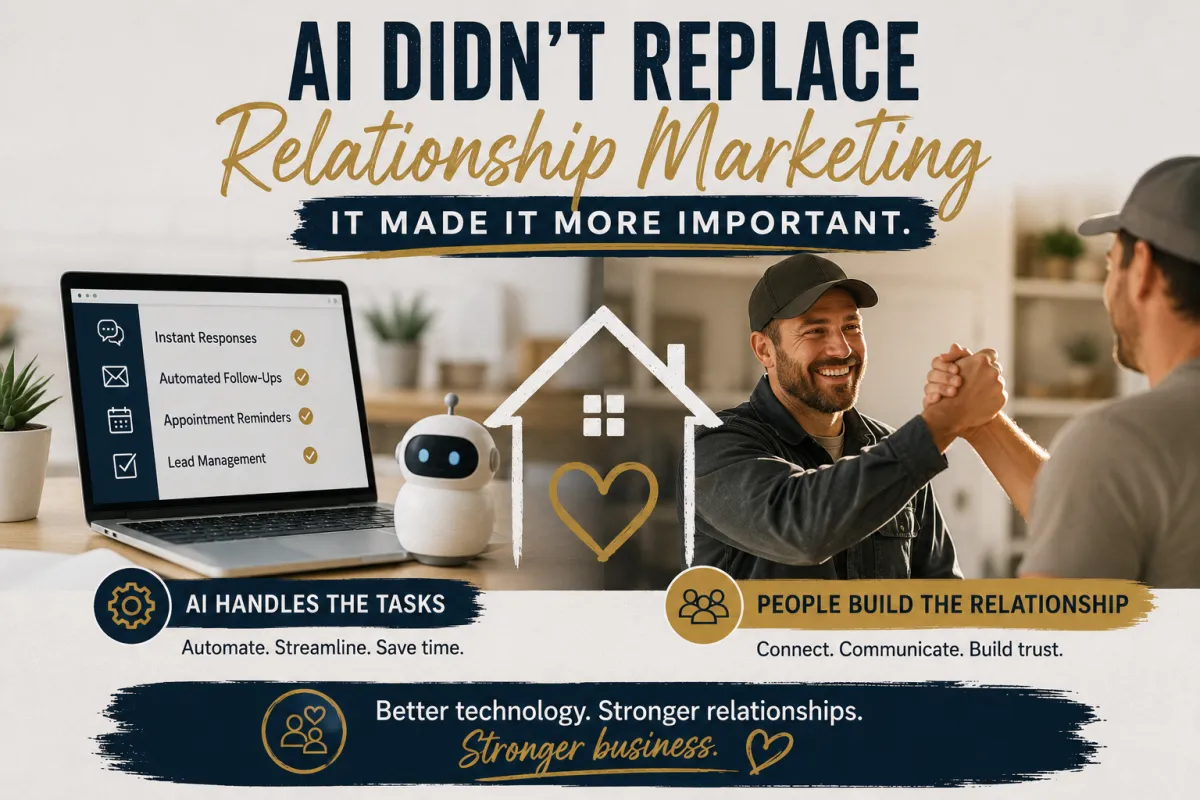
AI Didn't Replace Relationship Marketing It Made It More Important
AI Didn't Replace Relationship Marketing; It Made It More Important
Artificial intelligence (AI) is changing the way businesses communicate, market their services, and manage customer interactions. From answering common questions and automating follow-ups to organizing leads and streamlining administrative tasks, AI has become an increasingly valuable tool for improving efficiency.
For contractors, these advancements can save time, reduce repetitive work, and help teams stay organized. AI-powered tools can assist with scheduling appointments, sending reminders, managing customer inquiries, and supporting marketing efforts, all while allowing business owners and their teams to focus on higher-value work.
However, while AI can improve how businesses operate, it doesn't replace the human connections that build trust and long-term customer loyalty.
Customers don't stay loyal simply because they receive a fast response or an automated reminder. They remember businesses that communicate clearly, follow through on their promises, and make them feel valued throughout and after the customer journey.
That's why relationship marketing remains just as important today as it was before AI became widely available.
Rather than replacing relationship marketing, AI has made it even more valuable. As automation becomes more common, the businesses that stand out are often those that use technology to enhance the customer experience while maintaining authentic, meaningful relationships.
The goal isn't to choose between AI and human connection.
It's to use AI to support the relationships that technology alone can't create.
Free Resource: Calculate the potential value of stronger customer relationships with our Contractor ROI Calculator. See how improving referrals, repeat business, and customer retention can impact your revenue before investing in additional advertising.
Why More Contractors Are Adopting AI
Artificial intelligence has become increasingly accessible, making it easier for businesses of all sizes to automate routine tasks and improve day-to-day operations.
For contractors, managing a growing business often means balancing project schedules, responding to inquiries, preparing estimates, coordinating with customers, and keeping marketing efforts consistent. AI-powered tools can help simplify many of these responsibilities by handling repetitive administrative work more efficiently.
Today, many contractors use AI to:
Draft emails and customer communications
Organize and qualify incoming leads
Schedule appointments and send reminders
Answer frequently asked questions
Generate marketing ideas and content
Support CRM and workflow automation
Streamline internal processes
When used appropriately, these tools can improve efficiency, reduce manual work, and help teams respond to customers more consistently.
However, it's important to recognize what AI is and isn't designed to do.
AI can automate tasks.
It cannot build trust.
It can organize customer information.
It cannot create genuine appreciation.
It can help businesses communicate more efficiently.
It cannot replace meaningful relationships.
Customer loyalty, referrals, and repeat business are influenced by many factors, including the quality of the customer experience, ongoing communication, and the trust a business builds over time. While AI can support these efforts, it works best as a complement, not a replacement for human interaction.
Businesses that view AI as a tool for improving efficiency, while continuing to invest in authentic customer relationships, are often better positioned to create memorable experiences that encourage long-term loyalty.
Action Step: Make a list of every customer-facing task your business currently automates. Then ask yourself:
"Does this automation simply improve efficiency, or does it also contribute to a better customer experience?"
The answer can help identify opportunities to balance automation with meaningful human connection.
Why Relationships Still Matter
Artificial intelligence can make customer communication faster and more efficient, but efficiency alone doesn't create lasting customer relationships.
Whether someone is hiring a contractor for the first time or returning for another project, the overall experience often has a greater impact than the technology used behind the scenes. Customers are more likely to remember how they were treated, how well the company communicated, and whether they felt valued throughout the process.
Think about a business you've recommended to a friend or family member.
What made it stand out?
It probably wasn't because it used the latest software or automated every email.
More likely, it was because the experience left a positive impression.
Perhaps the team communicated clearly.
They followed through on their commitments.
They addressed concerns promptly.
They treated you with respect.
Or they stayed in touch even after the project was complete.
Those moments build confidence.
And confidence builds trust.
Trust is one of the strongest drivers of customer loyalty, referrals, and repeat business.
Technology can certainly help businesses deliver a more consistent experience. Automated appointment reminders, project updates, and follow-up emails all play an important role in keeping customers informed.
But technology is most effective when it supports, not replaces, the human side of customer relationships.
Customers may appreciate convenience, but they also appreciate authenticity.
A thoughtful follow-up.
A personalized thank-you.
Helpful educational content.
Checking in after a project is complete.
These interactions demonstrate that the relationship doesn't end when the invoice is paid.
Instead, they reinforce the idea that the customer is valued beyond a single transaction.
That's the difference between simply completing a project and building a relationship that lasts.
One Insight to Remember: Customers may forget the software you use, but they're far more likely to remember how your business made them feel throughout their experience.
The Hidden Cost of Over-Automation
Automation is designed to improve efficiency, and when used thoughtfully, it can create a smoother experience for both businesses and customers.
However, relying too heavily on automation without adding personal interaction can make communication feel impersonal over time.
Consider a typical customer journey.
A homeowner might receive:
An automated appointment confirmation.
An automated reminder before the consultation.
An automated estimate notification.
An automated invoice.
An automated review request.
An automated newsletter.
Each message serves a purpose.
Each arrives at the right time.
Yet if every interaction follows the same automated pattern, customers may begin to feel like they're moving through a process rather than building a relationship with a company.
Now imagine a different approach.
The business still uses automation to handle routine communication efficiently.
Appointment reminders are sent automatically.
Project updates are delivered on schedule.
Review requests are streamlined.
But alongside those automated touchpoints, the company intentionally creates moments that feel personal.
For example, they might:
Send a handwritten thank-you card after project completion.
Call the customer to ensure everything met expectations.
Share seasonal maintenance tips that provide ongoing value.
Celebrate the anniversary of a completed project with a thoughtful check-in.
Recognize customer referrals with a sincere expression of appreciation.
Automation keeps operations running smoothly.
People create memorable experiences.
This balance allows businesses to benefit from technology without losing the personal connection that helps customers feel valued.
It's also important to recognize that automation isn't the problem.
The challenge arises when businesses expect automation to replace relationship-building instead of supporting it.
The most effective customer communication strategies combine both.
Technology handles repetitive, time-consuming tasks.
People focus on empathy, appreciation, problem-solving, and meaningful conversations.
That's where long-term customer relationships are built.
Action Step: Review your current customer journey from the first inquiry through post-project follow-up. Identify which touchpoints are automated and ask yourself:
"Where could a personal interaction create a more memorable customer experience?"
Often, adding just one thoughtful human touch can leave a stronger impression than introducing another automated workflow.
Common Questions About AI and Customer Relationships
As AI becomes more common in the home service industry, many contractors have similar questions about how it fits into their customer communication strategy.
Here are some of the most common concerns and how to think about them.
"Our CRM already automates most of our customer communication. Isn't that enough?"
Customer relationship management (CRM) platforms and automation tools can improve consistency, reduce manual work, and help ensure important communications aren't missed.
However, automation alone doesn't create customer loyalty.
A CRM helps businesses stay organized and communicate more efficiently, but the quality of those interactions still matters. Customers are more likely to remember communication that feels relevant, helpful, and personal than messages that simply arrive on schedule.
Automation is a valuable foundation.
The customer experience built on top of that foundation is what often leaves a lasting impression.
"Can AI write our emails and marketing content?"
Yes.
AI can be an effective tool for drafting emails, newsletters, blog posts, social media content, and other marketing materials.
However, AI-generated content is most effective when it's reviewed and tailored to reflect your company's voice, values, and customer experience.
Adding specific examples, helpful insights, or a more personal tone can make communication feel more authentic while maintaining the efficiency AI provides.
Think of AI as a starting point not the final draft.
"Will customers know if we're using AI?"
In many cases, they may not notice.
And even if they do, using AI isn't inherently a negative thing.
Many customers appreciate quick responses, timely reminders, and easy access to information.
What matters most is that communication remains accurate, helpful, and appropriate for the situation.
Routine updates can often be automated successfully, while conversations involving complex questions, concerns, or customer service issues generally benefit from a personal response.
The goal isn't to hide the use of AI.
The goal is to use it in ways that improve the customer experience.
"Does relationship marketing still matter if AI can automate so much?"
More than ever.
As AI becomes increasingly accessible, many businesses will have access to similar automation tools.
Technology can improve operational efficiency, but it doesn't eliminate the importance of trust, credibility, and genuine customer relationships.
Businesses that consistently communicate, follow through on commitments, and continue providing value after a project is complete are more likely to stay top of mind when customers need future services or recommend a company to others.
Automation can support those efforts.
It doesn't replace them.
Action Step
Review your current automated communications and ask yourself:
Does each message provide value to the customer?
Does it sound like our company?
Would this communication still feel helpful if every competitor sent something similar?
If the answer is no, consider where personalization or additional value could strengthen the customer experience.
A Better Approach: Let AI Improve Efficiency While Your Team Builds Relationships
Rather than viewing AI and relationship marketing as competing strategies, businesses can often achieve the best results by using them together.
AI is particularly effective at handling repetitive, administrative tasks that help operations run smoothly.
Your team is best equipped to provide the empathy, expertise, and personal connection that technology can't replicate.
A balanced approach might look like this.
AI Can Help With
Appointment confirmations and reminders
Lead routing and organization
Calendar scheduling
Frequently asked questions
Workflow management
Administrative follow-ups
Marketing content drafting
Data organization and reporting
Your Team Can Focus On
Personalized customer conversations
Resolving questions or concerns
Expressing appreciation
Celebrating customer milestones
Building referral relationships
Providing expert guidance
Following up after project completion
Creating memorable customer experiences
When these responsibilities work together, technology enhances the customer journey instead of replacing the people behind it.
Customers may never notice the automation happening behind the scenes.
What they remember is how your business made them feel.
That's why the strongest customer experience strategies aren't built on automation alone.
They're built on meaningful interactions supported by efficient systems.
How Building Raving Fans Helps Businesses Strengthen Customer Relationships
At Building Raving Fans, we believe technology should make it easier to build stronger customer relationships, not replace them.
That's why our approach combines automation with intentional relationship marketing strategies that help businesses stay connected with customers long after a project is complete.
Depending on a company's goals, that may include:
Customer appreciation campaigns
Long-term email nurture programs
Personalized follow-up strategies
Customer gifting programs
Review generation systems
Referral marketing initiatives
Educational homeowner communication
Customer journey planning
Each of these strategies is designed to help businesses maintain meaningful communication throughout the customer lifecycle while using automation where it adds value.
Instead of relying solely on technology, businesses can create a customer experience that feels organized, consistent, and personal.
The result isn't simply more automated communication.
It's more opportunities to build trust, encourage referrals, and remain top of mind with past customers.
Technology supports the process.
Relationships make the experience memorable.
Why This Approach Matters
As AI continues to evolve, access to automation is becoming increasingly common.
What often distinguishes one business from another isn't whether they use AI it's how they use it.
Businesses that pair efficient systems with thoughtful communication, genuine appreciation, and long-term customer engagement are better positioned to create positive experiences that customers remember.
AI can help businesses work smarter.
Strong relationships help businesses grow stronger.
When the two work together, they create a customer experience that's both efficient and memorable.
The Bottom Line
Artificial intelligence is changing how contractors manage their businesses and communicate with customers.
From automating administrative tasks to supporting marketing efforts, AI offers practical ways to improve efficiency and free up time for higher-value work.
At the same time, the qualities that encourage customers to return and recommend a business trust, reliability, clear communication, and genuine appreciation remain fundamentally human.
Technology can help businesses respond faster, stay organized, and maintain consistency.
But meaningful customer relationships are built through positive experiences, thoughtful communication, and a commitment to providing value over time.
Rather than viewing AI and relationship marketing as competing priorities, businesses can benefit from using them together.
Automation helps streamline operations.
People create the moments customers remember.
When efficiency and human connection work hand in hand, businesses are better positioned to build lasting relationships that support customer loyalty, referrals, and repeat business.
Ready to Strengthen Your Customer Relationships?
If you're using AI, automation, or a CRM platform to improve your business, it's worth taking a closer look at how those tools fit into your overall customer experience.
At Building Raving Fans, we help contractors combine technology with intentional relationship marketing strategies that keep customers engaged long after a project is complete.
During a Building Raving Fans Strategy Call, we'll review your current customer communication process, identify opportunities to strengthen your customer journey, and discuss practical ways to use automation alongside meaningful relationship-building efforts.
Whether you're just beginning to explore AI or looking to improve an existing customer communication strategy, our goal is to help you create a more consistent, memorable experience for your customers.
If you're ready to build stronger customer relationships while making the most of today's technology, we'd be happy to start the conversation.
Because AI can help you work more efficiently, but meaningful relationships are what keep customers coming back.


