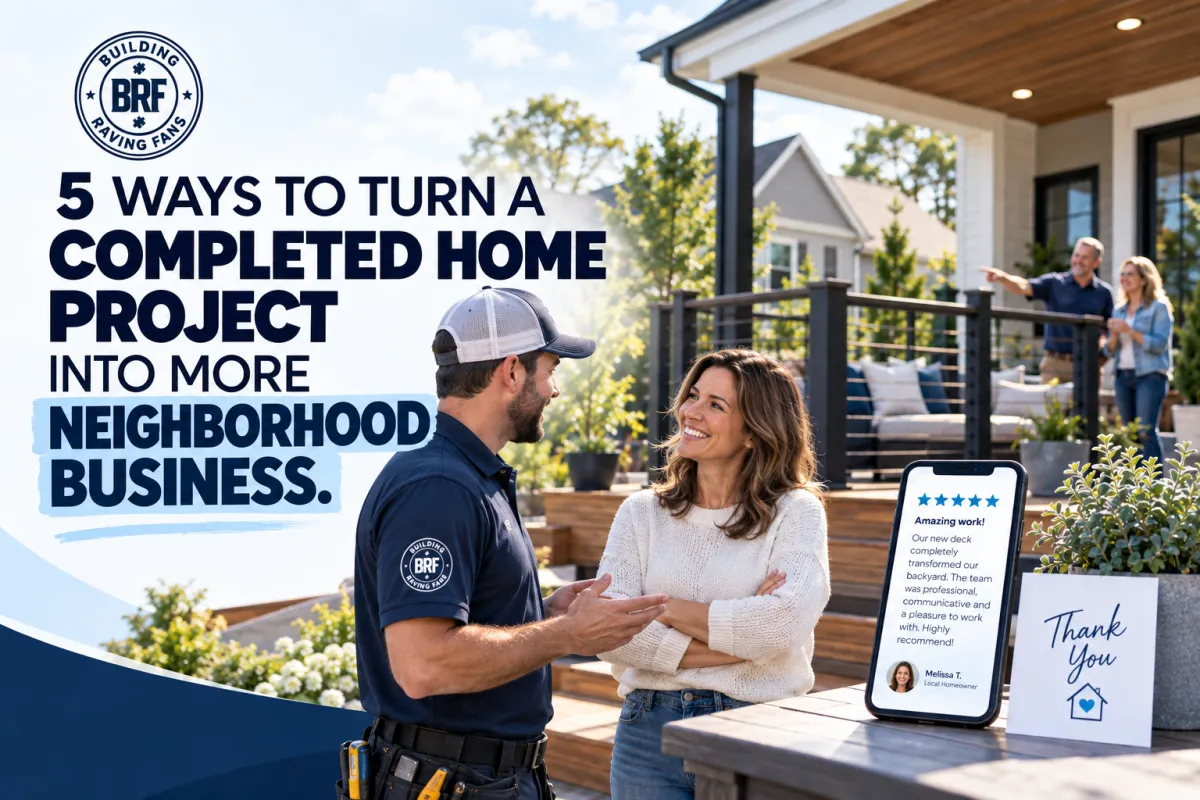
5 Ways to Turn a Completed Home Project Into More Neighborhood Business
How Contractors and Home-Service Businesses Can Turn Finished Projects Into Local Growth
A completed home project shouldn't be the end of your marketing opportunity.
For contractors, remodelers, deck builders, landscapers, roofers, painters, and other home-service businesses, every finished project represents more than revenue. It can become a source of reviews, referrals, repeat business, social proof, and new opportunities in the surrounding neighborhood.
Think about what happens when you complete a project in a residential community.
Neighbors see the trucks.
They notice the work taking place.
They see the transformation.
They may ask the homeowner who did the work.
And eventually, someone nearby may need the exact service your company just provided.
The question is: Will your business be the company they remember?
That is where relationship marketing can turn a completed home project into a local growth opportunity.
Instead of treating the final day of a project as the finish line, treat it as the beginning of the next phase of the customer relationship.
Here are five ways to turn completed projects into more neighborhood business.
1. Turn the Finished Project Into Local Social Proof
One of the most valuable things a completed project gives you is proof.
You didn't just tell someone you could build a deck, remodel a kitchen, replace a roof, or transform a backyard.
You actually did it.
And when that work is visible in a neighborhood, your project can become a real-world demonstration of your capabilities.
With the customer's permission, turn the finished project into useful marketing content.
That could include:
Before-and-after photos
A project spotlight
A customer testimonial
A case study
A Google review
A social media post
A website gallery
A neighborhood postcard
An email feature
A short project video
The key is to tell the customer's story, not just showcase your company's work.
Instead of:
“We built a new deck.”
Try:
“This family wanted a backyard where they could spend more time together. Here's how we transformed the space.”
The second version gives prospective customers something to connect with.
It demonstrates what you do while also showing the outcome your customer cared about.
Make Your Work Easy to Recognize
If you're trying to grow within a specific community, local relevance matters.
A homeowner who sees that your company has completed several projects nearby may feel more confident contacting you than they would with a company they've never seen in the area.
Google explains that local search results are influenced by factors including relevance, distance, and prominence. Google also notes that reviews and positive ratings can contribute to local prominence.
That means your completed projects, customer reviews, website content, and local reputation can all work together to strengthen your visibility.
2. Turn a Happy Customer Into a Review and Referral Opportunity
A satisfied customer is valuable.
A satisfied customer who shares their experience can become even more valuable.
Reviews help prospective customers understand what it's like to work with your business before they ever contact you.
Google's own guidance notes that reviews can help businesses stand out and contribute to local prominence.
That makes the period immediately after a successful project especially important.
Your customer has just experienced:
Your communication
Your workmanship
Your professionalism
Your project management
Your problem-solving
Your team's customer service
If they're happy, you have a natural opportunity to ask for feedback.
Make the Review Process Simple
One of the biggest mistakes businesses make is making customers work too hard to leave a review.
Don't send someone searching for your Google Business Profile.
Give them a clear, simple next step.
Building Raving Fans' Raving Fans Reviews platform helps businesses create a more consistent review-generation process.
Scan-to-review QR code cards can also give customers a simple physical way to access the review experience from their phone.
The goal isn't to pressure customers.
It's to remove friction when a customer genuinely wants to share their experience.
And don't stop at the review.
A positive review is also a signal that you've created a satisfied customer who may be open to deeper engagement.
For more on this strategy, link to Turning Reviews into Raving Fans: A BRF Approach for Contractors.
3. Show Genuine Appreciation After the Project
Your customer probably expects you to complete the project correctly.
They may not expect you to continue showing appreciation after the work is finished.
That difference can create a memorable experience.
A simple thank-you can reinforce the message:
“We appreciate that you trusted us with your home.”
That might be delivered through:
A handwritten note
A thoughtful gift
A project-completion package
A personal phone call
A customer appreciation email
A small surprise
A milestone message
The goal isn't to give customers something expensive.
The goal is to make them feel remembered.
Building Raving Fans helps businesses create automated gifting and appreciation programs that can trigger thoughtful touchpoints at important moments in the customer journey.
This matters because appreciation shouldn't depend on whether someone in the office remembers to send a gift on a busy Friday afternoon.
A system can help make gratitude consistent.
And consistency creates something valuable:
A customer who feels valued is more likely to remember your company.
That matters when a neighbor asks:
“Do you know anyone who can help us with our project?”
Your company has a much better chance of being mentioned when the customer remembers the experience—not just the transaction.
For more ideas, link to Building Trust Through Customer Appreciation.
4. Stay Connected Long After the Project Is Finished
One of the biggest missed opportunities in home services is what happens after the final invoice.
The project is completed.
The customer is happy.
The payment is processed.
And then communication disappears.
Months later, the customer may need another service.
Or their neighbor may ask for a recommendation.
But if the relationship has gone quiet, your business may not be the first name that comes to mind.
That's why long-term nurture matters.
A strong post-project nurture campaign gives you opportunities to remain useful without constantly trying to sell.
Your emails could include:
Seasonal home-maintenance tips
Helpful homeowner checklists
Project inspiration
Maintenance reminders
Anniversary messages
Customer appreciation messages
Educational blog content
Referral reminders
Seasonal promotions
Local information
The objective isn't to fill your customers' inboxes.
It's to remain useful, familiar, and memorable.
Building Raving Fans offers long-term nurture email campaigns designed to help businesses continue communicating with past customers after the project is complete.
For more on this approach, link to Client Nurture Systems That Run While You Work.
Why This Matters for Neighborhood Growth
Imagine a homeowner hired your company three years ago.
Today, their neighbor needs the same service.
If your company has stayed in touch through helpful content and thoughtful communication, the homeowner is more likely to remember you.
That's the relationship advantage.
You're not starting from zero.
You're building on trust you've already earned.
5. Use the Completed Project to Reach the Neighborhood Around It
This is where the finished project can become a genuine neighborhood marketing asset.
You've already completed the work.
You already have a customer.
You may already have photos and a testimonial.
Now think about the people who live nearby.
How can you introduce your business to them without making the campaign feel like generic advertising?
Consider a Neighborhood-Focused Campaign
Depending on your business and local regulations, you could use:
Direct mail
Project postcards
Neighborhood-specific social media
Local case studies
Customer stories
Educational content
Referral campaigns
Email marketing
Community events
For example, imagine a deck company completes a project in a neighborhood.
Instead of simply posting the finished deck on Instagram, the company could create a neighborhood-focused campaign:
“We recently completed this outdoor living project right here in [Neighborhood]. Here's how the homeowners transformed their backyard into a space for family gatherings.”
Then include:
A project photo
A short customer story
A review
A link to the company's website
A simple way to request an estimate
The campaign isn't saying:
“BUY FROM US!”
It's showing the neighborhood:
“We're already here. We've helped homeowners like you. Here's what we do.”
That feels more relevant.
The Completed Project Marketing Flywheel
The five strategies above become even more powerful when you connect them.
Instead of treating reviews, appreciation, email, referrals, and neighborhood marketing as separate activities, build them into one customer journey.
Here's a simple example:
Step 1: Complete the Project
Deliver an excellent customer experience.
Step 2: Confirm Satisfaction
Make sure the homeowner is happy with the finished work.
Step 3: Request the Review
Make it simple for the customer to share their experience.
Step 4: Show Appreciation
Thank the customer for choosing your company.
Step 5: Capture the Story
With permission, collect photos, testimonials, and project details.
Step 6: Continue the Relationship
Add the customer to an appropriate long-term nurture campaign.
Step 7: Activate the Neighborhood
Use the project as a local marketing opportunity.
Step 8: Make Referrals Easy
Give the customer a simple way to introduce your business to friends and neighbors.
Step 9: Measure the Results
Track where new opportunities are coming from.
That creates a flywheel:
Great Project → Happy Customer → Review → Appreciation → Nurture → Local Visibility → Referral → New Customer
And the cycle starts again.
Don't Make the Mistake of Treating Every Completed Project the Same
Not every project will have the same marketing potential.
Some projects are especially valuable because they:
Are highly visible
Have strong before-and-after transformations
Are located in target neighborhoods
Have enthusiastic customers
Generate strong photography
Solve a recognizable problem
Are likely to attract similar homeowners
Create a simple system for identifying these opportunities.
For example, your project-completion checklist could include:
Is the customer happy?
Did we request a review?
Did we send appreciation?
Did we collect project photos?
Did we ask permission to use the project in marketing?
Is this customer in a target neighborhood?
Should this customer enter a long-term nurture sequence?
Is there an opportunity to create neighborhood-specific content?
This turns marketing from something your team has to remember into something your business does consistently.
Measure More Than Leads
If you're going to turn completed projects into neighborhood business, track more than the number of leads generated.
Look at:
Reviews generated after project completion
Referral leads
Repeat customers
Leads by neighborhood
Revenue by neighborhood
Website visits from local searches
Calls and form submissions
Conversion rates
Customer engagement
Number of customers participating in nurture
Number of customers receiving appreciation
Over time, you may discover that certain neighborhoods produce significantly more opportunities than others.
That information can influence where you focus future marketing.
Instead of spreading your marketing budget equally across an entire service area, you can identify communities where you've already built trust and look for ways to deepen your presence.
One Completed Project Can Be More Valuable Than You Think
A completed project can look like a single line on a revenue report.
But it can represent much more.
It can become:
A review.
A testimonial.
A case study.
A referral.
A repeat customer.
A social media story.
A neighborhood postcard.
A long-term relationship.
The businesses that understand this stop thinking about customer acquisition as a straight line.
Instead, they build a system where every completed project has the potential to create the next opportunity.
That's relationship marketing in action.
Turn Your Finished Projects Into Future Opportunities
You don't have to choose between traditional marketing and relationship marketing.
Your completed projects can support both.
Use your work to demonstrate expertise.
Use reviews to build trust.
Use appreciation to strengthen relationships.
Use nurture to stay top-of-mind.
Use neighborhood marketing to expand local visibility.
And make referrals easy for customers who genuinely want to recommend you.
Building Raving Fans helps businesses create the systems behind these touchpoints through Raving Fans Reviews, Scan-to-Review QR code cards, automated gifting and appreciation programs, and long-term nurture email campaigns.
The goal isn't simply to finish more projects.
It's to make every project create more opportunities for the future.
Ready to Turn Completed Projects Into More Local Business?
Your next customer may already live a few houses away from someone you've already served.
The opportunity is to make that connection intentional.
Building Raving Fans can help you create a customer relationship system that turns completed projects into reviews, appreciation moments, long-term relationships, referrals, and neighborhood visibility.
If you're ready to get more value from the customers and projects you already have, talk with Building Raving Fans about building your relationship marketing system.
Don't let the project end when the job ends. Turn the finished project into the beginning of your next opportunity.


