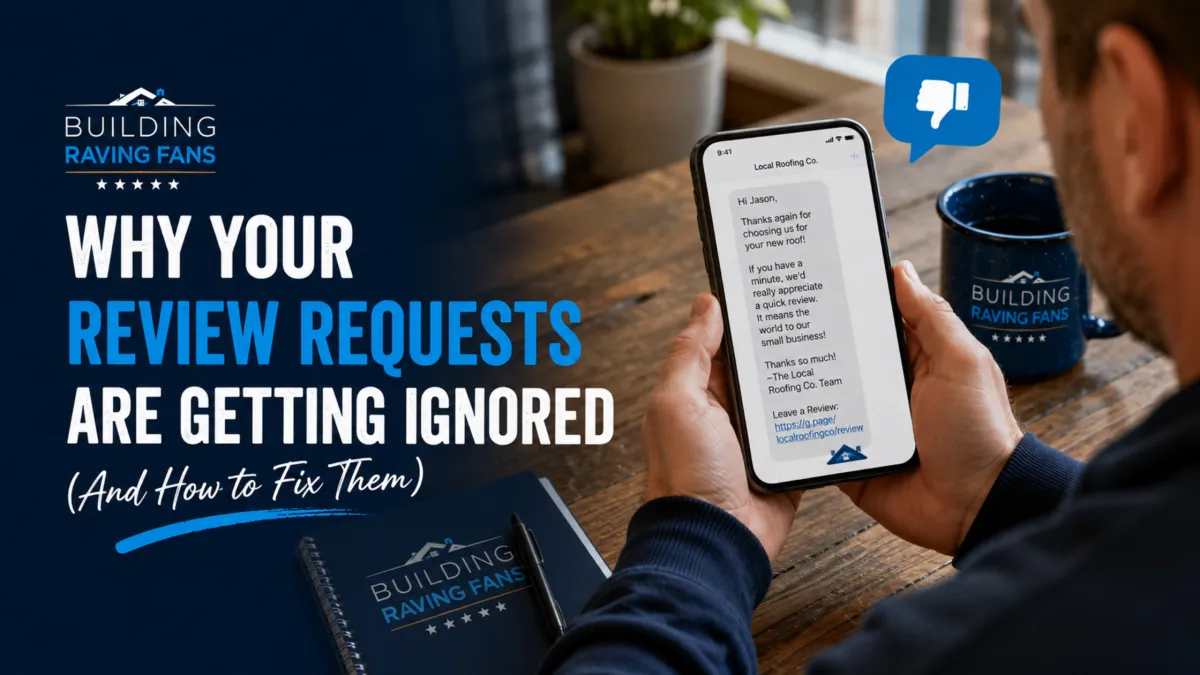
Why Your Review Requests Are Getting Ignored (And How to Fix Them)
Why Your Review Requests Are Getting Ignored (And How to Fix Them)
You send the review request. You wait. Nothing happens. A week later, you send another one, maybe with a little more urgency this time. Still nothing.
If that sounds familiar, the problem probably isn't your customers. Most people who ignore a review request weren't unhappy with the work they just weren't asked in a way that made responding feel worth their time. Here's why that happens, and what actually gets people to respond.
The Real Reason Review Requests Get Ignored
Most review requests fail for one of three reasons: bad timing, too much friction, or a transactional tone that doesn't match how the customer actually feels about the experience.
A request sent the moment an invoice is finalized treats the review like a formality instead of a genuine reflection of the work. It's focused on stars and SEO, not on the relationship, and customers can tell. We broke this pattern down in detail in From Review Requests to Relationship Builders: Rethinking How You Ask for Feedback, where a purely transactional ask consistently underperforms a request that's woven into a moment of genuine appreciation.
The takeaway: if your review requests are getting ignored, the message probably isn't the problem. The moment and the framing usually are.
Mistake #1: Asking Too Late
One of the most common mistakes is simply waiting too long. By the time a review request lands two or three weeks after project completion, the customer's excitement has faded, and the ask feels random instead of relevant.
Fast follow-up within days of the final walkthrough, while the finished work is still front of mind, dramatically increases the odds someone actually responds. Timing isn't a minor detail here. It's often the single biggest factor separating a review request that gets ignored from one that gets a response.
Mistake #2: Making It Feel Transactional
"Please leave us a review" asks for something without giving the customer any reason to feel good about doing it. Compare that to an approach that leads with appreciation first: a thank-you note or small gift- paired with an invitation to share feedback and the difference in response rate is significant.
People respond better to warmth than pressure. A request that feels like an invitation, not a demand, changes how customers experience the ask entirely.
Mistake #3: Too Much Friction
Even a customer who genuinely wants to leave a review will often skip it if it takes more than a few seconds. Searching for your business name on Google, finding the right listing, and figuring out how to leave a review is more effort than most people are willing to spend, even when they liked the work.
This is where tools like scan-to-review QR codes and tap-to-review QR code cards make a measurable difference: they turn a multi-step search into a single tap, removing the friction that quietly kills response rates. We cover this in more depth in The Simplest Way to Get More 5-Star Reviews Without Asking Awkwardly.
Mistake #4: Asking Only Once, Inconsistently
A single review request that goes unanswered often just gets forgotten not ignored on purpose, just buried under everything else in someone's inbox. Businesses that rely on one-off requests, sent only when someone remembers, end up with unpredictable results.
A repeatable follow-up system not a harder ask, but a more consistent one is what actually moves the needle. We've seen home service companies see meaningful increases in repeat business and referral activity simply by pairing automated follow-ups with a consistent review request cadence, as covered in How Consistent Follow-Ups Build Trust (Even When You're Busy Running the Business).
The takeaway: the businesses generating the most reviews aren't asking harder. They're asking consistently, at the right moment, with the friction removed.
Curious how your current review request process stacks up? A quick Strategy Call can pinpoint exactly where responses are falling off.
What a Review Request That Actually Works Looks Like
Put the fixes together, and the pattern is simple: appreciation first, low friction, good timing, and consistency.
Lead with a thank-you, not an ask. A short note or small gesture before the review request changes the tone entirely.
Time it to the moment of highest satisfaction right after the final walkthrough, not weeks later.
Remove every unnecessary step. A direct link or a tap-to-review card beats "just search us on Google."
Make it a system, not a memory. Automate the trigger so it happens for every customer, not just the ones your team had time to follow up with.
This is exactly the approach behind Building Raving Fans' Raving Fans Reviews platform: review requests are timed to the moment satisfaction peaks, paired with genuine appreciation rather than a bare ask, and built to run consistently without relying on your team remembering during a busy week.
It pairs naturally with a few other pieces that reduce friction and reinforce the relationship:
Automated gifting and appreciation programs: a small thank-you gesture that primes the customer to respond warmly when the review request follows
Tap-to-review QR code cards: a physical card your crew can hand over on-site, turning the ask into a single tap instead of a search
Long-term nurture email campaigns keeping the relationship warm so future review and referral requests land with someone who already feels remembered, not someone hearing from you out of nowhere
The takeaway: fixing ignored review requests isn't about a better script. It's about fixing the system the request lives inside.
A Quick Self-Check
Before your next review request goes out, ask:
Is this the first touchpoint after the job, or does it follow a genuine thank-you?
How many steps does the customer have to take to actually leave the review?
How long after project completion is this actually being sent?
Is this a one-time ask, or part of a consistent, repeatable process?
If the honest answers point to slow timing, high friction, or an inconsistent process, that's exactly where to start fixing things.
Stop Losing Reviews to a Fixable Problem
Ignored review requests rarely mean customers were unhappy. More often, it means the ask arrived too late, asked for too much effort, or never got sent again after the first attempt fell flat.
None of that requires convincing more customers to leave reviews. It requires building a system where the ask is warm, well-timed, and effortless every time, for every customer, without depending on your team's bandwidth during the busiest weeks of the year.
If your review requests have been falling flat, let's fix the system behind them. Schedule a Strategy Call with Building Raving Fans, and we'll show you what a review request process that actually gets responses looks like for your business.


