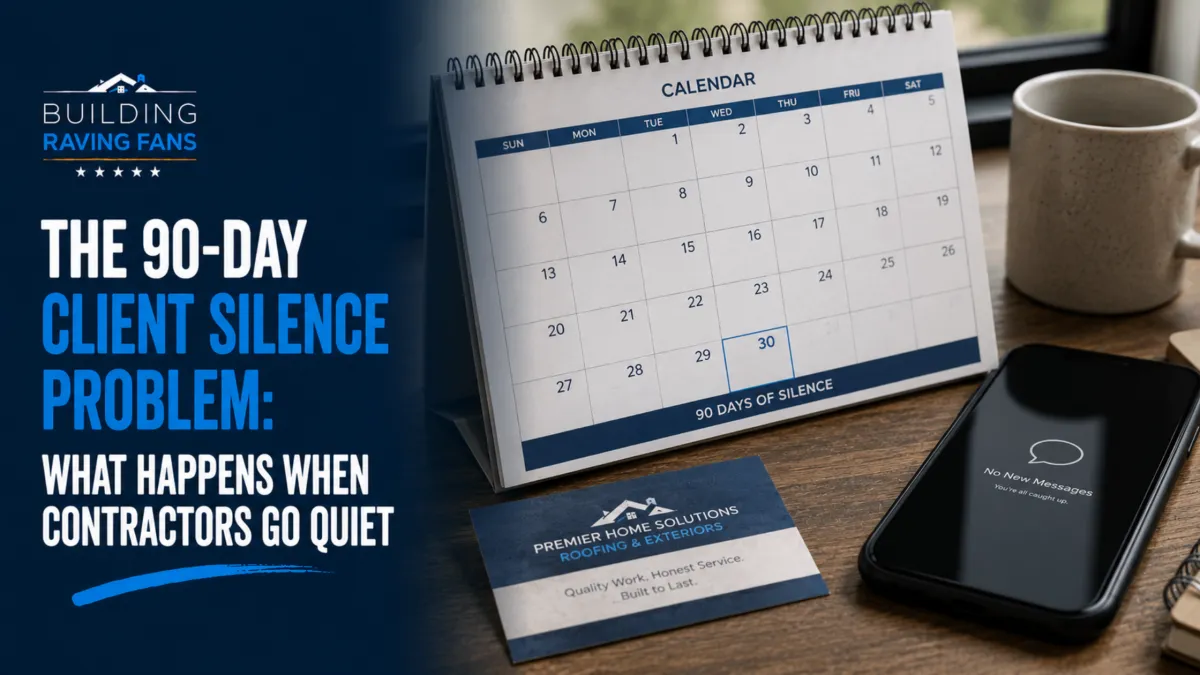
The 90-Day Client Silence Problem: What Happens When Contractors Go Quiet
The 90-Day Client Silence Problem: What Happens When Contractors Go Quiet
The project wrapped up. The invoice got paid. Everyone was happy. And then nothing. No thank-you, no check-in, no follow-up of any kind for months.
Most contractors don't realize this is happening in their own business, because it doesn't feel like a problem. There's no complaint, no bad review, no obvious sign anything went wrong. But client silence has a real, measurable cost, and the 90-day mark is where it starts to become almost impossible to reverse.
Why 90 Days Is the Line That Matters
This isn't an arbitrary number. Research on relationship dormancy consistently points to roughly three months as the threshold where a connection shifts from active to inactive in someone's mind. Work looking at retirees leaving an organization found that within about three months of losing regular contact, most no longer felt like they belonged to that group anymore; nothing about the person changed, only the frequency of contact did.
The same pattern shows up in how legal and financial industries define client relationships: a "dormant" account is consistently defined as one with no activity for 30 to 90 consecutive days. Past that window, reactivating the relationship gets measurably harder, and the psychological line between "our contractor" and "someone we used once" has usually already been crossed.
The takeaway: 90 days isn't just a long time. It's the point at which most people stop thinking of you as part of their world at all.
The Forgetting Curve Is Working Against You Faster Than You Think
There's a well-documented psychological principle called the forgetting curve, first described by psychologist Hermann Ebbinghaus, which shows that people forget a large majority of new information within just 24 hours without reinforcement. Applied to a client relationship, that means the specifics of why they chose you, what made the experience good, and how they'd describe you to a neighbor start fading almost immediately not months later.
Left unreinforced, that decay compounds. By 30 days without contact, a client may have already forgotten a meaningful share of what made your business memorable in the first place. By 90 days, the relationship isn't just fading for many clients; it's functionally over, even though nothing bad ever happened.
We touched on this same erosion pattern from the review-generation angle in The Hidden Revenue You're Losing by Not Following Up; the same silence that costs you reviews also costs you the referral that never gets made.
The takeaway: silence doesn't preserve a relationship in neutral. It actively erodes it, starting almost immediately after the last conversation.
What Silence Actually Costs You
Going quiet after a project doesn't usually cost you anything visible. That's exactly what makes it dangerous: there's no complaint to respond to, no bad review to manage. Just a slow, invisible drift where the client stops thinking of you as their default option and quietly starts considering alternatives if the need arises again.
That's a genuinely recoverable problem before the 90-day mark, and a genuinely expensive one after it. Data on re-engagement campaigns shows that reaching out at the 30, 60, and 90-day marks recovers a meaningful share of clients who've gone quiet, but success rates drop sharply once you're past the six-month mark, when the relationship has fully settled into "used them once" territory.
The takeaway: the cost of silence isn't a single lost sale. It's every referral, repeat project, and review that would have happened if the relationship had stayed active in the client's mind.
Not sure where your own client relationships stand on this timeline? A quick Strategy Call can help map out where silence might already be costing you.
Why Contractors Go Quiet in the First Place
Almost nobody goes silent on purpose. It happens because the crew moves on to the next job, the office is juggling new leads, and there's no natural trigger reminding anyone to check in with a client from two months ago.
That's the structural problem: without an automated system, follow-up depends entirely on someone remembering, and the busier a business gets, the less likely that is to happen consistently. We covered why manual follow-up systems quietly fail in How Consistent Follow-Ups Build Trust (Even When You're Busy Running the Business): the same gap that breaks review requests breaks the entire post-project relationship if nothing catches it.
Closing the Silence Gap Before It Opens
The fix isn't complicated, but it does require the touchpoints to happen automatically rather than depending on memory. A few checkpoints matter most:
Within the first week: a genuine thank-you, reinforcing the positive experience while it's still fresh
Around 30 days: a helpful, project-specific check-in with maintenance tips, a satisfaction check, nothing salesy
Around 90 days: a real touchpoint before the dormancy window closes, whether that's a seasonal reminder, a referral invitation, or simply genuine appreciation
At the one-year mark: an anniversary touchpoint, which tends to land as one of the most memorable moments in the entire relationship because it's unexpected
This is exactly the rhythm Building Raving Fans' long-term nurture email campaigns are built to maintain automatically, so the 30, 90, and 365-day checkpoints happen for every client, not just the ones a busy office remembers.
It works even better layered with the rest of a full appreciation system:
Automated gifting and appreciation programs a physical touchpoint at key milestones reinforces the digital ones, especially valuable right around the 90-day mark when a relationship is most at risk of going dormant
Raving Fans Reviews platform timing a review or referral ask to land while the relationship is still active, not after silence has already set in
Tap-to-review NFC cards capturing engagement and feedback in the moment, so the relationship doesn't depend entirely on email opens months later
The takeaway: you don't need constant contact to keep a relationship active. You need a handful of well-timed touchpoints that arrive before the 90-day dormancy window closes, not after.
A Quick Audit of Your Own Client Relationships
Before assuming this isn't happening in your business, check:
Do you have a system that tracks how long it's been since each past client heard from you, or is it purely by memory?
What's the longest gap between project completion and your next genuine touchpoint, on average?
Are your check-ins timed to real milestones (30, 90, 365 days), or sent randomly whenever someone has time?
How many past clients could you honestly say still think of your business as "their contractor" versus "someone we used once"?
If those answers gave you pause, the good news is this is one of the most fixable problems in a service business as long as it's caught before the silence sets in.
Don't Let Silence Undo the Work You Already Did
The frustrating part of the 90-day silence problem is that it happens after everything else went right. The project was good, the client was happy and then the relationship quietly faded simply because nobody reinforced it. That's not a service problem. It's a follow-up problem, and it's entirely preventable with the right system in place.
If your post-project relationships tend to go quiet after the invoice is paid, let's fix that before more of them cross the 90-day line. Schedule a Strategy Call with Building Raving Fans, and we'll show you what a relationship that never goes silent actually looks like.


