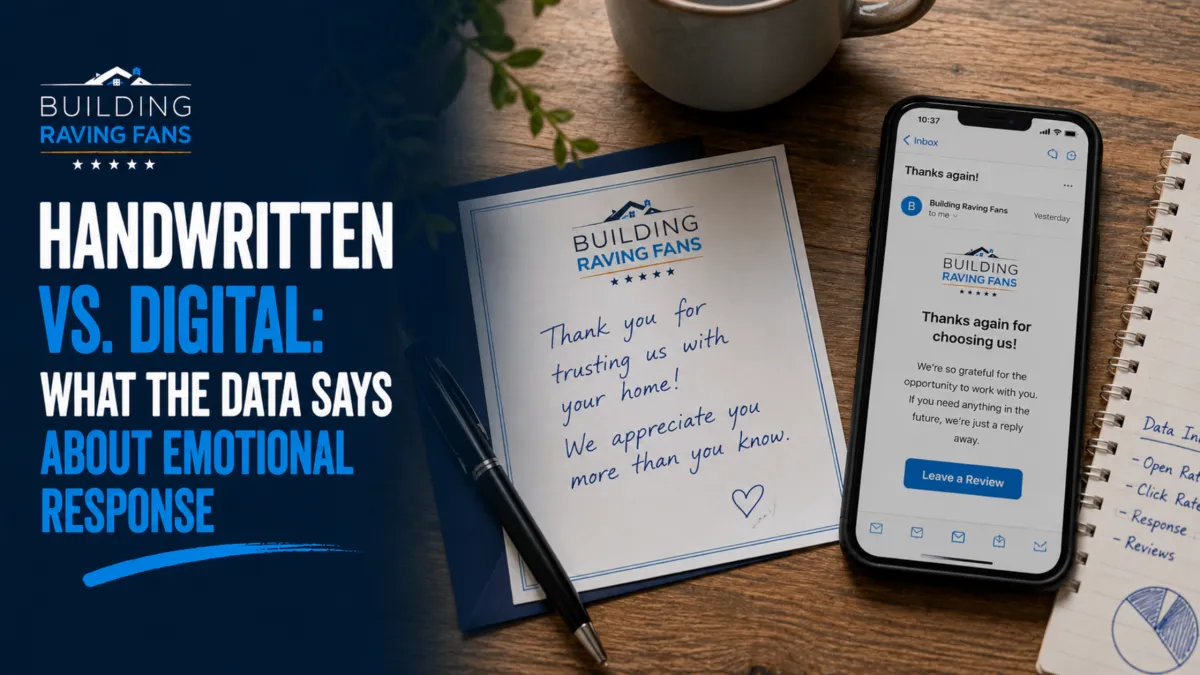
Handwritten vs. Digital: What the Data Says About Emotional Response
Handwritten vs. Digital: What the Data Says About Emotional Response
Every contractor has sent a thank-you email. Far fewer have sent a handwritten card. The gap isn't about effort or intention; it's usually just about what's fast and what fits into a busy week.
But the research on how people actually respond to each format is surprisingly one-sided. Handwritten communication doesn't just feel more personal; it measurably produces a different emotional and neurological response than digital messages do. Here's what the data actually shows, and why it matters for how you follow up with clients.
The Brain Responds Differently to Handwritten Text
This isn't just a marketing claim; it's backed by neuroscience. Functional MRI research has found that viewing handwritten text activates brain regions associated with social cognition and empathy more strongly than viewing typed text does. The response isn't a cultural preference; it's a physical reaction to seeing the traces of another person's effort directly on the page.
Researchers point to what they call "motor signature cues": the small variations in pressure, slant, spacing, and rhythm present in anyone's handwriting. Those subtle imperfections are exactly what a typed message can't replicate, and they're part of why a handwritten note reads as unmistakably human in a way an email simply doesn't.
We touched on this same idea from a business-results angle in Why Handwritten Notes Still Outperform Digital Emails in 2026; the neuroscience is the underlying reason the business outcomes hold up so consistently.
The takeaway: the emotional impact of a handwritten note isn't a matter of taste. It's a measurable, physical brain response that digital communication doesn't trigger the same way.
Sincerity Isn't Just Felt; It's Rated Differently
One of the more striking findings in this research area: when people are shown the exact same message, word for word, they consistently rate it as more sincere when it's handwritten than when it's typed, even when they know the content is identical.
That's worth sitting with. The words weren't different. Only the format was. Which means the format itself is doing real emotional work, independent of what's actually being said.
For a business built on relationships, where a customer's read on your sincerity often decides whether they refer you or quietly move on, that's not a small detail. It's the difference between a thank-you that gets glanced at and deleted, and one that actually changes how a client feels about your business.
Memory Formation Works Differently Too
It's not just how a message feels in the moment. Handwritten communication is processed and stored differently in memory than digital messages are. Recipients are meaningfully more likely to remember both the message and the sender when it arrives handwritten rather than digital.
That has a direct, practical implication: a handwritten thank-you card isn't just a nicer gesture. It's more likely to still be remembered and to keep your business top-of-mind weeks or months after an email would have long since scrolled out of view. We explored the retention side of this effect in Gratitude That Converts: How Thank-You Cards Build Future Revenue, where the same memory-formation research connects directly to referral behavior.
The takeaway: an email might get read once. A handwritten card is more likely to get remembered, kept, and associated with your business long after that first reading.
Why Digital Communication Struggles to Compete
None of this means email or text is useless they're fast, scalable, and essential for a lot of what a business needs to do. But research on media and emotional communication has consistently found that digital messages are perceived as lower-effort and lower-value than handwritten ones, precisely because they're so easy to produce.
That's the tradeoff: the same speed that makes digital communication practical also makes it feel less weighty. A message that costs the sender nothing to send tends to be received as costing the recipient's attention less, too.
Curious where a handwritten touchpoint would have the biggest emotional impact in your client journey? A quick Strategy Call can help map out the highest-leverage moments.
Where This Matters Most for Contractors
The research suggests handwritten impact scales with emotional stakes the higher the moment matters to the recipient, the more a physical format adds. For contractors and home service businesses, a few moments stand out as clear opportunities:
Project completion: the moment satisfaction peaks, and where a handwritten note reinforces the emotional high point of the experience
The one-year anniversary, a milestone most businesses never acknowledge, making the memory-formation effect even stronger since it's unexpected
Referral thank-yous reinforcing that a client's trust in recommending you was genuinely noticed, not just logged
We go deeper on specific moments worth building into a handwritten card program in Leveraging Handwritten Cards in the Digital Age.
Getting the Emotional Impact Without the Manual Workload
The research is clear that handwritten communication outperforms digital. What's less obvious is how to actually deliver it consistently without adding hours to your team's week because a handwritten card program that depends on someone finding time to write dozens of notes by hand rarely survives your busiest months.
That's exactly the gap Building Raving Fans' automated handwritten mail program is built to close: real ink-on-paper cards, personalized to the client and the moment, triggered automatically off project milestones instead of a manual to-do list.
It works best layered into a full appreciation system:
Automated gifting and appreciation programs pairing a handwritten card with a small gift at higher-emotional-stakes moments, like the one-year anniversary
Raving Fans Reviews platform timing a review request to land right after the handwritten card has already reinforced genuine appreciation
Tap-to-review QR code cards giving the recipient an effortless way to act on that goodwill in the moment
Long-term nurture email campaigns using digital communication for what it's actually good at (frequency, timeliness, information) while reserving handwritten touchpoints for the moments that carry real emotional weight
The takeaway: the goal isn't choosing handwritten over digital. It's using each format for what the research shows it's actually good at and making sure the handwritten moments still happen even when your team is at its busiest.
Let the Data Guide Your Follow-Up Strategy
Handwritten communication isn't a nostalgic preference; it's measurably different from digital messaging in how the brain processes it, how sincere it's perceived to be, and how well it's remembered. For a relationship-based business, that's not a minor detail. It's a genuine competitive advantage if you actually use it.
If you want to build handwritten touchpoints into your client journey without adding manual work to your team's plate, Building Raving Fans can build the system for you.


