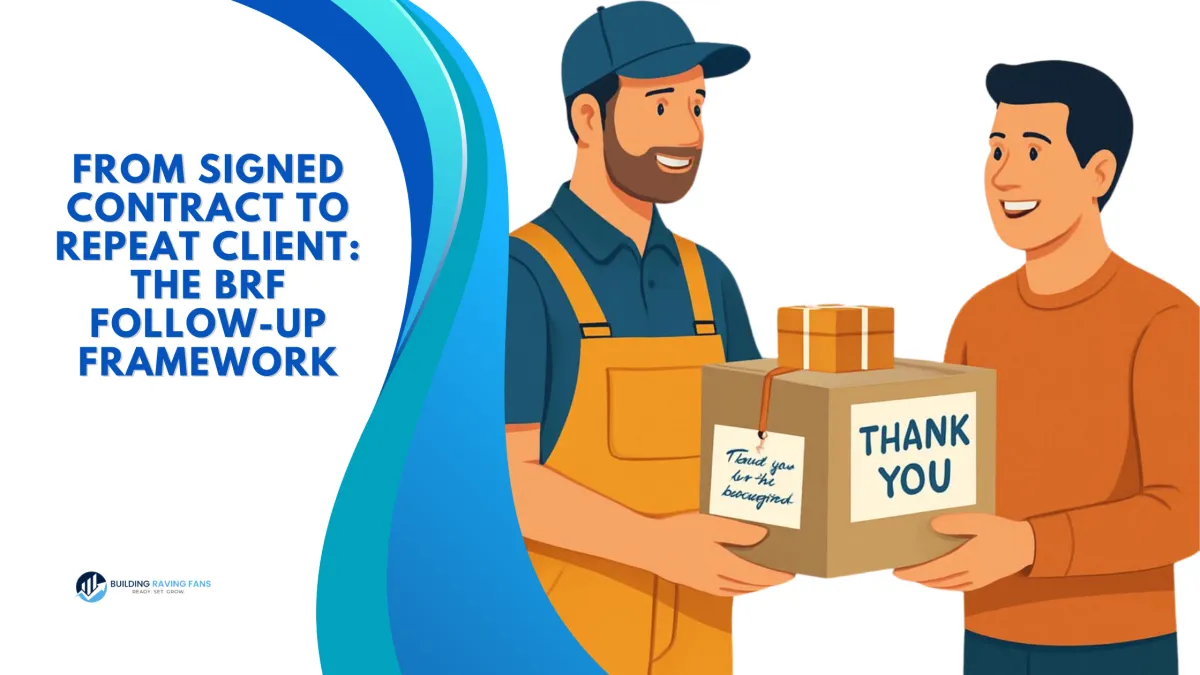
From Signed Contract to Repeat Client: The BRF Follow-Up Framework
Most businesses celebrate when a contract is signed.
But the most successful companies know that’s just the beginning.
If your process ends at project completion, you’re leaving a massive opportunity on the table opportunity for:
Repeat business
Referrals
Long-term client value
The truth is, what happens after the contract is signed determines whether a client becomes a one-time transaction… or a lifelong advocate.
In this blog, we’ll break down the BRF Follow-Up Framework, a proven system designed to turn every client into a repeat client and raving fan.
Why Follow-Up Is the Most Overlooked Growth Strategy
In construction and home services, most businesses focus heavily on:
Lead generation
Sales conversion
Project delivery
But very few have a structured post-sale follow-up system.
That’s a problem.
Because:
Acquiring a new customer can cost 5–7x more than retaining one
Repeat clients spend more and convert faster
Referrals come from strong relationships, not one-time interactions
Follow-up isn’t just good service, it’s a growth engine.
The BRF Follow-Up Framework (Overview)
The BRF Follow-Up Framework is built around one core principle:
Consistent, thoughtful touchpoints create lasting relationships.
It consists of five key stages:
Post-Signature Experience
During-Project Communication
Project Completion Moment
Post-Project Follow-Up
Long-Term Relationship Nurture
Let’s break each one down.
1. Post-Signature Experience: Set the Tone Early
The moment a client signs is your first opportunity to stand out.
Most companies send a generic confirmation email.
Instead, use this moment to:
Reinforce trust
Show appreciation
Set expectations
Simple upgrades:
Send a personalized welcome message
Deliver a small onboarding gift
Include a handwritten thank-you note
This creates an immediate emotional connection and positions your brand as thoughtful and professional.
2. During-Project Communication: Build Confidence and Trust
Poor communication is one of the top reasons clients feel frustrated, even if the work itself is high quality.
To avoid this:
Provide regular updates
Be proactive, not reactive
Set clear timelines and expectations
Consistency here builds confidence, which is essential for turning clients into advocates.
3. Project Completion: Create a Memorable Finish
The final impression is just as important as the first.
Instead of simply finishing the job and sending an invoice, create a moment.
Examples:
A thank-you gift
A personalized note
A small “project completion” package
This is where automated gifting & appreciation programs can make a big impact.
They allow you to:
Deliver consistent experiences
Personalize without manual effort
Scale your appreciation strategy
A strong finish increases the likelihood of:
Positive reviews
Referrals
Repeat business
4. Post-Project Follow-Up: Capture Momentum
Right after project completion is when client satisfaction is at its peak.
This is the best time to:
Ask for a review
Request feedback
Reinforce the relationship
However, many businesses either:
Forget to ask
Make it too complicated
That’s where the Raving Fans Reviews platform comes in.
It helps you:
Automate review requests
Capture feedback efficiently
Increase your online reputation
To make it even easier, use Scan-to-review QR code cards:
Clients tap with their phone
They’re instantly directed to leave a review
No friction, no confusion
The easier the process, the higher your response rate.
5. Long-Term Nurture: Stay Top-of-Mind
This is where most businesses drop off and where the biggest opportunity lies.
Once the project is done, communication stops.
But relationships should continue.
With long-term nurture email campaigns, you can:
Stay connected with past clients
Provide ongoing value
Reopen conversations naturally
Content ideas:
Seasonal maintenance tips
Project inspiration
Helpful homeowner advice
Over time, this keeps your brand relevant so when the next opportunity arises, you’re the obvious choice.
How the Framework Drives Repeat Business and Referrals
When you implement this framework, something powerful happens:
Clients don’t just remember the outcome, they remember the experience.
And that leads to:
Repeat projects (they trust you already)
Referrals (they want others to have the same experience)
Stronger reviews (they feel appreciated)
This transforms your business from transactional to relationship-driven.
Real-World Example: From One Job to Multiple Referrals
A contractor implemented a structured follow-up system similar to the BRF Framework.
They:
Sent a welcome gift after signing
Maintained consistent communication
Delivered a completion gift
Followed up with a review request
Stayed in touch via email
The result:
Increased 5-star reviews
Multiple referrals from the same client
Repeat business within months
The takeaway:
The relationship doesn’t end it compounds.
Common Follow-Up Mistakes to Avoid
Even with the right framework, execution matters.
Avoid these:
Inconsistent follow-up
Generic messaging
Only reaching out when you need something
Lack of systems
The key is to make follow-up feel intentional and natural, not forced.
How to Implement the BRF Follow-Up Framework
You don’t need to overhaul your entire process overnight.
Start with:
One or two key touchpoints
Simple appreciation gestures
A review system
Then build from there.
Over time, you’ll create a fully systemized experience that runs consistently.
If you’re already delivering great work, the next step is making sure your follow-up process matches that level of quality and consistency.
Ready to turn every signed contract into a repeat client?
At Building Raving Fans, we help service-based businesses implement the BRF Follow-Up Framework with:
Automated gifting & appreciation programs
Review generation through the Raving Fans Reviews platform
Scan-to-review QR code tools
Long-term nurture campaigns that drive repeat business
👉 Book a strategy call today and start building a follow-up system that turns clients into loyal advocates.


