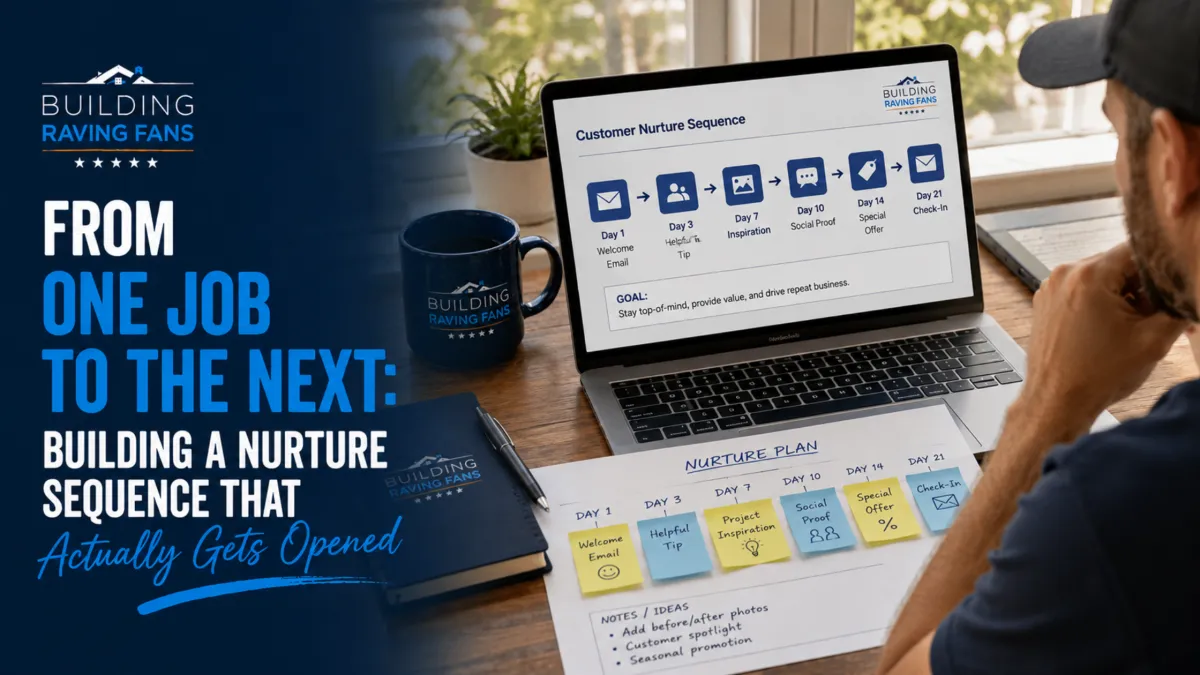
From One Job to the Next: Building a Nurture Sequence That Actually Gets Opened
From One Job to the Next: Building a Nurture Sequence That Actually Gets Opened
Most contractors have a nurture sequence sitting somewhere in their email platform. Far fewer have one that actually gets opened.
The average email open rate across industries hovers around 20–25%, which means three out of every four emails a past client receives from you never even get seen. That's not a copywriting problem. It's a structural one and it's fixable with the right sequence design, not just better subject lines.
Why Most Nurture Sequences Get Ignored
A nurture sequence fails for one of two reasons: it doesn't earn the open, or it doesn't earn the next open after that.
The first email after a project often performs fine; the relationship is fresh, and the client is still paying attention. The problem shows up three or four emails later, when the content turns generic, the timing feels random, and the client's brain has already filed your business under "safe to ignore." Once that happens, even a genuinely useful email, a real referral offer, or a helpful seasonal reminder gets buried along with everything else.
We covered why generic, one-size sequences quietly underperform in How to Activate Long-Term Nurture Sequences That Actually Convert. The fix isn't sending more emails; it's structuring the sequence so each one earns the next open.
The takeaway: a nurture sequence isn't one email repeated on a schedule. It's a series of individually earned opens, and losing that trust early costs you every email that follows.
What Actually Gets an Email Opened
Before a client even reads your message, the subject line has already decided whether they will. Data from large-scale subject line studies consistently shows that shorter, more specific subject lines outperform long, vague ones. Subject lines in the six-to-ten-word range tend to significantly outperform longer ones, and personalization (a name, a project reference) measurably improves open rates on top of that.
A subject line like "Monthly Newsletter" competes with dozens of other forgettable ones in an inbox. "How's that new deck holding up, [Name]?" references something specific and personal, and specificity is what breaks through.
Quick subject line checklist:
Keep it under 10 words
Reference something specific to the client, not generic company news
Avoid words that read as a mass blast ("newsletter," "update," "monthly")
Ask a question when it fits naturally; questions consistently outperform statements
The Sequence Structure That Actually Works
A nurture sequence built to actually get opened follows the natural arc of the relationship, not a fixed monthly template. Here's a structure that works well for contractors moving from one completed job to the next:
Immediate (Days 1–3): Genuine thank-you, no ask.
Just appreciation. No links, no requests, nothing transactional. This email earns trust for everything that follows.
Week 2–3: Helpful, project-specific content.
Maintenance tips relevant to exactly what was installed or built. A roofing client gets roof care tips, not generic home advice; specificity is what makes this email feel worth opening.
Month 1–2: Soft review and referral opening.
Now that appreciation and value have been established, a low-pressure invitation to share feedback or refer a friend feels earned instead of transactional.
Month 3–6: Seasonal or maintenance check-in.
Tied to something real: a season change, a maintenance milestone, not a generic "just checking in."
Month 11–12: Anniversary touchpoint.
One of the highest-opened emails in a well-built sequence, because it references a specific, personal milestone the client didn't expect you to remember.
We break down why that anniversary moment specifically performs so well in Uncover the Hidden ROI of a Loyalty + Referral + Appreciation System. Tying content to real moments, not arbitrary intervals, is the throughline across the entire sequence.
Curious how your current sequence stacks up against this structure? A quick Strategy Call can pinpoint exactly where opens are dropping off.
Segmentation: The Piece Most Contractors Skip
A single sequence sent to every past client, regardless of what they had done or when, guarantees some percentage of it feels irrelevant. A client from a kitchen remodel and a client from a roof replacement don't need the same maintenance tips, and a mismatched email is one of the fastest ways to train someone to stop opening your messages.
Segmenting by project type, project date, and engagement level lets you keep every email specific enough to earn the open. We covered how this pairs with multi-channel follow-up in The Contractor's Guide to Automating Lead Follow-Up Without Sounding Robotic. The same segmentation logic that keeps leads engaged keeps past clients engaged too.
The takeaway: one sequence for every client guarantees some of it feels irrelevant. Segmentation is what keeps every email worth opening.
Turning This Into a System
Building a sequence like this manually timed correctly, segmented properly, with genuinely specific content at each stage is a lot to maintain by hand, especially during your busiest months.
That's exactly what Building Raving Fans' long-term nurture email campaigns are built to handle: automated timing tied to real project milestones, segmented by project type, with review requests and referral prompts placed at the moments they're most likely to land, not on a generic monthly schedule.
It works even better paired with the rest of a relationship marketing system:
Automated gifting and appreciation programs: a physical gift or handwritten card timed to the same milestones as your email sequence reinforces the message across channels, not just in the inbox
Raving Fans Reviews platform timing review requests within the sequence to the moment satisfaction peaks, rather than a generic "please review us" email
Tap-to-review NFC cards capturing the reviews and engagement that email alone might miss, especially from clients who don't respond to email at all
The takeaway: the goal isn't writing more emails. It's building a sequence structured well enough that every email earns the next one.
A Quick Audit for Your Current Sequence
Before your next send, check your sequence against this:
Does the first email lead with pure appreciation, or does it ask for something right away?
Is each subject line under 10 words and specific to the client, not generic?
Is content segmented by project type, or is every client getting the same message?
Does the sequence include a real anniversary touchpoint, or does it stop after a few months?
If more than one of these gives you pause, that's exactly where to start rebuilding.
Build a Sequence Worth Opening
A nurture sequence that gets ignored isn't a wasted effort; it's a liability, quietly training your best past clients to stop paying attention to you right before you need them most for a referral or repeat project.
The fix isn't sending more emails. It's building a sequence specific enough, timed well enough, and segmented smart enough that every email earns the next open from the first thank-you all the way to the anniversary touchpoint a year later.
If your current sequence isn't getting opened the way it should, let's fix the structure behind it. Schedule a Strategy Call with Building Raving Fans, and we'll show you what a nurture sequence built to actually get opened looks like for your business.


