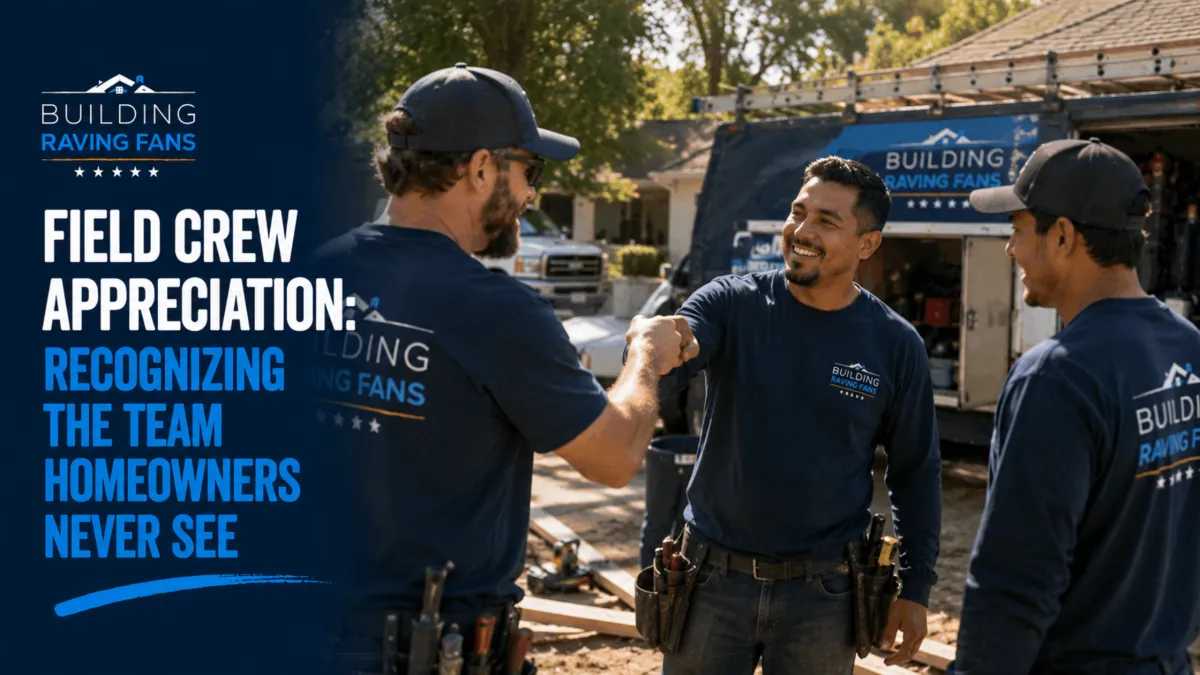
Field Crew Appreciation: Recognizing the Team Homeowners Never See
Field Crew Appreciation: Recognizing the Team Homeowners Never See
The homeowner remembers the sales rep who walked them through the estimate. They remember the office staff who scheduled everything. What they rarely remember by name is the crew who actually did the work: the people up on the roof, in the crawlspace, or running wire through the walls all day.
That's not a homeowner problem. It's a visibility problem, and it's one most home service businesses never fix. Here's why field crews are structurally left out of recognition, and what it actually takes to make sure the people doing the hardest work don't feel invisible.
Why Field Crews Get Overlooked by Design
Most workplace recognition programs weren't built with field crews in mind. They assume a company email address, a desk, regular access to an intranet or team chat, none of which describes a technician spending the day on a roof or a job site with spotty signal.
That gap isn't a small oversight. More than half of all U.S. wage and salary workers are paid hourly, and most of them work in roles in field service, construction, warehouse, and skilled trades that fall outside the reach of typical recognition tools built for office environments. Field workers in particular face what's sometimes called a visibility problem: achievements happen on rooftops, in trenches, and at customer homes far from anyone with the authority to actually recognize them, and by the time news of great work filters back to leadership, the moment has already passed.
The takeaway: field crews aren't overlooked because their work matters less. They're overlooked because most recognition systems were never designed to reach them in the first place.
The Cost of Staying Invisible
This isn't just a morale issue it shows up in retention numbers. Research from Gallup has found that companies with strong recognition programs see meaningfully lower voluntary turnover than those without, and the construction and field service industries are already dealing with real labor shortages that make every departure more costly.
Only a minority of field service technicians expect to stay in their current field for their entire career, and the technicians most likely to leave are often the ones who feel like their work goes unnoticed by anyone above them. When the people doing the physical, difficult, often uncomfortable work never hear a specific "great job," just a paycheck, disengagement builds quietly, long before anyone gives notice.
The takeaway: the businesses losing skilled field workers aren't always losing them over pay. They're often losing them because nobody made sure the work was seen.
What Actually Reaches a Field Crew
Fixing this doesn't require a full HR platform overhaul. It requires recognition designed around how field crews actually work, not retrofitted from an office-first tool.
Make it mobile, not email-dependent. A text or a quick voice message reaches someone on a job site. A recognition portal buried in a company intranet doesn't.
Make it specific to the job, not generic. "Great work on the Miller install; the homeowner specifically mentioned how clean the site was left" lands differently than "thanks for your hard work this month."
Make it visible to the whole crew, not just delivered privately. A shout-out during a morning huddle or in a group text does more for team culture than the same words said one-on-one.
Build in milestone recognition automatically. Tenure anniversaries and project completions are easy to miss when a manager oversees crews spread across dozens of job sites; automating the trigger removes that dependency entirely.
Curious how your own recognition rhythm reaches (or doesn't reach) your field crews specifically? A quick Strategy Call can help map out the gaps.
The Recognition Source Most Businesses Miss: The Homeowner
Here's the piece most companies overlook entirely: homeowners are already giving your crew credit; it just usually gets absorbed into a generic "great company" review instead of reaching the specific people who earned it.
When a homeowner leaves a five-star review that mentions how respectful the crew was, or how clean they left the site, that praise is a genuine recognition moment for the people who did the work if it actually gets back to them. Most businesses let that feedback disappear into a star rating nobody on the crew ever sees.
This is where a system like the Raving Fans Reviews platform does more than generate reviews for marketing purposes. Reviews that specifically name or describe a crew's work can be routed back to the team itself, turning a homeowner's genuine appreciation into recognition your crew actually experiences, not just a number that shows up on your Google listing.
We touched on the internal side of this loop in The Science Behind Gratitude: How Appreciation Boosts Client Loyalty, where team shout-outs and internal appreciation programs are called out as reinforcing the same gratitude clients eventually feel too; it's a loop that runs in both directions.
The takeaway: you don't need to invent new recognition content. Your clients are already giving your crew credit. The fix is making sure it actually reaches them.
Building This Into a System
The businesses that get field crew recognition right don't rely on a manager remembering to pass along praise during a hectic week. They build it into the operating rhythm of the business.
A few pieces work especially well for field crews specifically:
Automated gifting and appreciation programs: milestone recognition (tenure, safety records, project completions) triggered automatically, so it reaches every crew regardless of how spread out job sites are
Long-term nurture email campaigns: the same consistency principle that keeps clients engaged applies internally, keeping recognition flowing between big project milestones instead of only at annual reviews
Tap-to-review NFC cards capturing homeowner praise at the exact moment a crew finishes a job, making it easier to route specific, timely feedback back to the people who earned it
We covered the broader pitfalls that undercut appreciation efforts being inconsistent, generic, or too slow in The Contractor's Guide to Building Raving Fans Through Gratitude. The same mistakes apply just as directly to how crews experience recognition as they do to how clients experience it.
The takeaway: field crew appreciation works best when it's specific, timely, and doesn't depend on a manager remembering the exact same standard most businesses already hold their client experience to.
A Quick Check for Your Crew
Ask yourself honestly:
Does your crew ever hear the specific things homeowners say about their work, or does that feedback stop at a star rating?
Is recognition designed to reach someone on a job site, or does it assume access to email and a desk?
When was the last time a technician got public, specific credit for something a client noticed?
Are milestone moments (tenure, project completions) tracked automatically, or dependent on a manager remembering across dozens of job sites?
If any of these gave you pause, that's exactly where to start.
Make the Invisible Team Visible
The people doing the hardest, most physical work in your business are often the ones least likely to hear a specific thank-you, not because they matter less, but because most recognition systems were never built to reach a job site. Fixing that isn't complicated. It just requires being intentional about closing the gap between the praise your clients are already giving and the crew who actually earned it.
If you're ready to build a recognition system that actually reaches your field teams, not just your office staff, Building Raving Fans can help you put it in place.


