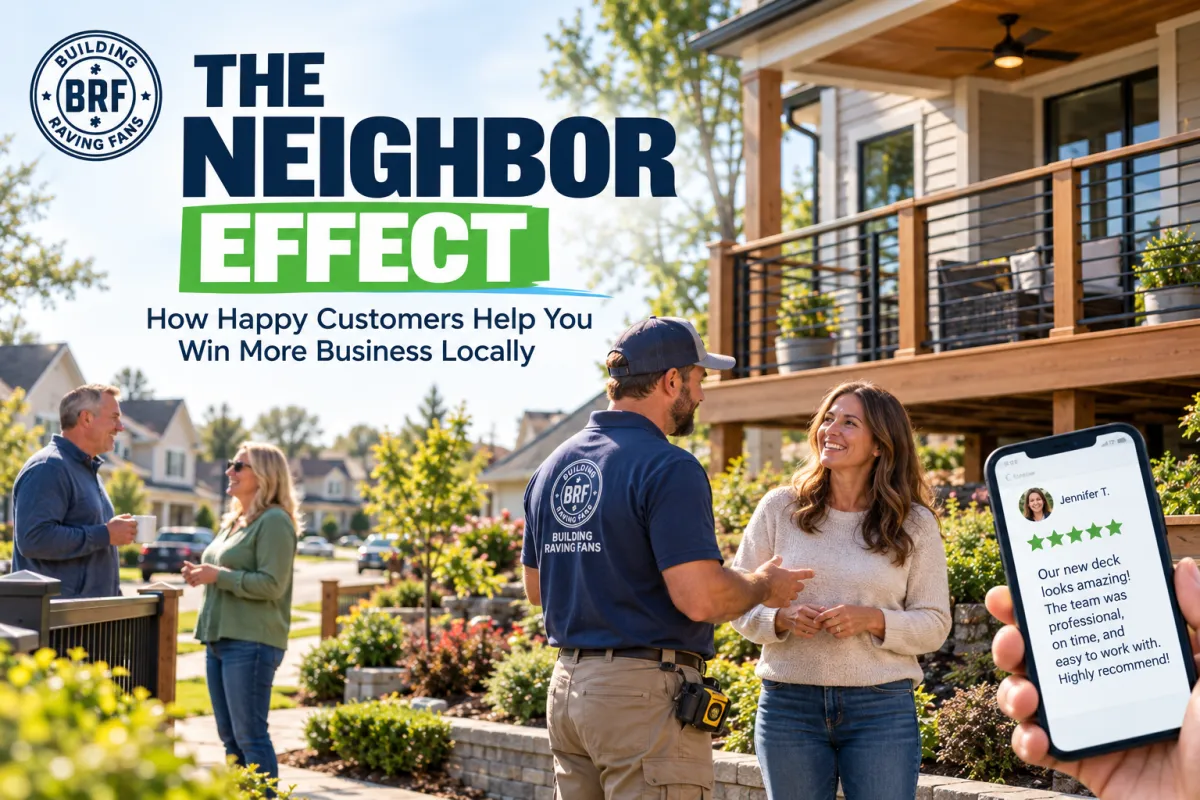
The “Neighbor Effect”: How Happy Customers Help You Win More Business Locally
How Happy Customers Can Become Your Best Local Marketing Advantage
What if your next great customer isn't waiting for you to find them online?
What if they're living next door to someone you've already made happy?
For contractors, remodelers, home-service companies, and other relationship-based businesses, one satisfied customer can influence far more than a single future purchase.
A great experience can lead to a Google review.
A review can build trust with a prospective customer.
A completed project can become something a neighbor notices.
A thoughtful thank-you can strengthen the relationship.
And a happy customer can recommend your business when someone nearby asks, “Who did that work?”
This is the Neighbor Effect: the idea that one exceptional customer experience can create visibility, trust, referrals, and new business throughout the surrounding community.
Instead of constantly starting from zero to find your next lead, you can build outward from the customers who already know and trust you.
For local businesses, that's a powerful growth opportunity.
What Is the Neighbor Effect?
The Neighbor Effect happens when a positive customer experience creates opportunities beyond the original customer.
Imagine a remodeling company completes a kitchen renovation.
The homeowner is thrilled.
They tell a neighbor about the contractor.
Another neighbor sees the finished project.
The homeowner leaves a review.
The company shares the project with permission on social media.
A third neighbor visits the company's website after seeing the project online.
A few months later, another homeowner requests an estimate.
The original project has now influenced several potential customers.
That's the Neighbor Effect.
The important part is that the business didn't necessarily have to find those people through traditional advertising.
The relationship created the opportunity.
Why Happy Customers Are More Valuable Than a One-Time Sale
A completed transaction is not necessarily the end of the customer journey.
For relationship-based businesses, it can be the beginning of a much larger relationship.
Consider everything a satisfied customer can potentially contribute to your business:
A positive Google review
A referral
Repeat business
A testimonial
A project photo
A case study
A social media mention
A recommendation to a neighbor
A connection to another homeowner
Long-term brand awareness
The mistake many businesses make is treating these as separate marketing activities.
They don't have to be.
They can all be connected to one thing:
A great customer experience.
Your customer experience becomes the foundation.
Your review strategy amplifies it.
Your appreciation strategy strengthens it.
Your nurture strategy keeps it alive.
And your referral strategy helps it spread.
The Neighborhood Is Already Paying Attention
Think about what happens when a contractor starts working on a home in a residential neighborhood.
Neighbors notice the trucks.
They notice the crew.
They notice the materials.
They notice the progress.
And eventually, they notice the finished project.
For highly visible home-service businesses, your work is often marketing itself before you ever knock on another door.
A beautiful deck.
A new roof.
A transformed backyard.
A remodeled kitchen.
A new addition.
A fresh exterior.
These projects are physical proof of what your company can do.
The question is:
Are you giving the neighborhood a reason to connect that work with your business?
That's where intentional relationship marketing comes in.
Step 1: Identify Your Happiest Customers
The Neighbor Effect starts with your existing customer list.
Don't begin by looking for strangers.
Start by identifying the customers who already have a positive relationship with your business.
Look for customers who:
Have left positive reviews
Have referred friends or family
Have purchased multiple times
Have complimented your team
Have responded positively to follow-up
Have shared photos of their project
Have engaged with your emails
Have been customers for several years
Have given permission to feature their project
Live in neighborhoods you want to grow
These customers are your potential local advocates.
They're not just people who bought something from you.
They're people who can help other people become comfortable choosing you.
Step 2: Look for Customer Clusters
Once you've identified your best customers, look at where they live.
This is where your CRM can become more than a database.
It can become a map of opportunity.
Look for clusters such as:
5 customers in one subdivision
8 customers within a few blocks
10 customers in the same ZIP code
Multiple projects on the same street
Those clusters are important because trust can travel geographically.
If you've already completed several successful projects in an area, you have something a brand-new competitor doesn't have:
A local track record.
You know the neighborhood.
You've worked on homes nearby.
You have customers who can speak about their experience.
And you have real examples of your work.
That gives you a foundation for neighborhood marketing.
Step 3: Turn One Great Project Into Multiple Marketing Assets
A completed project can create far more marketing content than most businesses realize.
Let's say you're a deck builder.
You finish a beautiful outdoor living project.
Instead of simply taking the final payment and moving on, think about how that project can continue working for your business.
With the customer's permission, you could create:
A before-and-after photo
A project spotlight
A customer testimonial
A Google review
A social media post
A website case study
A neighborhood postcard
A customer email
A referral touchpoint
A seasonal follow-up
One project becomes multiple marketing opportunities.
This is especially powerful when the project is located in a neighborhood where you want more business.
Your work is no longer just proof that you can complete a project.
It becomes local social proof.
Step 4: Make Reviews Part of the Customer Experience
A happy customer doesn't automatically leave a review.
Even customers who genuinely love your work can forget.
That's why review generation should be built into your customer experience instead of left to chance.
The ideal moment to ask is usually when the positive experience is still fresh.
For example:
Project completed → customer satisfied → thank customer → make review easy → continue the relationship.
The easier you make the process, the less friction your customer has to overcome.
Building Raving Fans helps businesses systemize this process through the Raving Fans Reviews platform.
Businesses can also use Scan-to-Review QR code cards to create a simple physical touchpoint. A customer can tap their phone and quickly access the review experience.
The goal isn't to pressure customers into leaving reviews.
It's to make it easy for genuinely satisfied customers to share what they already think.
And those reviews can then become part of your neighborhood marketing.
A prospective customer who sees:
“We just had our deck built by [Company]. They were fantastic.”
may feel very differently about that company than someone who sees an unfamiliar business with no local proof.
Step 5: Use Appreciation to Create Something Worth Talking About
Here's an important distinction:
Satisfaction gets remembered. Appreciation gets felt.
Your customer may expect you to complete the project correctly.
They may not expect you to follow up afterward with a thoughtful thank-you.
That surprise can create a stronger emotional connection.
Consider:
A handwritten thank-you
A thoughtful gift
A project-completion package
A personalized email
A customer anniversary message
A seasonal check-in
A small unexpected gesture
The point isn't to spend a fortune.
The point is to communicate:
“We remember you, and we're grateful you trusted us.”
Building Raving Fans' automated gifting and appreciation programs help businesses make these moments consistent without requiring someone on the team to remember every customer manually.
That consistency matters.
Because the customer who feels remembered is more likely to remember you.
And the customer who remembers you is easier to turn into a repeat customer, reviewer, or referral source.
For more ideas on this, see Building Trust Through Customer Appreciation.
Step 6: Don't Let the Relationship End When the Project Ends
One of the biggest missed opportunities in construction and home services happens after the work is finished.
The business completes the project.
The customer pays.
Everyone moves on.
Months later, the homeowner needs another service.
Or their neighbor asks for a recommendation.
But the business hasn't communicated with them in months.
The company may have delivered excellent work, but it has allowed the relationship to become quiet.
That's where long-term nurture becomes valuable.
A nurture campaign can provide useful reasons to stay connected without constantly selling.
For example:
Seasonal maintenance tips
Homeowner education
Project inspiration
Helpful checklists
Local information
Customer appreciation messages
Project anniversaries
Referral reminders
Company updates
Helpful blog content
The goal is not to fill someone's inbox.
The goal is to remain useful, familiar, and memorable.
Building Raving Fans offers long-term nurture email campaigns designed to help businesses stay connected with customers after the transaction.
For more on this strategy, read Client Nurture Systems That Run While You Work.
Step 7: Give Your Customers Something Easy to Share
Happy customers don't always know how to recommend your business.
They may say:
“I'll definitely tell people about you.”
But that's not a system.
Make sharing simple.
Give customers something useful they can easily pass along:
Your website
Your Google review link
A project page
A helpful resource
A referral page
A neighborhood-specific offer
A simple introduction message
You can even give your team a natural phrase to use:
“We're always grateful when our customers introduce us to friends or neighbors. If you know someone who needs help with a similar project, we'd be happy to take care of them too.”
That's very different from aggressively asking for referrals.
It's simply making the opportunity visible.
Step 8: Turn Your Reviews Into Local Social Proof
A review shouldn't live only on Google.
With permission and appropriate use, strong customer feedback can become part of your broader marketing ecosystem.
You can use reviews in:
Website content
Social media
Case studies
Email campaigns
Project spotlights
Sales presentations
Neighborhood marketing
Direct mail
Imagine a homeowner researching contractors in your area.
They see your company.
Then they see a project you've completed nearby.
Then they read a review from a customer who lives in that neighborhood.
Then they visit your website.
Every step reinforces the same message:
This company has successfully served people like me.
That's how trust compounds.
For more on using reviews strategically, see Turning Reviews into Raving Fans: A BRF Approach for Contractors.
Step 9: Make the Neighborhood Part of Your Content Strategy
If you want more local business, your content shouldn't always talk about your company.
It should talk about the problems your local customers are trying to solve.
For example:
A roofing company could publish:
“5 Signs Your Roof May Need Attention Before Winter”
A deck builder could publish:
“How to Design a Backyard That Works for Family Gatherings”
A landscaper could publish:
“How to Prepare Your Yard for the Next Season”
A remodeling company could publish:
“What Homeowners Should Know Before Starting a Kitchen Remodel”
Then connect those topics to your local market where appropriate.
Your content can educate.
Your projects can demonstrate expertise.
Your reviews can provide proof.
Your customer relationships can create referrals.
Together, those elements create a local growth engine.
Step 10: Measure the Neighbor Effect
You can't improve what you don't measure.
Start tracking where your leads come from.
Ask new customers:
“How did you hear about us?”
But don't stop there.
Track:
Referral leads
Reviews generated
Repeat customers
Leads by neighborhood
Projects by ZIP code
Website traffic from local searches
Calls and form submissions
Referral conversion rates
Revenue from existing customers
Customer engagement
You may eventually discover something interesting:
A neighborhood that originally represented only a few customers is producing a disproportionate number of new opportunities.
That's the Neighbor Effect in action.
A Simple Neighbor Effect Framework
If you want to put this strategy into practice, start with this simple framework:
1. SERVE
Deliver an exceptional customer experience.
2. THANK
Show genuine appreciation after important milestones.
3. REVIEW
Make it easy for satisfied customers to share their experience.
4. NURTURE
Stay connected after the project ends.
5. SHARE
Turn great customer experiences into appropriate social proof and content.
6. REFER
Make it natural and easy for customers to introduce you to others.
7. REPEAT
Continue strengthening relationships over time.
The process creates a flywheel:
Great Experience → Appreciation → Review → Trust → Visibility → Referral → New Customer → Great Experience
And then the cycle starts again.
The Goal Isn't More Customers. It's More Connected Customers.
There's a difference.
A business can collect thousands of leads and still struggle to build sustainable growth.
Another business can have a smaller customer base but incredibly strong relationships.
Those relationships can create:
Repeat business
Reviews
Referrals
Local reputation
Customer loyalty
Neighborhood visibility
Long-term revenue
That's why relationship marketing is so powerful for local businesses.
You're not simply trying to make someone buy.
You're creating an experience that gives them a reason to remember you.
Then you're making it easy for that relationship to influence the people around them.
Your Best Marketing May Already Be Happening Next Door
Your customers are already talking.
The question is whether your business is creating experiences worth talking about.
If someone sees your work, hears their neighbor recommend you, reads a recent review, and discovers that you've consistently taken care of people in their community, your company becomes more than another name in a search result.
You become familiar.
You become trusted.
You become the company people remember.
That's the Neighbor Effect.
And it starts with something much more valuable than another ad:
A customer who genuinely feels like a raving fan.
Ready to Turn Happy Customers Into Local Growth?
You don't need to leave referrals, reviews, appreciation, and long-term customer relationships to chance.
Building Raving Fans helps relationship-based businesses create systems that make those moments consistent.
From the Raving Fans Reviews platform and Scan-to-Review QR code cards to automated gifting and appreciation programs and long-term nurture email campaigns, BRF helps businesses turn great customer experiences into stronger relationships, reviews, referrals, and repeat business.
Your next customer may not be across town.
They may be right next door to someone you've already made happy.
Ready to build a customer experience that creates more local growth? Talk with Building Raving Fans and discover how to turn your happy customers into your strongest local marketing advantage.


