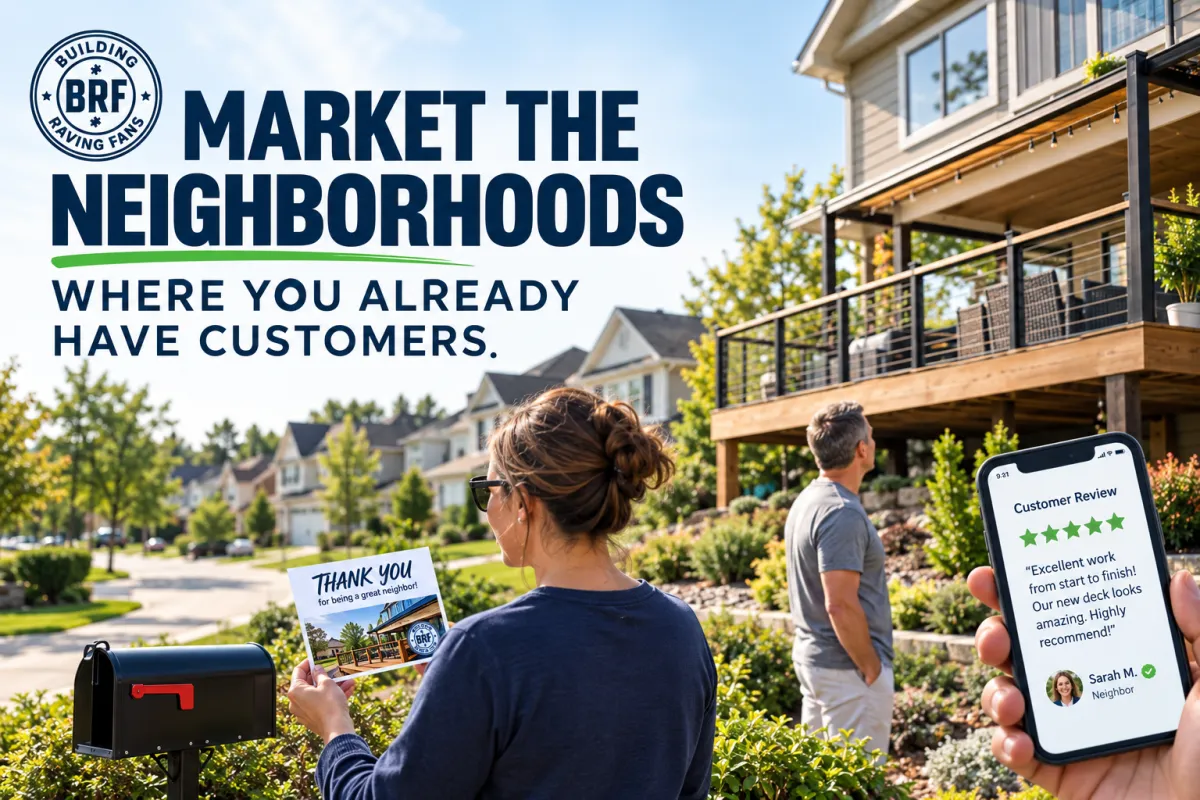
How to Market to the Neighborhoods Where You Already Have Customers
How to Market to the Neighborhoods Where You Already Have Customers
If you’re a contractor, home-service business, or local business owner looking for a better way to generate leads, start by looking at where your best existing customers already live.
You may already have a valuable marketing advantage hiding inside your customer database: geographic concentration.
Maybe you completed three roofing projects on the same street. Maybe your remodeling company has five happy homeowners within one subdivision. Maybe your landscaping business has dozens of past customers within a few miles of one another.
Those customers aren't just revenue from past jobs.
They can become the foundation of a neighborhood marketing strategy that generates reviews, referrals, repeat business, and new opportunities from people who already live near someone who knows and trusts your company.
That is the idea behind marketing to the neighborhoods where you already have customers.
Why Your Existing Customer Map Matters
Most businesses think about marketing geographically by asking:
“Where should we advertise?”
A better question is:
“Where have we already earned trust?”
If you know where your happiest customers live, you can identify areas where your business already has something advertising can't easily buy: local proof.
You have completed projects.
You have customers who can talk about their experience.
You may have reviews, photos, referrals, and relationships already established in the area.
And when a homeowner sees that a company has successfully completed work for someone nearby, the business becomes more familiar.
That familiarity matters.
Research from Nielsen found that 92% of consumers surveyed globally said they trusted recommendations from people they knew above other forms of advertising.
Your goal isn't simply to reach more people.
It's to make your existing trust visible to more of the right people.
Start by Mapping Where Your Best Customers Live
The first step in neighborhood marketing is surprisingly simple: look at your customer data.
Pull your past and current customer list and identify where customers are located.
Depending on your business, you might organize customers by:
ZIP code
Neighborhood
Subdivision
Street
Service area
City
Project type
Customer value
Project completion date
Review status
Referral activity
Then look for clusters.
For example, imagine a remodeling company discovers:
Neighborhood A: 12 completed projects
Neighborhood B: 2 completed projects
Neighborhood C: 9 completed projects
Neighborhood D: 1 completed project
Neighborhoods A and C may deserve more attention than simply spreading the same marketing budget evenly across the entire service area.
Why?
Because the company already has relationships there.
Find Your “Raving Fan” Customers
Not every customer should be treated the same.
Your best neighborhood marketing opportunities often come from customers who have already demonstrated that they like and trust your company.
Look for customers who:
Left a positive review
Referred someone
Purchased more than once
Complimented your team
Shared photos of the project
Engaged with your emails
Reached out after the project
Have been customers for years
Have given permission to use project photos or testimonials
These customers can become your local advocates.
Think of them as relationship anchors within the neighborhood.
One happy customer may not generate immediate business.
But one happy customer who is surrounded by dozens or hundreds of nearby homeowners represents a much larger opportunity.
Turn Completed Projects Into Neighborhood Marketing Assets
A completed project shouldn't disappear from your marketing once the final invoice is paid.
With appropriate customer permission, a project can become a collection of useful marketing assets.
For example:
A deck builder completes a backyard project.
The business could create:
Before-and-after photos
A project spotlight
A customer testimonial
A Google review
A social media post
A neighborhood postcard
An email featuring the transformation
A referral touchpoint
Now one project can create multiple opportunities to stay visible.
The key is to focus on the customer's experience, not simply the company's accomplishments.
Instead of:
“We built this beautiful deck.”
Consider:
“This family wanted a backyard where they could spend more time together. Here's how the project transformed the space.”
That tells a story neighbors can connect with.
Build Your Review Strategy Into the Neighborhood Strategy
Reviews are especially important for local businesses because they help bridge the gap between “I've never heard of this company” and “People like me have trusted them.”
Google says local results are primarily influenced by relevance, distance, and prominence, and notes that review quantity and positive ratings can contribute to local prominence.
Consumer research also shows how heavily people rely on reviews when evaluating local businesses.
BrightLocal's 2026 Local Consumer Review Survey found that 97% of consumers read reviews for local businesses. The survey also found that 85% of consumers are more likely to use a business after reading positive reviews, while 54% subsequently visit the business's website.
That makes your review strategy part of your neighborhood visibility strategy.
Make Reviews Easy
Don't make a happy customer hunt for your Google profile.
Ask at the right moment.
Give them a simple next step.
Make the process mobile-friendly.
And remove unnecessary friction.
Building Raving Fans' Raving Fans Reviews platform is designed to help businesses systemize review requests and follow-up instead of relying on employees to remember to ask every customer.
For businesses that want an even simpler physical touchpoint, Scan-to-Review QR code cards can make it easy for customers to access the review experience directly from their phone.
The goal isn't to manufacture reviews.
It's to make it easier for genuinely satisfied customers to share their experience.
Use Appreciation to Strengthen the Relationship
Here's where neighborhood marketing becomes different from traditional advertising.
You're not simply trying to get attention.
You're strengthening relationships.
After a project, consider sending a thoughtful thank-you message, card, or gift.
It could be as simple as:
“Thank you for trusting us with your home. We truly appreciate the opportunity to work with your family.”
That small moment reinforces the relationship after the transaction is over.
And appreciation can create another opportunity for conversation.
A customer who feels remembered is more likely to remember your company when a neighbor asks:
“Do you know anyone who can help us with this?”
Building Raving Fans helps businesses systemize these moments through automated gifting and appreciation programs, so appreciation doesn't depend entirely on someone's memory during a busy week.
The technology handles the timing and logistics.
The business gets to deliver the relationship.
Don't Disappear After the Project
One of the biggest missed opportunities in home services is what happens after the job is complete.
The customer is happy.
The invoice is paid.
The crew leaves.
And then… silence.
Months pass.
Eventually, the homeowner needs another service—or a neighbor asks for a recommendation—and your company isn't the first name that comes to mind.
This is why long-term nurture matters.
Client Nurture Systems That Run While You Work
A useful nurture campaign might include:
Seasonal homeowner tips
Maintenance reminders
Anniversary messages
Helpful project ideas
Customer appreciation messages
Referral reminders
Educational content
Occasional company updates
You aren't trying to sell something every week.
You're trying to remain useful and memorable.
Create Neighborhood-Specific Content
Once you've identified your strongest customer neighborhoods, make your marketing more relevant to those areas.
For example, a roofing company could create:
“5 Roofing Problems Homeowners Should Watch for Before Winter in [City]”
A landscaper could create:
“The Best Fall Yard Preparation Checklist for Homeowners in [City]”
A deck builder could create:
“How to Prepare Your Outdoor Living Space for the Next Season”
The goal is to connect your expertise to the needs of the people who live in your market.
This also creates opportunities for local SEO.
Your website, Google Business Profile, social media, email campaigns, and customer stories can all reinforce the geographic areas you serve.
Use Direct Mail to Reach the People Around Your Customers
Digital marketing isn't the only way to reach a neighborhood.
Sometimes the mailbox can complement the inbox.
Imagine completing a project for a customer and then creating a tasteful neighborhood campaign around that project.
You might feature:
A completed project
A homeowner story
A seasonal tip
A neighborhood-specific offer
A referral opportunity
A customer testimonial
The important distinction is that the mail shouldn't feel like random advertising.
It should feel relevant to the neighborhood.
You're showing potential customers that your company is already working nearby.
That's a powerful form of local social proof.
Create a Simple “Customer → Neighborhood” System
You don't need a complicated marketing machine.
Start with a simple sequence.
Step 1: Identify the project
A job is completed.
Step 2: Create the customer experience
Thank the customer and make sure they're satisfied.
Step 3: Capture the review
Make it easy for the customer to share their experience.
Step 4: Appreciate the customer
Send a thoughtful gift, note, or personalized message.
Step 5: Add them to long-term nurture
Continue providing useful communication.
Step 6: Identify the neighborhood opportunity
Look at nearby households, previous customers, and geographic clusters.
Step 7: Create local visibility
Use appropriate project content, direct mail, social media, referrals, and local marketing.
Step 8: Track the results
Measure:
Reviews
Referral leads
Leads by neighborhood
Website traffic
Calls
Booked appointments
Repeat customers
Revenue from existing customers
Now you're not simply “doing marketing.”
You're building a repeatable growth system.
Don't Forget the Customer Who Already Lives There
One of the easiest mistakes to make is focusing so heavily on acquiring the neighbor that you forget the customer who already lives in the neighborhood.
Don't do that.
Your existing customer should remain at the center of the strategy.
Thank them.
Check in.
Celebrate milestones.
Ask how the project is performing.
Provide useful information.
Invite feedback.
Show appreciation.
When appropriate, make it easy for them to refer a neighbor.
The goal isn't to turn your customer into a salesperson.
It's to create such a strong relationship that recommending your business feels natural.
Your Customer List May Be Your Best Neighborhood Marketing List
Before spending more money trying to reach strangers, look at the relationships you've already earned.
You may discover that your best opportunities aren't spread evenly across your market.
They're clustered around people who already know your company.
That's the foundation of an Own the Block marketing strategy.
You identify where your happiest customers live.
You strengthen those relationships.
You create reviews and social proof.
You stay connected through long-term nurture.
You show genuine appreciation.
Then you use those relationships to increase visibility throughout the surrounding neighborhood.
The result isn't just more exposure.
It's a stronger local reputation built on relationships rather than impressions alone.
Ready to Turn Your Customer Base Into a Neighborhood Growth Engine?
Building Raving Fans helps relationship-based businesses turn customer appreciation into a repeatable growth system.
From Raving Fans Reviews and Scan-to-Review QR code cards to automated gifting and appreciation programs and long-term nurture email campaigns, we help businesses stay connected with the customers who already know, trust, and value them.
Because your next great customer may not be across town.
They may be right next door to someone you've already made happy.
Ready to find the opportunities hiding inside your customer list? Talk with Building Raving Fans about building an Own the Block strategy for your business.


